Main Character Syndrome: Are Movies Shaping Our Expectations?
Main Character Syndrome: Are Movies Shaping Our Expectations?
|


Main Character Syndrome: Are Movies Shaping Our Expectations?
Have you ever watched a movie or a Netflix series and thought, “Why doesn't my life look like that?” If yes, you’re definitely not the only one. Whether it’s the perfect love story, the dream friend group, or the main character who somehow has everything figured out by 25, it’s easy to compare our own lives to what we see on the screen. For Gen Z, this has become even more common because we’re constantly surrounded by movies, shows and social media content that makes everything look so exciting than it actually is which blurs the line between reality and fiction. Gen Z is constantly exposed to picture-perfect versions of love and life. Because of this it is easy to start comparing our own experiences to stories we see on the screen. But are these comparisons harmless, or are they shaping unrealistic expectations?
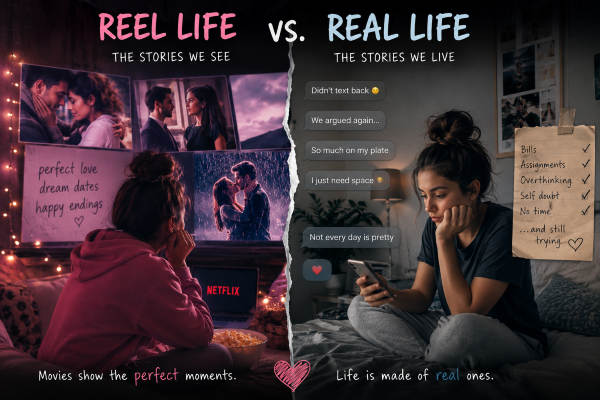
One of the reasons we get these thoughts is because movies tend to focus on the highlights. We see people falling in love almost instantly, making romantic grand gestures that magically fix everything and overcoming obstacles in ways that seem so effortless. Everything usually works out in the end, leaving us viewers with the idea that relationships should always feel exciting and magical.
The reality however is very different. Real relationships are built through communication, patience, trust and understanding. They involve disagreements, awkward conversations and moments that are far less dramatic that what we see on the screen.
Ask yourself this: What’s more realistic ?
1. Falling in love after one unforgettable encounter.
2. Slowly building a connection with someone over time through shared experiences and efforts. Most healthy relationships are much closer to option 2, even if it doesn't make a blockbuster movie.
Social media adds another layer of comparison to this. Everyday we’re exposed to videos of couples going on aesthetic dates, giving expensive gifts or posting cute moments together. What we rarely see are arguments, stressful days, insecurities or challenges that every relationship experiences. Because we are only seeing the highlight reel, it’s easy to assume that everyone else has figured things out while we’re falling behind. This can make our lives seem less exciting, even when they’re perfectly normal.
Quick reality check:
Do you sometimes compare your everyday life to someone’s carefully curated Instagram post? If the answer is yes, you are experiencing something that many people in our generation struggle with. That being said, I am not saying that movies and social media are entirely negative. They can inspire us to communicate better, express our feelings more openly and appreciate the people around us. The problem begins when we stop seeing them as entertainment and start treating them as a parallel to our lives and how we look at it.
Instead of asking, “ why isn’t my life like a movie?” maybe a better question is “What can I take from these stories without expecting them to become my reality?”
At the end of the day, real life isn’t scripted. It doesn’t come with perfect timing, background music or guaranteed happy endings. There is no director or writer who will guide our story for us. In fact we are the director and writer of our own story. When i talk about this, i would really like you to see the movie ‘Tamasha”, there is so much to understand from that movie and it very specifically talks about the fact that we are the writers of our story.
Gen Z isn’t the first generation to compare reality with fiction, but with constant access to movies, streaming platforms and social media, these comparisons have become more prominent than ever. The key is learning to enjoy the stories we watch without letting them define our expectations. After all this, the best relationships aren’t the ones that look perfect on screen, they’re the ones that have those flaws and imperfections but we still accept them whole heartedly, they are the ones that feel real in everyday life.
-Maitrayee Repal