The UPSC Dream vs. The Startup Grind
Which One Actually Pays Off in 2026?
|


The UPSC Dream vs. The Startup Grind
Which One Actually Pays Off in 2026?
Every Indian family has that one uncle. "Beta, IAS bano. Set life." And every college campus has that guy in the hoodie who tells you bro just build something. Both are confident, both are loud, and honestly both are a little right and a little delusional at the same time. So let's actually talk about this. Not the motivational poster version. The one nobody frames.
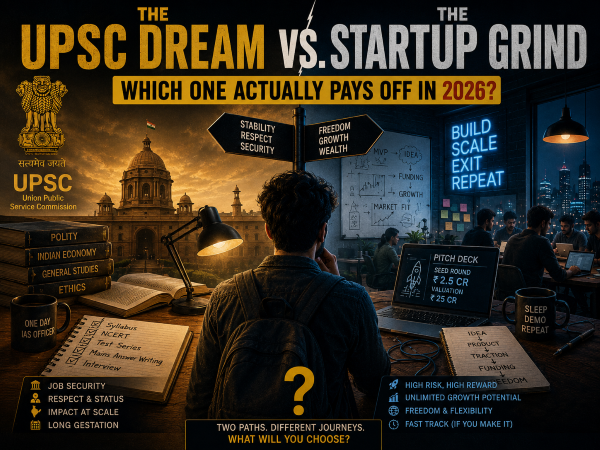
UPSC isn't just an exam. It's a lifestyle decision you make at twenty-one that quietly governs your entire twenties. The average successful candidate clears it at twenty-six or twenty-seven after three or four attempts. That's not a gap year. That's a half decade gap. The allure is real though. An IAS officer gets the bungalow, the driver, the job security until sixty, the pension and something no startup equity can ever match which is respect at a shaadi. The moment someone's son becomes a Collector the entire mohalla celebrates like India just won the World Cup. That currency is genuinely not nothing. Here's the number people conveniently skip over though. Roughly nine lakh students appear for UPSC Prelims every year and around a thousand make the final list. That's a 0.1% selection rate. You have a statistically better shot at going viral on Instagram than becoming an IAS officer and at least Instagram doesn't run a three stage elimination round. And the ones who don't make it after four or five years are left in a genuinely brutal spot. Overqualified for most private sector roles, emotionally exhausted and carrying the weight of a dream the system simply didn't have room for. Nobody talks about them loudly enough.
The Startup Fantasy. On the other side every engineering college in India now has an entrepreneurship cell that mostly organises pitch competitions where nobody actually gets funded. The startup dream has been glamorised to a point where grinding in a co-working space in Bombay has become a full personality. The pitch is seductive. Move fast, raise money, disrupt something, become the next Zerodha. And some people genuinely do. But most Indian startups don't survive past year two. The funding winter hit hard in 2023 and the hangover is still very much there in 2026. A lot of founders are, if we're being honest, just unemployed people with a LinkedIn bio that says building something stealth. That said the ones who make it actually make it. A founder who builds even a moderately successful SaaS product or a D2C brand can be earning more at twenty-seven than a District Collector earns across a decade. No postings, no protocol, no bureaucratic ceiling on what you can create or accumulate.
So What Actually Pays Off? Depends entirely on what you mean by pays off.
If you want stability, social prestige and a life your parents can explain at dinner parties without hesitation then UPSC pays off. The ceiling is structured but so is the floor. You will not starve. You will matter in rooms that matter. If you want financial upside, creative control and you're genuinely okay with chaos being your default setting then startups pay off. But only if you're actually building something and not just performing the idea of entrepreneurship.
The honest answer nobody gives you is that most people should do neither right away. Get a job. Learn how money moves, how systems work, how people operate under pressure. Build actual skills and then decide. UPSC is a marathon that rewards patience and obsession. Startups reward speed and a high tolerance for failure. Both ask you to stake your twenties on a bet about your thirties. The real question isn't which one pays off. It's which one you can genuinely commit to and which one you're just chasing because someone else made it look easy from the outside.
- Devangshu Purohit