India That Is Bharat - Notes From a History Lecture That Lowkey Hit Hard
Notes From a History Lecture That Lowkey Hit Hard


India That Is Bharat
Okay so today’s history lecture was not the usual “learn dates, forget dates, survive exam” type vibe.
It actually made me think about what Bharat even means.
Like, India is not just a country on Google Maps with borders and states and traffic memes. The idea of Bharat has been evolving for thousands of years. The land stayed mostly the same, but the identity? Constantly changing, remixing, adapting — literally like a civilization update patch every few centuries.
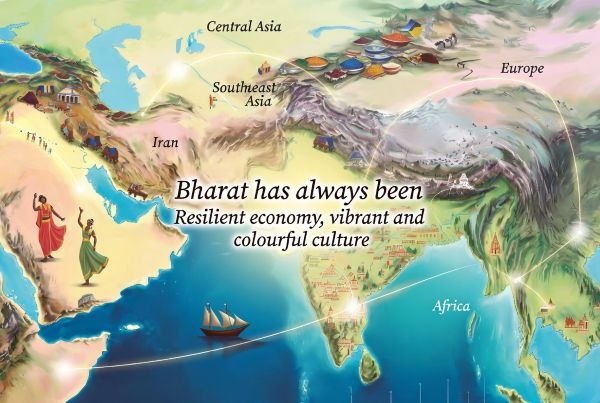
One thing that shocked me: ancient Bharat was super connected to the world.
We usually imagine old India as this separate ancient civilization just chilling on its own, but nah. People from the Indus region traded and interacted with Central Asia, Iran, Southeast Asia and even parts of Europe. Goods, culture, ideas, stories, languages — everything travelled.
Basically, globalization existed before LinkedIn bros invented the word.
Archaeological evidence, shared hymns, trade routes and artefacts all show that Bharat was part of a massive cultural network. So when someone says ancient India was backward or disconnected, history literally says: “Bro, source?”
Geography Basically Decided History
This part was kinda fascinating.
India’s geography is honestly built like a final boss map.
You’ve got:
the Himalayas in the north,
deserts in the northwest,
crazy humid coastal regions in the south,
massive river plains,
forests,
plateaus,
flood-prone areas,
drought-prone areas.
And all this shaped how people lived, traded and ruled.
The Indus and Ganga plains helped early empires grow because rivers = agriculture + trade + movement. Meanwhile, the mountains and plateaus in South India created more regional kingdoms because the terrain naturally divided regions.
So geography wasn’t just background scenery.
It was basically the hidden character running the plot.
Then Europeans Entered the Chat
When Europeans arrived around the 17th century, they saw India very differently.
To them, India was both:
a paradise full of resources,
and a survival challenge with diseases, floods, famines and extreme climate.
But here’s the important part: they saw Bharat mainly as something to exploit.
Forests? Resource.
Agriculture? Resource.
Wildlife? Resource.
People? Taxpayers.
Colonialism wasn’t just military control. It changed how India was viewed and governed.
And honestly, one reason European powers managed to dominate was because many Indian states at the time were politically fragmented and ideologically outdated. While Europe was industrializing and modernizing warfare, many kingdoms here were still stuck in older power structures.
History can be brutal like that.
Divide and Rule Wasn’t Just a Meme
The lecture also talked about the Morley–Minto Reforms of 1909.
Sounds boring initially. I know. I almost zoned out too.
But this reform changed Indian politics massively because it introduced separate electorates. Communities started getting politically categorized more rigidly through religion, ethnicity and language.
Basically, identity became political.
And once politics enters identity debates, things get messy real quick.
A lot of the divisions we still argue about online today didn’t appear overnight. Colonial systems strengthened and formalized many of them.
Gandhi Wanted Unity — But Reality Was Complicated
Then came M. K. Gandhi.
Whatever your political opinion is today, you can’t deny that Gandhi transformed the freedom struggle into a mass movement. Before that, politics was mostly limited to elites.
He wanted one united movement against British rule. One Bharat. No internal divisions.
But here’s where the lecture became heavy.
Even after independence, India struggled to eliminate:
poverty,
caste discrimination,
oppression,
social inequality,
communal divisions.
And honestly, that’s the uncomfortable part of history.
Freedom from foreign rule happened.
Freedom from internal problems? Still loading.
So… What Does “Bharat” Mean Today?
This was probably the biggest takeaway for me.
The idea of Bharat is still being debated and rewritten.
Over the past few decades, there’s been a strong push to revisit history textbooks, rediscover forgotten narratives and restore pride in Bharatvarsh. Some people see this as cultural correction. Others worry about political bias.
Either way, history is not just about the past anymore. It’s about identity, memory and the future.
And maybe that’s why history becomes such a heated topic online. People aren’t just debating facts. They’re debating belonging.
Final Thought
What I understood today is this:
Bharat was never perfect.
But it was never weak either.
It survived invasions, empires, colonization, partitions, famines and political chaos — yet somehow remained culturally alive.
That’s honestly insane resilience.
Maybe the real challenge today is not just economic growth or technology. Maybe it’s figuring out whether we can become a society that keeps its diversity without constantly fighting over it.
Can Bharat become united without erasing differences?
Can pride exist without hate?
Can history teach us instead of dividing us?
No idea.
But yeah… for a history lecture, this one lowkey cooked.