The Detector Dilemma and the Student Caught in the Middle
The Detector Dilemma and the Student Caught in the Middle


The Detector Dilemma and the Student Caught in the Middle
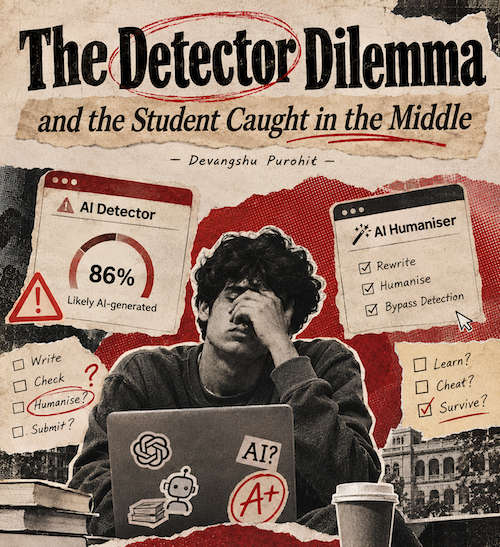
Few students in 2026 can open a laptop without meeting an AI tool. Chatbots draft essays in seconds and detectors promise to catch them. Humanisers claim to rewrite machine text so it slips past those detectors. Between all three stands the student who is often just trying to finish an assignment on time. What began as a technology story has turned into a story about trust and fairness and anxiety. Many students now worry less about learning the material and more about whether a piece of software will believe they wrote their own work.
AI detector work by scanning text for patterns that look statistically predictable. Machine writing tends to use smooth and even phrasing so detectors give it a probability score. The trouble is that a score is only a guess. Detectors can flag honest writing as machine made and miss text that really was generated. OpenAI itself withdrew its own detection tool after admitting its accuracy was too low. Some universities have also paused or limited the use of detector scores in misconduct cases because the risk of a wrong accusation is too high. A tool that cannot be fully trusted is now sitting in the middle of academic careers.
The cost of a false flag falls hardest on certain students. Research from Stanford found that detectors were more likely to label writing by non native English speakers as AI generated. Their simpler vocabulary and careful grammar can look predictable to an algorithm. Students who write in a clean and structured style can face the same problem. Imagine spending a weekend on an essay and then being asked to prove your innocence with no real evidence beyond your own word. Some students now record their screens while writing or keep every draft just to defend themselves. That is a heavy burden to carry for work they did honestly.
This fear has created a booming market for AI humanisers. These tools take a block of text and reword it so detectors read it as human. Some students use them to cover real cheating and that is a genuine problem that teachers are right to worry about. Others use them out of panic after a detector flagged their own writing. Either way a strange cycle has formed. Detectors improve and humanisers adapt and detectors improve again. Nobody in this loop is learning anything. Humanisers also tend to make writing clumsy and awkward and sometimes change the meaning of a sentence. A student who relies on one may submit worse work than the draft they started with.
The way out is probably not a smarter detector. It is a change in how learning is measured. Teachers can ask for drafts and outlines and short oral discussions of an essay so that understanding becomes visible. Clear policies can explain when AI help such as brainstorming or grammar support is acceptable and when it is not. Students for their part can protect themselves by keeping version history and writing in their own voice and learning to use AI as a tutor rather than a ghostwriter. The goal is an education where honest effort is recognised and no student has to fear a percentage on a screen. Until institutions get there the struggle will continue and it will continue to land on the people least able to afford it.