From “What Will People Say?” to “This Is My Style”
How young Indians are rewriting the rules of traditional fashion.


From “What Will People Say?” to “This Is My Style”
How young Indians are rewriting the rules of traditional fashion.
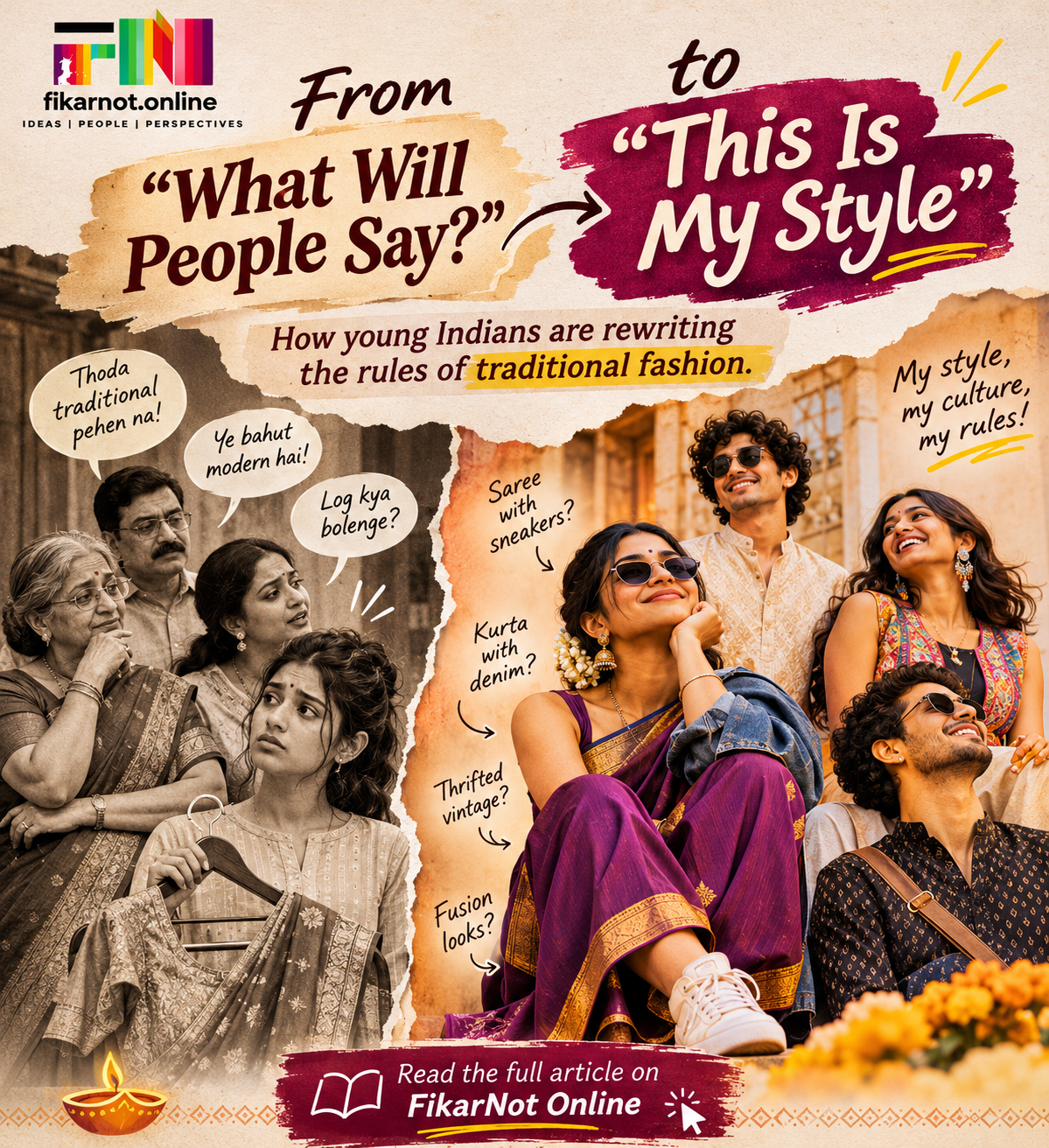
There was a time when getting ready for a festival came with its own little family committee.
You would stand in front of the mirror and ask, “Ye pehnu kya?”
And before you could decide, someone at home would have an opinion.
“Thoda traditional pehen.”
“Ye bahut modern hai.”
“Log kya bolenge?”
And finally, the most powerful fashion consultant would enter the room:
Mummy.
Decision made.
But something has changed.
Today, a girl might wear her grandmother's Paithani with a modern blouse and sneakers.
A guy might pair a classic kurta with jeans and white sneakers.
Someone might wear a saree with chunky jewellery.
Someone else might choose a simple black outfit because “mujhe bas ye achha lagta hai.”
And suddenly, the question is no longer:
“What will people say?”
It is:
“Does this feel like me?”
That small change tells us a lot about how young Indians are approaching fashion.
Tradition Is Not Disappearing. It's Getting a Remix.
One of the most interesting things happening in Indian fashion is that young people aren't necessarily rejecting traditional clothes.
They are reinterpreting them.
A saree with sneakers.
A kurta with denim.
A traditional Maharashtrian nath with a contemporary outfit.
A Paithani blouse with a modern silhouette.
A Nehru jacket over a plain T-shirt.
Your grandmother's jewellery with an entirely modern dress.
Pehle agar someone had said, “I'll wear a saree with sneakers,” someone at home would probably ask:
“Saree ghalun shoes kon ghalta?”
Today, that's literally a fashion statement.
And honestly, why not?
Tradition was never supposed to be a museum piece.
It survived because every generation found its own way of wearing it.
Your Mother's Old Saree Is Suddenly “Vintage”
There is something wonderfully funny happening in Indian wardrobes.
The clothes our parents once considered old-fashioned are suddenly becoming cool again.
That Paithani lying quietly in a cupboard?
Vintage.
Your mother's old jewellery?
Statement piece.
Grandmother's embroidered dupatta?
“Don't throw this! It's so aesthetic!”
And your mother is probably standing there thinking:
“Arre, he tar majhya college madhla aahe!”
Fashion calls it vintage.
Your family calls it “junya kapatatla.”
But maybe that's the beauty of fashion.
Sometimes the next big trend isn't something new.
It is something we already had.
We simply needed a new generation to look at it differently.
Instagram Has Changed the Dressing Room
Let's be honest.
We don't only dress for the occasion anymore.
We dress for the camera too.
Earlier, you could wear the same outfit to three family functions, and nobody really cared.
Today?
“Wait… I wore this in last year's Diwali photo!”
The outfit needs to photograph well.
The jewellery needs to catch the light.
The background needs to match.
The lighting needs to be right.
And suddenly, getting ready for Diwali becomes a small production.
First the outfit.
Then the mirror selfie.
Then the terrace.
Then the group photograph.
Then:
“Ek candid ghe na.”
Of course, there is nothing wrong with this.
Fashion has always been about expression.
But Instagram has made that expression public.
Your outfit isn't just what you wear anymore.
It becomes part of how you present yourself to the world.
Your clothes become a little piece of your digital identity.
Pinterest Has Entered the Indian Family
There was a time when fashion inspiration came from your cousin, neighbour or the actress on television.
Now?
Pinterest.
Instagram.
YouTube.
Fashion creators.
Celebrity airport looks.
“GRWM” videos.
And suddenly you are saving 14 different ways to style the same kurta.
A college student in Pune can see a styling idea from Mumbai, jewellery from Jaipur, a saree draping style from Kolkata and a blouse design from Bengaluru—and combine all of them into one outfit.
The fashion world has basically entered our bedroom.
And our wardrobe is having a very busy time keeping up.
But Who Decides What Is “Traditional”?
This is where things get interesting.
For a long time, traditional fashion came with a fairly fixed idea of what was “correct.”
Saree means this.
Kurta means that.
Wedding means this colour.
Diwali means traditional clothes.
Men should wear this.
Women should wear that.
But young Indians are slowly asking:
Who made these rules?
A Maharashtrian woman can wear a Paithani traditionally.
Or style it in a completely contemporary way.
A man can wear a kurta with a dhoti.
Or with jeans.
Or even with sneakers.
Someone can wear a lehenga.
Someone can wear a simple cotton saree.
Someone can wear a shirt and trousers.
And all of them can celebrate the same festival.
Because culture doesn't become less meaningful just because the outfit looks different.
And Then Comes the Family Review Board
Of course, there is one institution that no Instagram influencer can defeat.
The Indian family.
You walk downstairs wearing your carefully planned outfit.
Mom looks at you.
Dad looks at you.
A relative looks at you.
Then comes the sentence:
“Thoda vegla nahi vatat?”
Or:
“Traditional kahi tari ghatla asta tar ajun chhan disla asta.”
You smile.
Because maybe this time, you're not changing.
Not because you don't respect tradition.
But because you have started understanding something important:
Respecting tradition doesn't mean giving up your individuality.
You can love your culture and still experiment with your clothes.
You can wear a Paithani without styling it exactly the way your grandmother did.
You can wear a kurta because you genuinely like it—not because someone told you that “Diwali la kurta ghalaychach.”
And you can choose not to wear traditional clothing at all.
That's personal choice too.
The New Indian Fashion Confidence
Maybe this is the bigger change.
Young Indians are becoming more comfortable saying:
“I like this.”
Without immediately asking:
“Will everyone else like this?”
That is a much bigger cultural shift than it sounds.
For generations, clothes were connected to expectations—family, community, age, occasion and social norms.
Those expectations haven't disappeared.
But they are being negotiated.
A young woman can wear a saree because she genuinely loves it—not because someone told her that “girls should wear sarees.”
A young man can wear a kurta because it feels good—not simply because it's Diwali.
And someone can choose a completely contemporary outfit while still feeling deeply connected to their culture.
Because identity doesn't live inside one particular piece of clothing.
Fashion Is Becoming a Conversation Between Generations
Maybe the future isn't traditional vs modern.
Maybe it's both sitting inside the same wardrobe.
Your grandmother's saree.
Your mother's jewellery.
Your own styling.
Your friend's suggestion.
A Pinterest reference.
A pair of sneakers.
And suddenly, five generations are present in one outfit.
That's what makes Indian fashion so interesting.
We don't always throw the old away.
Sometimes, we re-style it.
And maybe that's exactly how traditions survive.
Not by remaining unchanged.
But by remaining relevant.
So… What Will People Say?
They will probably say something.
Too traditional.
Too modern.
Too simple.
Too flashy.
Too different.
Too much.
Too little.
Indian society has never really run out of opinions.
But perhaps young Indians are finally learning that fashion isn't a public referendum.
You don't need 500 people to approve your outfit.
Sometimes you just need to look in the mirror and think:
“Yeah. This feels like me.”
And maybe that's the real fashion revolution happening around us.
Young Indians aren't necessarily abandoning tradition.
They aren't blindly following trends either.
They are learning to choose.
What to keep.
What to change.
What to remix.
And what to make their own.
Because the most interesting outfit isn't always the most expensive one.
Sometimes it's simply the one where tradition meets personality.
And somewhere between “What will people say?” and “This is my style,” a new generation is quietly rewriting the rules.
- Pranay S. Pale