Fabric So Loved It Was Banned.
Fabric So Loved It Was Banned.


This success created a serious problem for local industries. European wool and silk weavers found that customers were choosing Indian cotton instead. It was lighter and easier to wear and easier to clean and often cheaper. Local makers could not compete with the skill and affordability of Indian craftsmanship. Workers feared for their jobs and manufacturers demanded protection. What began as a fashion trend turned into an economic and political struggle.
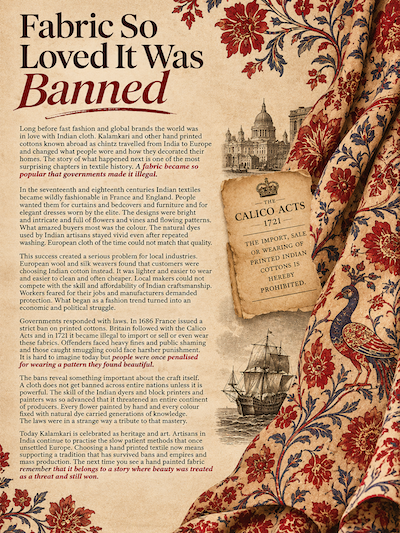
Governments responded with laws. In 1686 France issued a strict ban on printed cottons. Britain followed with the Calico Acts and in 1721 it became illegal to import or sell or even wear these fabrics. Offenders faced heavy fines and public shaming and those caught smuggling could face harsher punishment. It is hard to imagine today but people were once penalised for wearing a pattern they found beautiful. The bans reveal something important about the craft itself. A cloth does not get banned across entire nations unless it is powerful. The skill of the Indian dyers and block printers and painters was so advanced that it threatened an entire continent of producers. Every flower painted by hand and every colour fixed with natural dye carried generations of knowledge. The laws were in a strange way a tribute to that mastery.
Today Kalamkari is celebrated as heritage and art. Artisans in India continue to practise the slow patient methods that once unsettled Europe. Choosing a hand printed textile now means supporting a tradition that has survived bans and empires and mass production. The next time you see a hand painted fabric remember that it belongs to a story where beauty was treated as a threat and still won.
-Devangshu Purohit