Deepfakes and Online Trust in the Age of Artificial Intelligence
How AI-generated videos, voice cloning and digital fraud are changing the way we trust information online.


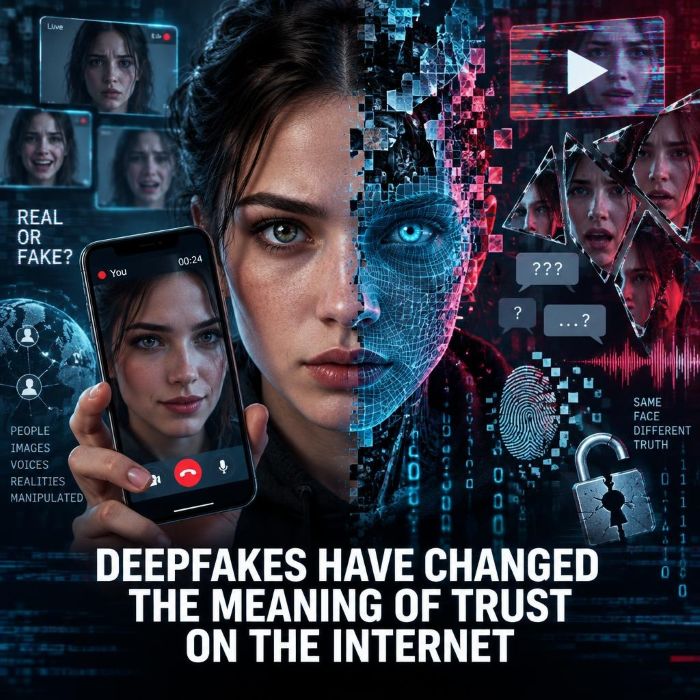
Deepfakes Have Changed the Meaning of Trust on the Internet
Deepfakes and online trust have become major concerns in today's digital world.A few years ago, if someone in my family group said, "There's a video, so it must be true," nobody argued. A video was the final proof. You could doubt a forwarded message or a blurry screenshot, but a clip of a person actually saying something? Case closed. Nobody stopped to ask who made it, because making a fake one seemed like something only a big film studio could pull off.
I'm 21, I'm in the second year of my BTech, and I've spent most of my life online. I like to think I'm hard to fool. Still, I've caught myself watching a reel, believing it completely, and then finding out from the comments that the whole thing was AI. That feeling is strange. It's not just "oh, I got tricked." It's more like, "wait, how many others did I never find out about?"
That, to me, is what deepfakes have really done. They haven't only added more fake content to the internet. They've changed what trusting something even means.
A deepfake is audio, video or an image created or altered using AI so that it looks real. Someone's face can be put on another body. Their voice can be copied. They can be made to say things they never said. Earlier, this needed serious skill and hardware. Now there are apps that make it feel as easy as adding a filter.
As an engineering student, I'll admit the tech is fascinating. The same tools can dub a lecture into another language or help a filmmaker with a small budget. But the cool demo and the cruel misuse run on pretty much the same idea, and that's the uncomfortable part.
Take the case of Arup, a British engineering firm. In 2024, an employee in its Hong Kong office joined a video call with what looked like the company's CFO and other colleagues. He had doubts at first, but the faces on screen settled them. He went on to transfer about 25 million dollars to fraudsters. The people he thought he was talking to were fake.
Now bring that closer home. Imagine your mother getting a call in your voice, crying, saying you've had an accident and need money right now. Would she stop to check? I don't think mine would. Panic doesn't leave much room for fact-checking.
And money isn't even the worst of it. Many deepfakes are used to create sexual images of people, mostly women, without their consent. For the person targeted, "it's fake" doesn't undo the humiliation. A girl in college shouldn't have to prove to relatives and classmates that a photo of her isn't real. Yet the burden usually lands on her, not on the person who made it.
There's another problem that I think we don't talk about enough. If anything can be faked, then anything real can be called fake. A politician caught saying something awful can simply shrug and say, "That's AI." So the liar gets two weapons: he can create false proof, and he can throw away true proof. When people stop believing everything, honest voices lose too.
To be fair, things are moving. India amended its IT Rules this year, and since February 20, platforms have had to label AI-generated content and act much faster on takedowns, in some cases within hours. That's a good step. But a rule on paper can't stop a clip from travelling through a hundred WhatsApp groups before anyone reports it.
So what can we actually do? I don't have a grand solution, just some habits that take barely a minute but can save a lot of regret.
Pause before forwarding, especially if a video makes you angry or scared. Check who posted it first and whether any reliable news source is reporting the same thing. If a call asks for money, hang up and call the person back on their saved number. Agree on a family code word. And talk to your parents and grandparents about this, patiently, without making them feel silly.
Most importantly, if someone you know is targeted, don't share the clip, not even to "warn" others. Support them, save the evidence, and report it on the platform and at cybercrime.gov.in.
I don't want to live online assuming everyone is lying. That sounds exhausting. But I also can't go back to believing my eyes without asking questions. Maybe trust now has to be something we verify, not something a video hands to us for free.
The internet taught my generation that seeing is believing. Now we have to unlearn it, and teach the people we love to do the same.