The AI That Knows You Better Than You Know Yourself: A Wake-Up Call
How artificial intelligence studies our habits, predicts our preferences and influences the choices we make online.


The AI That Knows You Better Than You Know Yourself
AI recommendation algorithms are becoming powerful enough to predict our interests, understand our habits and influence what we see online.
Last week I opened a music app after a really bad day. I hadn't typed anything or told anyone how I felt. Still, the first thing it suggested was a playlist of slow, sad songs. I laughed for a second. Then I stopped laughing and thought, how did it know?
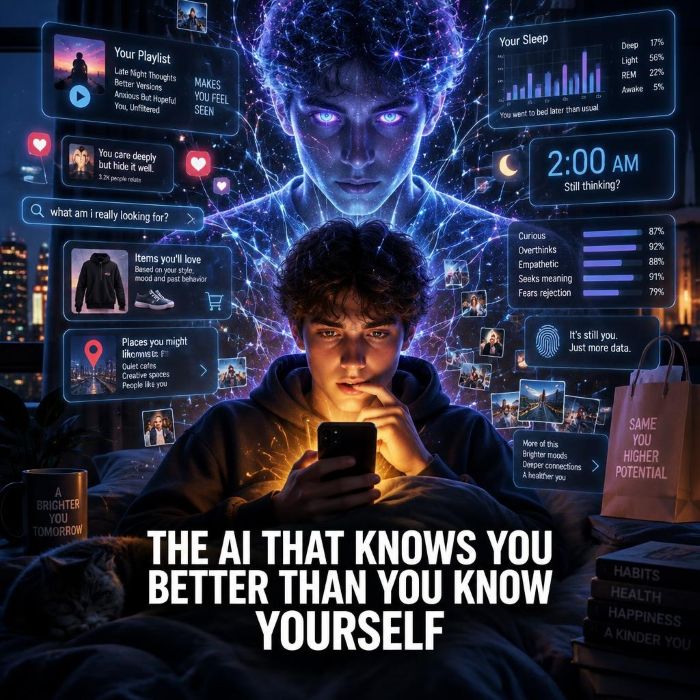
I like to think I understand how this stuff works. I know there's no tiny genius sitting inside my phone reading my mind. It's data, patterns and a lot of math. But knowing that doesn't make it feel any less weird.
Think about everything your phone sees in a single day. What time you wake up. Which reel you watch twice. Which one you skip in half a second. What you search at 2 a.m. and would never ask a friend. How long you stare at a pair of shoes you can't afford. Each thing looks harmless on its own. Put them together and you get a pretty detailed sketch of a person.
The funny part is that this sketch can be more honest than the one we have of ourselves. If you ask me what I like, I'll say documentaries, tech talks and maybe some old Hindi songs. My watch history will politely disagree. It knows I spend far more time on random cooking videos and cringe comedy than I'd ever admit. I describe the person I want to be. The algorithm records the person I actually am.
That's where this gets interesting, and also a little scary.
A recommendation system doesn't need to understand why you're lonely. It only needs to notice that you scroll longer at night, reply less to friends and keep watching a certain kind of video. It can't feel anything for you, but it can still guess what will keep you there. And a good guess, repeated every day, starts to look a lot like knowing someone.
I'm not going to pretend it's all bad. I love that a map warns me about traffic before I leave. I've found songs I'd never have searched for. AI tools have explained concepts to me at midnight when no professor was picking up. For a student with an exam the next morning, that's a blessing.
But there's a difference between a tool that helps you get what you want and one that slowly decides what you want. When every video, song and product is picked for you, how much of your taste is still yours? I sometimes wonder if I really like something or if I've just seen it forty times.
It can also trap you in an old version of yourself. Watch a few breakup videos in a rough week and your feed keeps serving heartbreak long after you're trying to move on. People change. The data takes its time catching up, and sometimes it pulls you back.
And then comes the question of who else gets this sketch. A close friend who knows your weak spots uses them to look out for you. A company that knows them also has ads to sell. If an app can tell when you're bored, sad or likely to spend money, that's a lot of power to hand over just because we tapped "I agree" without reading anything. I've done it. You've probably done it too.
So should we delete everything and move to a village with no network? I'm not doing that, and I doubt you are. What I've started doing is smaller.
I check app permissions and switch off the ones that make no sense, like a calculator asking for my location. I clear or pause my watch history now and then. I search for things on purpose instead of only taking what the feed gives me. Some evenings I keep the phone away and just sit with being bored, which is harder than it sounds.
Most of all, I try to ask one question before a long scroll: did I choose this, or was it chosen for me? I don't always like the answer.
Maybe the AI doesn't truly know me better than I know myself. It doesn't know why a certain song reminds me of school, or why I still save my grandfather's voice notes. It knows what I do, not everything that it means. But it pays attention to what I do far more closely than I ever have.
And that's the real wake-up call for me. If a machine is studying my habits this carefully, I should probably start studying them too. Knowing yourself was always important. Now it might be the only way to make sure someone else, or something else, doesn't do the defining for you.