Small AI Models vs Powerful AI Models: Does Bigger Always Win?
Why Smaller AI Models Could Be the Smarter Choice for Developers


Small AI Models vs Powerful AI Models: Does Bigger Always Mean Better?
Imagine hiring a brilliant professor to sort your email. They would probably do it well, but you'd be paying for expertise the job never needed. A lot of AI usage looks like this today: we send tiny tasks to enormous models and call it progress.
Large models are remarkable. But "most capable" and "best for the job" are different titles, and the gap between them is where small models are getting interesting.
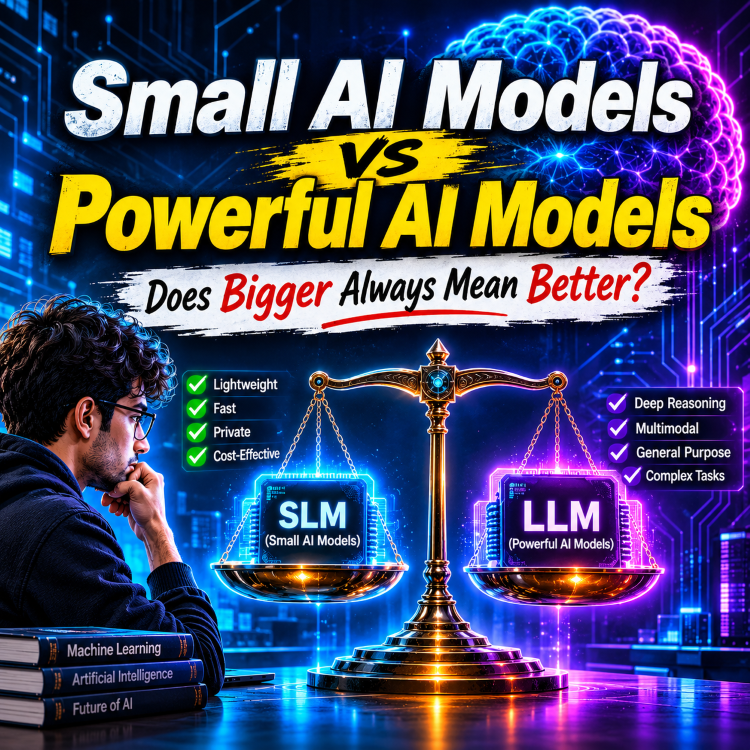
Why Everyone Wanted a Bigger Model
The race toward scale wasn't irrational. For years, researchers saw that training larger networks on more data with more computing power produced predictably better results. Models improved at writing, coding and answering questions, often without anyone designing those skills one by one. For companies, a stronger model also meant better products, investor attention and bragging rights.
Parameters are the numbers a model adjusts while learning. More of them generally give it more room to capture patterns. That makes parameter count an easy scoreboard, much like megapixels once were for phone cameras.
The trouble is that parameters measure size, not intelligence. Data quality, architecture and post-training matter enormously. A well-built newer model can beat an older, larger one on many tasks.
Small and Large: What's the Difference?
A large language model (LLM) is designed to handle a huge range of requests. A small language model (SLM) works on the same basic principle with far fewer parameters. There's no official dividing line, but "small" usually means anything from under a billion to the low tens of billions. Large models can run to hundreds of billions or more.
That difference shows up in memory. At 16-bit precision, each parameter takes two bytes, so a 4-billion-parameter model needs about 8 GB just for its weights. A 400-billion-parameter model needs about 800 GB, which is firmly server territory.
Bigger models also tend to need more computation for every response. In return, they usually know more and cope better with unfamiliar problems.
Where Small Models Have the Edge
The most obvious advantage is that you can actually run them yourself. Meta's Llama 3.2 includes 1B and 3B text models aimed at lightweight deployment. Microsoft's Phi-4-mini has 3.8 billion parameters, while the main Phi-4 model has 14 billion. Google's Gemma 4 family includes E2B and E4B variants built for devices such as phones, alongside much larger versions.
The family name alone doesn't tell you much. Llama 4 Scout, for instance, has 109 billion total parameters, so it's hardly a pocket-sized model.
A suitable small model can summarise notes on a laptop or suggest replies on a phone. There's no network round trip, so responses can feel quicker, although speed still depends on your hardware. It can also work on a flight or in a village with patchy connectivity.
Privacy improves too. If processing genuinely stays on the device, your medical notes or unfinished code never have to reach a remote server. "Local model" isn't a blanket guarantee, though; the app around it can still sync or log data.
For businesses, smaller models can sharply reduce inference costs, the computing bill paid each time a model generates an answer. That matters when the same simple task runs thousands of times a day.
Where Powerful Models Still Win
Now try asking a model to trace a bug across several services, read an error screenshot, propose a fix and explain what else it might break.
This is where powerful models tend to pull ahead. They're generally better at long chains of reasoning, difficult debugging and instructions with many constraints. The strongest systems also handle images, audio and documents with broader skill.
Small models can be multimodal and can reason surprisingly well. Their limits usually appear when problems become messy, open-ended or unfamiliar.
The Task Matters More Than the Trophy
Consider a company's support desk. It needs to classify tickets as billing, login or delivery problems. A small model fine-tuned on well-labelled examples of those tickets can outperform a larger general-purpose model, because it has learned the company's categories and edge cases.
The same idea could apply to a tutor built around one syllabus, or a coding helper trained on a team's conventions. Fine-tuning is no magic trick: poor data produces a confidently poor specialist. The sensible test is to compare models on real examples, measuring accuracy, speed, cost and the seriousness of mistakes.
Smaller, Smarter and Working Together
Several techniques are narrowing the gap. Distillation trains a smaller "student" model to learn from a stronger "teacher". Quantization stores weights with less precision, a bit like compressing a photo; it saves memory but can cost some quality. Efficient designs such as mixture-of-experts activate only part of a model for each piece of text, although the whole model still has to be stored.
Together with better phone and laptop chips, these methods make edge AI, meaning AI that runs close to where data is created, much more practical.
My bet is on teamwork. A personal assistant could handle reminders and private summaries locally, then ask permission to send a harder problem to a powerful cloud model.
So the better question isn't "How big is your model?" It's "How much model does this problem need?" Good engineering has never meant using the biggest tool available. As AI becomes part of ordinary software, knowing when not to use a giant model may be one of the smartest skills a developer can have.