Why Do We Remember People's Worst Moments?
One bad decision can become someone"s permanent identity in our minds.


Why Do We Remember People's Worst Moments?
One bad decision can become someone's permanent identity in our minds.
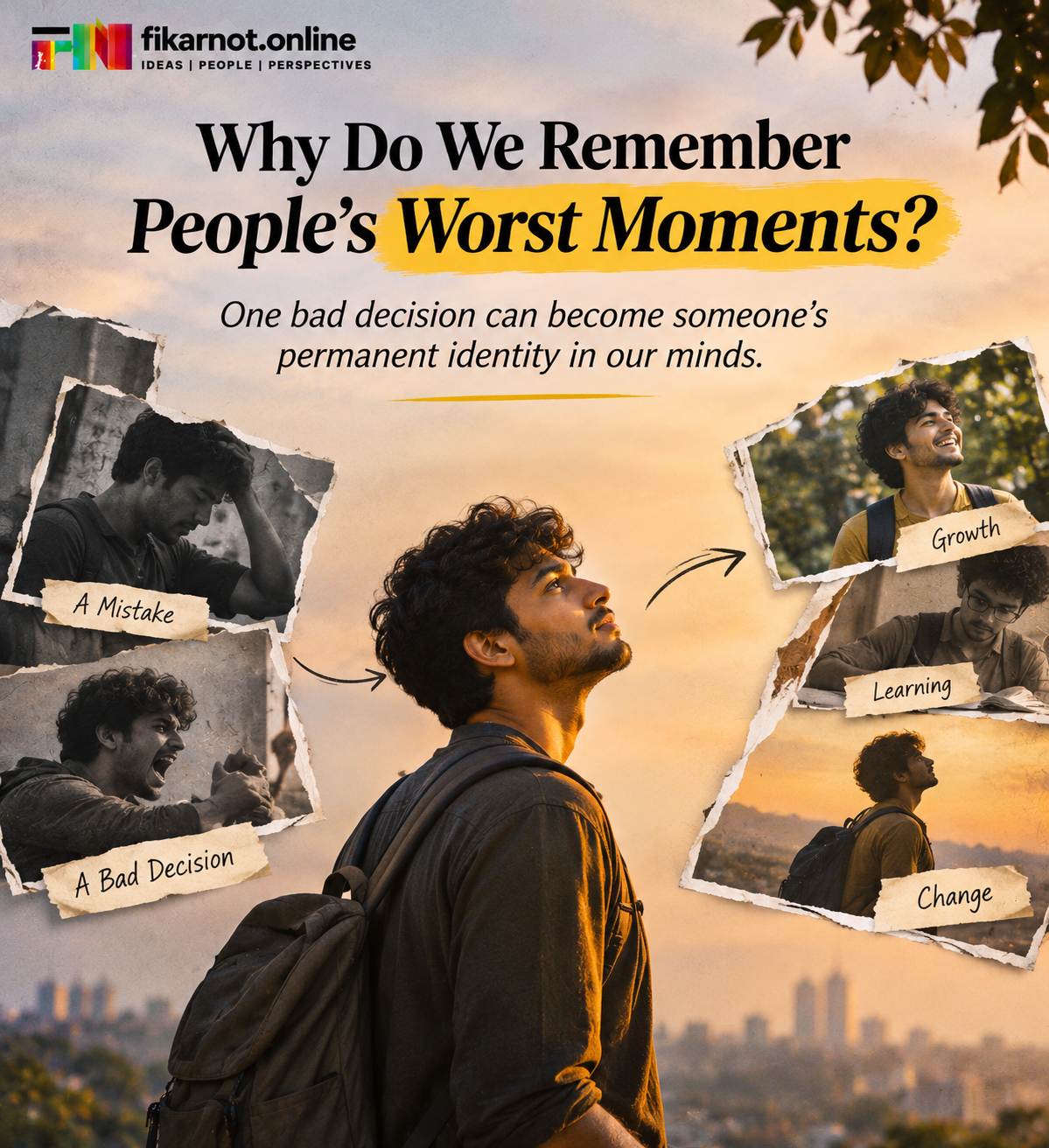
Think about someone you know who made a stupid mistake years ago. Maybe they lied once. Maybe they lost their temper. Maybe they failed badly at something. Maybe they made one terrible relationship decision. Maybe they said something insensitive when they were angry. Years later, someone brings it up and says: “Yeah, but remember what they did?” Funny thing is, we remember. The person may have changed completely since then. They may have apologised, learned, grown up, and become a much better version of themselves. But in our minds, that one moment sometimes refuses to leave. Why?
We Remember the Moment That Hurt Us
Our brains are not completely neutral recorders. Negative experiences often grab our attention more strongly than positive ones. Psychologists call this the negativity bias, our tendency to give more weight to negative information than equally strong positive information. Think about it. Someone compliments your work ten times. One person says, “Honestly, this isn't that good.” Guess which comment you remember while lying in bed that night? Exactly. The same thing can happen with people. Someone can be kind to us for years. Then one day, they disappoint us. Suddenly, the disappointment becomes the headline of the relationship.
“He is selfish.” “She can't be trusted.” “He's always like this.” Except… Maybe they aren't. Maybe they were just human on one particular day.
We Are Quick to Turn a Moment Into a Personality
This happens all the time. A friend cancels plans twice. We say, “She doesn't care about me.” Someone doesn't reply to our message. “She's ignoring me.” A colleague makes one mistake. “He's careless.” A person behaves badly during an argument. “That's who he really is.” We take one behaviour and turn it into an identity. And once we create that identity, every future action gets interpreted through it. If they are late again, we think, “See? I knew it.” If they do something kind, we might think, “He's probably doing it for a reason.” Psychologists have studied a related tendency called the fundamental attribution error we often explain other people's behaviour through their personality while giving ourselves more credit for the situation we were in. When we're late: “Traffic was terrible.” When someone else is late: “They are irresponsible.” Same traffic. Different explanation.
But We Don't Judge Ourselves the Same Way
This is where things get interesting. Think about the worst version of yourself. The decision you regret. The message you wish you hadn't sent. The person you were five years ago. You probably have an explanation for it. “I was immature.” “I was going through a lot.” “I didn't understand.” “I've changed now.” And that's fair. People are complicated. But shouldn't we sometimes allow other people the same possibility? Not always, of course. Some actions have serious consequences. Some behaviour should not be excused simply because time has passed. Forgiveness doesn't mean pretending nothing happened. Trust doesn't have to be restored automatically. But accountability and permanent condemnation are not the same thing.
Imagine If Nobody Let You Outgrow Your Past
Imagine meeting someone who knew you at 18. They remember every stupid thing you did. Every embarrassing opinion. Every bad relationship decision. Every immature reaction. And whenever you try to become better, they say: “Don't act different. I know who you really are.” Wouldn't that feel unfair? Most of us would want to say: “Yes, I did that. But I'm not that person anymore.” And perhaps that is something worth remembering about other people too.
We Love Transformation Stories Until We Know the Person
We love stories about people who changed. The athlete who came back after failure. The entrepreneur whose first business collapsed. The student who struggled before succeeding. The person who overcame their past. We celebrate them because the transformation is complete. But real life is messier. You don't get to see someone's transformation as a neat before-and-after photograph. You see it in small things. The friend who used to lose their temper but now walks away from arguments. The person who once wasted money but has finally learned to manage it. The colleague who used to avoid responsibility but now owns their mistakes. The parent who grew up emotionally distant but is trying to communicate better with their children. Change rarely arrives with an announcement. Sometimes it looks like someone simply behaving differently than they used to.
There Is an Interesting Thing About Memory Too
Our memories are not perfect recordings of the past. Research on memory has repeatedly shown that remembering is a reconstructive process. Each time we recall an event, our present understanding can shape how we remember it. That means the story we tell ourselves about someone can become stronger over time even if the person themselves has changed. We don't just remember what happened. Sometimes, we keep re-editing what happened. And eventually, the person becomes the villain in a story that hasn't been updated in years.
So, Should We Forget People's Mistakes?
No. That's not the point. Remembering can protect us. Experience teaches us. Patterns matter. If someone repeatedly hurts you, you don't have to keep giving them unlimited chances just because “people change.” But there is a difference between saying: “I remember what you did.” and “I will never believe you can become anything different.” The first is memory. The second is a verdict. And perhaps we should be a little careful about giving permanent verdicts on temporary versions of people. Because here's the uncomfortable part: We all hope people will judge us by who we are becoming, not only by who we have been.
Maybe we should offer others the same possibility. Not blind forgiveness. Not forgetting. Not excusing. Just a little room for growth. Because sometimes the person you remember is not the person standing in front of you anymore. And maybe the kindest thing we can do is notice the difference.