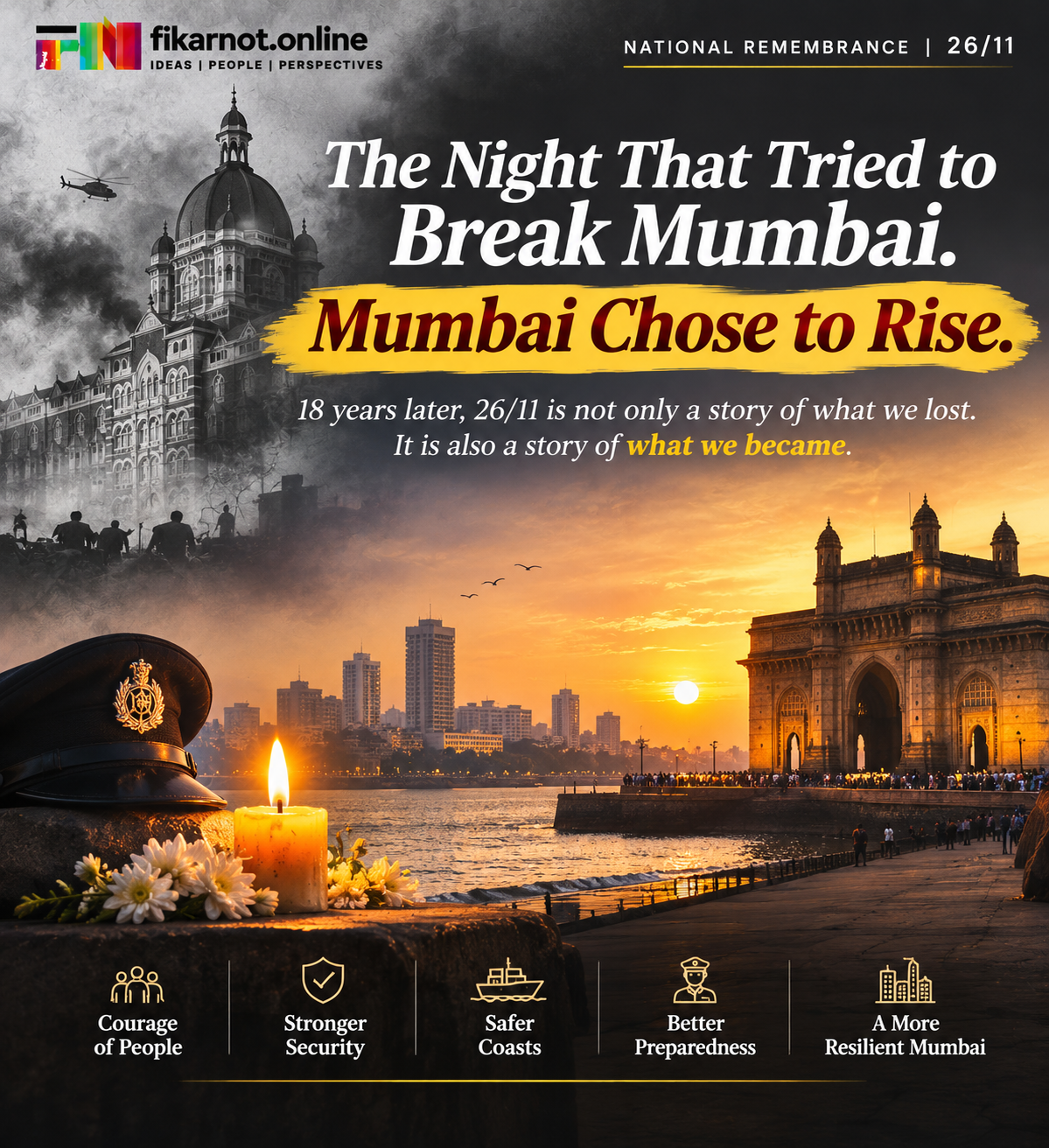
The Night That Tried to Break Mumbai. Mumbai Chose to Rise.
18 years later, 26/11 is not only a story of what we lost. It is also a story of what we became.


The Night That Tried to Break Mumbai. Mumbai Chose to Rise.
On 26 November 2008, Mumbai went to sleep as one city and woke up to a nightmare.
For more than 60 hours, terror had a physical address.
CST.
Taj.
Oberoi.
Nariman House.
Ten terrorists attacked multiple locations across Mumbai. By the time the operation ended on 29 November, 166 people had been killed and hundreds injured.
Eighteen years later, we still remember them.
And we should.
But perhaps there is another part of the 26/11 story worth remembering.
What happened after the night ended.
Because terrorism tried to create fear.
Mumbai answered with something else.
Resilience.
The City Didn't Pretend Nothing Happened
There is a difference between moving on and pretending.
Mumbai did not forget.
Families continued to grieve. Survivors continued to deal with physical, emotional and financial consequences. Even today, some survivors are still struggling with health, livelihood and rehabilitation issues.
That matters.
Because optimism should never mean saying, “Everything is fine.”
It means saying:
“Something terrible happened. We will remember it. And we will still build tomorrow.”
That is a much stronger form of hope.
The People Who Ran Towards the Danger
When most people were trying to get away, some people were moving towards the danger.
Police officers.
Security personnel.
Firefighters.
Doctors.
Hotel staff.
Railway and emergency workers.
Ordinary citizens helping strangers.
The official record of the operation tells us that security forces faced heavily armed attackers, hostage situations and extremely difficult conditions, yet eventually neutralised the terrorists and rescued hundreds of people trapped inside the targeted buildings.
That is the part of 26/11 that deserves to be remembered alongside the horror.
Courage is not the absence of fear.
Sometimes courage is simply deciding that someone needs help more than you need safety.
And Then India Changed
One of the most important ways to remember a tragedy is to ask:
What did we learn from it?
26/11 exposed serious vulnerabilities in India's coastal and counter-terror security architecture.
The response was not perfect overnight.
But systems changed.
The Indian Navy became the lead agency for overall maritime security, while the Coast Guard took responsibility for coastal security in territorial waters. A broader whole-of-government approach to maritime security was developed.
Maharashtra also created Force One in 2009, a dedicated counter-terror unit created in the aftermath of 26/11 so that the state would have a specialised response capability of its own.
And the learning continues.
This month, India conducted Sea Vigil-26, a nationwide coastal defence exercise involving the Navy, Coast Guard, Coastal Security Police, Customs and other agencies, along with coastal communities. The exercise itself was conceived after 26/11 to test and strengthen maritime security.
Think about what that means.
The same sea through which the attackers entered Mumbai has become part of a much larger system of surveillance, preparedness and coordinated defence.
That is what learning from tragedy looks like.
Mumbai Didn't Become Fearless. It Became Stronger.
We often say, “Mumbai never stops.”
It sounds like a slogan.
But after 26/11, it became something more meaningful.
People returned to work.
Trains ran.
Restaurants reopened.
Offices opened their doors.
The streets became crowded again.
Not because the city had forgotten what happened.
Because a city cannot allow terrorists to decide whether its people are allowed to live normally.
There is something deeply powerful about that.
The goal of terrorism is not only to kill. It is also to create fear that continues long after the attack.
When ordinary people refuse to surrender their everyday lives to that fear, they take something back.
Their city.
Their freedom.
Their future.
But Resilience Is Not Just a Mumbai Thing
This lesson goes beyond one city.
Every generation faces moments that make it wonder whether things will ever feel normal again.
Terror attacks.
Pandemics.
Economic crises.
Natural disasters.
Social unrest.
And every time, societies have a choice.
We can allow fear to shrink our world.
Or we can learn, adapt and rebuild.
That doesn't mean becoming careless.
In fact, the opposite.
Remembering should make us more alert, not more afraid.
That is why this year's 26/11 memorial and pledge ceremony at the Gateway of India carries the theme #NEVEREVER—a commitment to remember the victims and martyrs while strengthening the resolve that such a tragedy should never happen again.
So, What Should We Remember?
Remember the 166 people who never came home.
Remember the families who had to rebuild their lives.
Remember the survivors.
Remember the police officers and security personnel who ran towards danger.
Remember the doctors, hotel workers, emergency responders and ordinary citizens who helped others.
And remember the lessons that followed.
Because 26/11 is not only a date in a history book.
It is a reminder that security cannot be taken for granted.
That preparedness matters.
That institutions must learn.
That citizens matter.
And that resilience is not some magical quality a city is born with.
It is something people choose.
Every time they return to work.
Every time they rebuild a home.
Every time a survivor chooses to speak.
Every time a police officer trains for a threat that may never come.
Every time a city lights up again.
Mumbai's Answer
Terrorism wanted Mumbai to remember fear.
Mumbai chose to remember courage.
It tried to interrupt the city's rhythm.
The city found its rhythm again.
It left scars.
But it did not get the final word.
And perhaps that is the most important lesson of 26/11.
Resilience doesn't mean you were never broken.
It means you refused to remain broken.
Eighteen years later, we remember.
We mourn.
We learn.
We stay vigilant.
And then, just as Mumbai has done for generations—
we rise.