Prompt Engineering Is Dying: What Comes Next for AI Engineers
Why Context Engineering, AI Agents, and Critical Thinking Are Replacing Traditional Prompting Skills


Prompt Engineering Is Dying. What Comes After It?
Not long ago, "Prompt Engineer" was hyped as the hottest six-figure job in tech. Job boards were filled with listings for people who could coax better answers out of large language models using clever phrasing. If you knew how to type "Act as a world-class senior architect," "Think step by step," or "I'll tip you $200 for a perfect answer," you looked like a wizard.
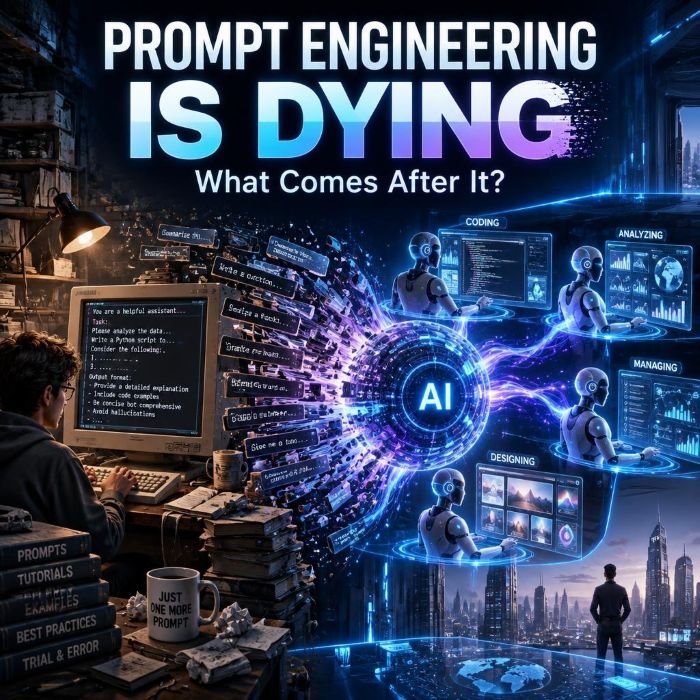
That era is already fading. Traditional prompt engineering—the art of memorizing phrasing hacks to trick an AI into behaving—is quietly dying. And honestly, it was always meant to.
Why Prompt Hacking Lost Its Edge
Early LLMs were brittle. A tiny tweak in wording could swing an output from brilliant to completely unusable. Prompt engineering existed as a temporary patch for models that didn't fully understand human intent.
Modern AI models have closed that gap. Newer reasoning models automatically break down complex problems behind the scenes without needing you to beg them to "think step by step." Better alignment, native structured outputs, and automatic prompt optimization mean the models themselves now handle much of the linguistic heavy lifting. If you still need a secret incantation to get a decent answer, that's no longer a clever skill—it's a sign you're using an outdated workflow.
Clear communication still matters, of course. You can't give vague instructions to a human teammate and expect great work, and AI is no different. But typing clever sentences into a chat box is no longer a standalone discipline. Something much bigger is taking its place.
1. Context Engineering
If the last few years were about how you ask, the next era is about what the model can see. Welcome to context engineering—the practice of designing, filtering, and delivering the exact information an AI needs at the exact moment it needs it.
Think about coding with an AI assistant. Asking it to "fix the authentication bug" fails not because your prompt lacked magic adjectives, but because the model can't see your database schema, recent commits, or error logs. Context engineering solves this through retrieval pipelines (RAG), structured memory, clean documentation, and smart pruning so the model isn't drowned in irrelevant noise. Garbage context in means confident hallucinations out.
2. Agentic Workflows and Orchestration
The single-turn chat interface is already feeling cramped. Instead of babysitting one giant prompt and hoping for a flawless response, engineers are building agentic workflows—multi-step systems where AI models plan, call external tools, read live data, execute code, and self-correct.
In this world, you aren't trying to write one master prompt that does everything. You're breaking a messy goal into reliable stages: one step researches, another writes, a third runs tests, and a fourth reviews the diff. Connecting models to APIs, databases, and local environments turns AI from a clever text generator into actual software infrastructure. The winning skill here isn't wordsmithing; it's systems architecture.
3. Evals and Verification
Anyone can build an AI prototype that looks impressive on a Friday afternoon. Getting it to work reliably 99% of the time in production is a completely different game.
That's why evaluation engineering (evals) is becoming one of the most valuable skills in AI. Instead of "vibe checking" three sample outputs and calling it a day, teams now build automated test suites that grade model responses for accuracy, latency, safety, and edge-case failures. When a new model drops or a prompt changes, evals tell you immediately whether your system actually improved or quietly broke. You can't engineer what you can't measure.
4. Problem Framing and Domain Taste
As AI gets cheaper and faster at generating output, the bottleneck shifts from execution to judgment. Knowing what to build, defining tight constraints, spotting subtle logical flaws, and understanding the real human problem behind a request are skills no model can fully outsource for you.
Whether you're writing software, analyzing data, or designing a product, the people who thrive next won't be the ones hoarding lists of "Top 50 ChatGPT Prompts." They'll be the ones who understand their domain deeply enough to decompose hard problems, wire up the right context, and verify the results.
Moving Beyond the Chat Box
Prompt engineering didn't fail—it simply graduated. Just as early web users once had to learn rigid search-engine syntax before Google learned to understand plain English, we're moving past the awkward phase of speaking "AI-ese."
The future belongs to builders who stop treating AI like a genie to trick and start engineering it like a system.