AI Project Building: Why 10-Minute Projects Can Hurt Learning
How AI is changing the way students build projects, learn engineering, and develop real-world skills.


The 10-Minute Project Problem: When AI Makes Building Too Easy
AI project building has become faster than ever. Last week, I built an entire Computer Networks course project in ten minutes.
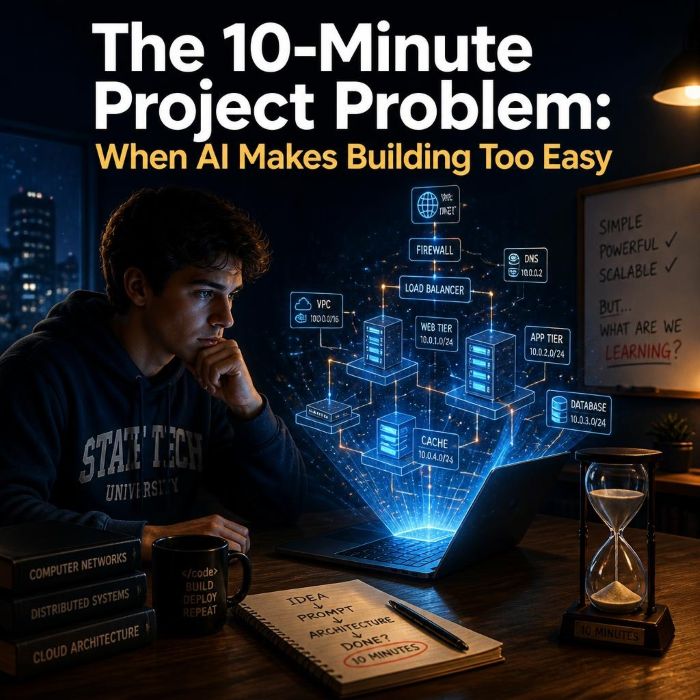
It wasn’t a tiny script, either. It was a full networking system for business management—complete with departmental VLANs, a subnetting scheme, routing configurations, firewall policies, and a clean architecture diagram separating HR, Finance, and Operations. Three years ago, that kind of assignment would have eaten up an entire weekend, a few pots of coffee, and at least two minor meltdowns over why the Finance subnet couldn't ping the main server.
This time? I typed a detailed prompt, went back and forth twice to tweak the IP ranges, and watched a working, textbook-clean network design materialize on my screen before my chai even went cold.
For about five minutes, I felt unstoppable. Then the weirdest feeling kicked in. It wasn't pride. It was emptiness.
The Illusion of Getting Things Done
We’re living through a strange moment as students and builders. The barrier between having an idea and holding a finished product has basically collapsed. If you need a backend, a frontend, a data pipeline, or a business management network, you can prompt your way to a 90% working prototype before you’ve even properly read the problem statement.
On paper, this looks like peak productivity. You hit the deadline. The topology works. The documentation looks professional. Nobody can tell it took ten minutes instead of ten hours.
Except you can.
The problem with a 10-minute project isn’t that the output is bad. Honestly, the output is usually scarily good. The problem is that you skipped the exact part that turns you into an actual engineer: the friction.
When the Screen Goes Blank
You don’t really notice what you missed until someone asks a simple follow-up question.
Imagine sitting in a project review or a viva. The professor looks at your business management network and asks, "Why did you go with OSPF instead of static routing for these branch offices? And what happens to your ACLs if we add a guest Wi-Fi subnet?"
If you built that network by hand—if you actually sat there calculating subnet masks, misconfiguring a router interface, watching packets drop in simulation, and hunting down the mistake—you don't need to memorize the answer. You lived it. You know why that design choice is there because you tried the wrong one first and watched it break.
When AI builds it for you, you’re just a tourist in your own project. You’re reading off a map you didn't draw. The second something goes slightly off-script, you freeze, because you never built the mental model underneath the finished files.
Friction Was Never the Enemy
We’ve been conditioned to treat friction as a bug. Slow code? Optimize it. Tedious setup? Automate it. Hard assignment? Prompt it.
But in learning, friction isn’t a bug. Friction is the whole mechanism.
Your brain doesn't wire itself when everything works on the first try. It wires itself when you’re staring at a broken configuration at 1 AM, testing a theory, realizing you misunderstood how a default gateway actually routes traffic, and finally getting that green ping response. That frustration is literally the feeling of a concept locking into place.
When AI hands you the finished networking system in ten minutes, it robs you of the struggle. It turns you from a builder into a middle manager who just approves drafts they don't fully understand. And the scary part is how easy it is to convince yourself that you're learning, just because you're moving fast.
Taking Back the Wheel
Look, I’m not saying we should throw AI out the window and pretend it’s 2015. That’s unrealistic, and honestly, a waste of a great tool. Nobody gets bonus points for manually formatting boilerplate configs when a machine can do it in seconds.
The fix isn't to stop using AI. It's to stop letting it do the thinking first.
Next time I have to build something—whether it's a networking system or a full-stack app—I’m flipping the workflow. I’ll sketch the rough topology on paper first. I’ll calculate the subnets myself, even if I mess them up. I’ll build the ugly, broken version 1.0 on my own, and then bring AI in to roast my design, point out security holes, or explain why my packets are looping.
Use it as a senior engineer sitting next to you, not as a ghostwriter doing your job while you watch.
Because a 10-minute project will easily get you through tomorrow’s submission. It just won't help you when you're in a real job, the system goes down, and there's no prompt box to save you.