Guru Nanak Wasn't Asking You to Believe. He Was Asking You to Think.
In an age of instant opinions, one of Guru Nanak’s greatest lessons may be the courage to question.


Guru Nanak Wasn't Asking You to Believe. He Was Asking You to Think.
In an age of instant opinions, one of Guru Nanak’s greatest lessons may be the courage to question.
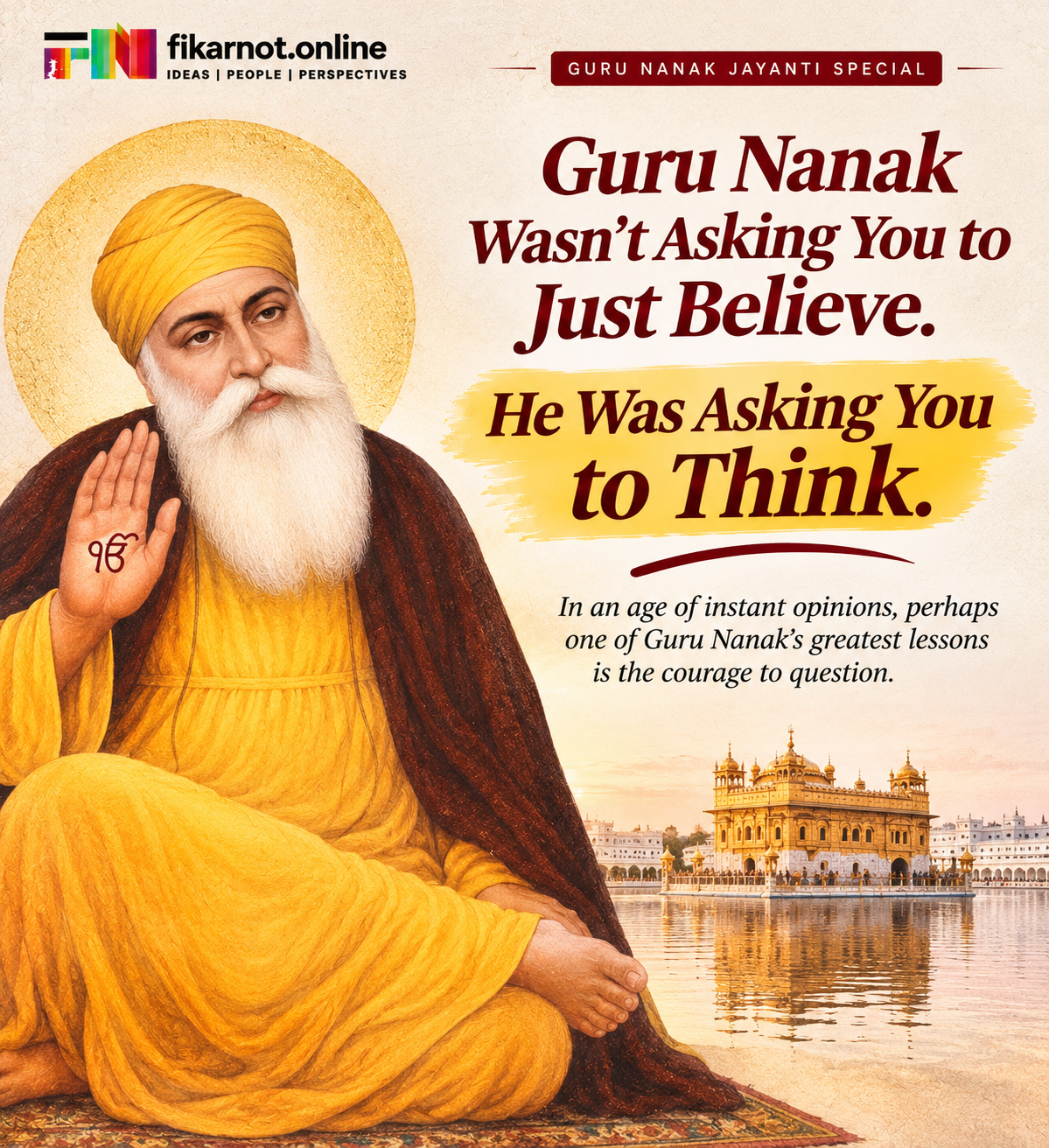
We live in an interesting time. We have Google for answers, AI for explanations, Instagram for opinions, and WhatsApp for forwarding both. And yet, somehow, we have become less comfortable with one simple question: “Why?” Why do we believe this? Why do we follow this? Why do we think this person is good and that person is bad? Why have we always done things this way? More than five centuries ago, Guru Nanak challenged people to look beyond blind ritual, social divisions, and inherited assumptions. His message was not simply about believing something because someone told you to.
It was about experiencing, questioning, and living the truth.
The Courage to Question
Think about everyday life. Someone sends you a WhatsApp message saying, “This is what our tradition says.”Do you check it? Or do you forward it because it sounds right? Someone says, “Rich people are all selfish.” Someone else says, “Poor people just don't work hard enough.” Someone says, “Young people have no values.” Another says, “Older generations don't understand anything.” We collect these statements like ready-made answers. Guru Nanak's spirit invites a different approach: Stop. Think. Look deeper. Questioning does not necessarily mean disrespect. Sometimes, questioning is the beginning of understanding.
He Questioned the Divisions People Had Normalised
Guru Nanak lived in a society deeply shaped by distinctions of caste, status, religious identity, and social hierarchy. His teachings challenged the idea that human worth could be decided by birth or social position. That idea still feels surprisingly modern. Look around today. We may have smartphones instead of scrolls and corporate offices instead of royal courts, but we still create hierarchies. By salary. By English.By college. By surname. By followers. By job title. By where someone lives. We may not call it caste or hierarchy every time. Sometimes we simply call it “status.” The labels have changed. The human tendency hasn't.
The Langar Was an Idea You Could Sit Inside
Perhaps one of the most powerful examples is the tradition of Langar. People sit together. Eat together. Share the same food. The principle is beautifully simple: before God and humanity, your social status does not make your hunger more important than someone else's. And think about how radical that idea still is. We live in a world where people often ask: “What do you do?” “Where do you work?” “Which college?” “How much do you earn?” “What car do you drive?” Langar quietly asks a different question: Can you sit beside another human being without needing to know their status first? That's not just spirituality. That's social philosophy.
Learning Is Not the Same as Collecting Information
Today, we confuse knowing with understanding. We watch a 30-second reel about history and feel like historians. We read one headline and become experts on geopolitics. We hear one podcast and suddenly have a complete theory about relationships, economics, and human behaviour. But learning requires something more uncomfortable: The willingness to say, “Maybe I don't know enough yet.” That is where curiosity begins. And perhaps this is why Guru Nanak's message remains relevant. Because a thinking mind is never completely satisfied with easy answers.
You Can Question Without Becoming Cynical
There is another important distinction. Questioning everything doesn't mean believing nothing. It means refusing to accept something simply because it is popular, convenient, or inherited. You can question a tradition and still respect it. You can disagree with someone and still listen. You can challenge an idea without insulting the person who holds it. You can learn from another tradition without losing your own identity. That is not confusion. That is intellectual maturity.
What Would Guru Nanak's Message Look Like Today?
Maybe it would look less dramatic than we imagine. It could mean checking before forwarding. Listening before reacting. Talking to someone outside your social bubble. Reading something that challenges your worldview. Treating a person with dignity even when they cannot give you anything in return. Working honestly when nobody is watching. Sharing when you have enough. And asking yourself, occasionally: “Am I thinking for myself, or am I simply repeating what I have been told?” That question can be uncomfortable. But perhaps that's the point. Guru Nanak wasn't asking us to stop believing. He was asking us to wake up. To look beyond labels. To question our assumptions. To recognise the humanity of the person sitting across from us. And to turn what we believe into how we live. Because faith without reflection can become routine. And knowledge without humility can become arrogance. But a curious mind, a compassionate heart, and an honest life those can still change the world. Perhaps that is one of Guru Nanak's most timeless lessons:
Don't just inherit your answers.
Have the courage to ask better questions.