The Most Important Programming Skill in the AI Era: Clear Thinking
Why Critical Thinking, Clear Communication and Problem-Solving Matter More Than Ever


The Most Important Programming Skill in the AI Era Might Not Be Programming
Last semester I was sitting in the lab at 1 a.m., staring at a bug that refused to die. I had a deadline, half a packet of chips, and a friend next to me who had already finished. When I asked how, he shrugged and said, "I just told the AI what I actually wanted."
That sentence has been living in my head rent-free ever since.
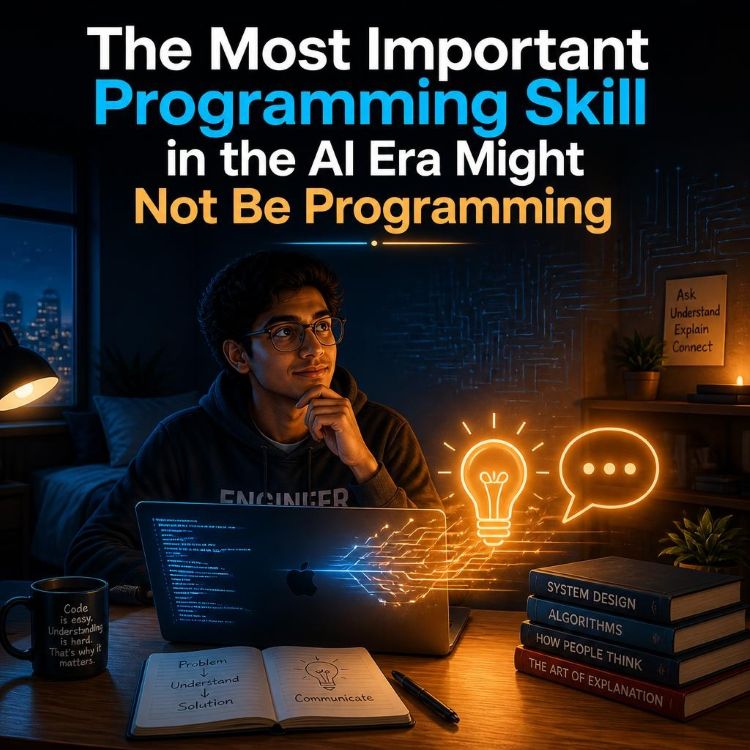
The code was never the hard part
Here's what nobody told me in first year: typing code was never the real difficulty. The real difficulty was figuring out what to build, why, and what could go wrong. Syntax was just the tax we paid to get there.
Now the tax is almost gone. You can describe a login system in plain English and get working code back. But try it with a vague idea and you get a vague mess. My friend didn't win that night because he knew more syntax. He won because he knew exactly what he wanted, broke it into small clear pieces, and explained them like he was talking to a smart but very literal teammate.
That's the skill. Thinking clearly, and then saying it clearly.
Clear thinking is the new superpower
I started noticing this in my own work. When I rushed and typed something like "make a student management app," I got something generic and half useless. When I slowed down and wrote who uses it, what data it stores, what happens when someone enters garbage, and what the edge cases are, the output was suddenly good.
The AI didn't get smarter between those two attempts. I did. Or rather, I was forced to be, because the tool can't read my mind. It can only read my prompt, and my prompt is only as good as my thinking.
Honestly, this is what good engineers have always done. They ask annoying questions before writing a single line. They poke holes in the plan. AI just made that habit the main event instead of a side quest.
But please, don't skip the fundamentals
Before someone in the comments yells at me: no, I'm not saying learning to code is pointless. Quite the opposite.
I've seen AI confidently hand me code that looked perfect and was quietly wrong. It had a sneaky off-by-one error, an unsafe query, and logic that worked for three test cases and collapsed on the fourth. If I hadn't understood loops, data structures, and how things actually run, I would've shipped that straight to my professor and called it a day.
So the fundamentals matter, just for a different reason. They're not for typing faster anymore. They're for judging what the machine gives you. You can't review what you can't read. Think of it like being the editor of a very fast, very confident writer who sometimes makes things up.
Taste, curiosity, and knowing when something feels off
There's another thing that's hard to teach and impossible to autocomplete: taste. Knowing when a solution is overcomplicated. Knowing when a quick hack will hurt you in three months. Knowing when to stop prompting and just think.
Some of my best learning this year came from being annoyed at an AI answer, asking myself why it felt wrong, and digging until I understood. Curiosity does more for me than any tutorial playlist. The tools can give me answers all day, but they can't make me care about the question.
What I'm actually doing about it
I'm not panicking, but I'm changing a few habits. I write out the problem in plain words before I touch the keyboard. I explain my code to a friend, or to a rubber duck on my desk, because if I can't explain it, I don't understand it. I read more than I write now, because reading is where the judgment comes from. And I practice being specific, which turns out to be harder than any algorithm I've learned.
I also try to build things that matter to me, not just assignments. A tool that solves a real annoyance teaches you more about requirements than ten exams.
The takeaway
If you're a student wondering whether to be scared, I get it. I've been there at 1 a.m. with chips and doubt. But I don't think programming is dying. I think it's growing up. The boring, mechanical part is getting automated, and what's left is the part that was always the heart of it: understanding problems, communicating clearly, and having the judgment to know a good answer from a bad one.
So yes, keep learning to code. But also learn to think, to question, and to explain. Those are the skills the AI can't hand you.