Learn to Say No, Learn to Hear No
Why healthy relationships need boundaries on both sides.


Learn to Say No, Learn to Hear No
Why healthy relationships need boundaries on both sides.
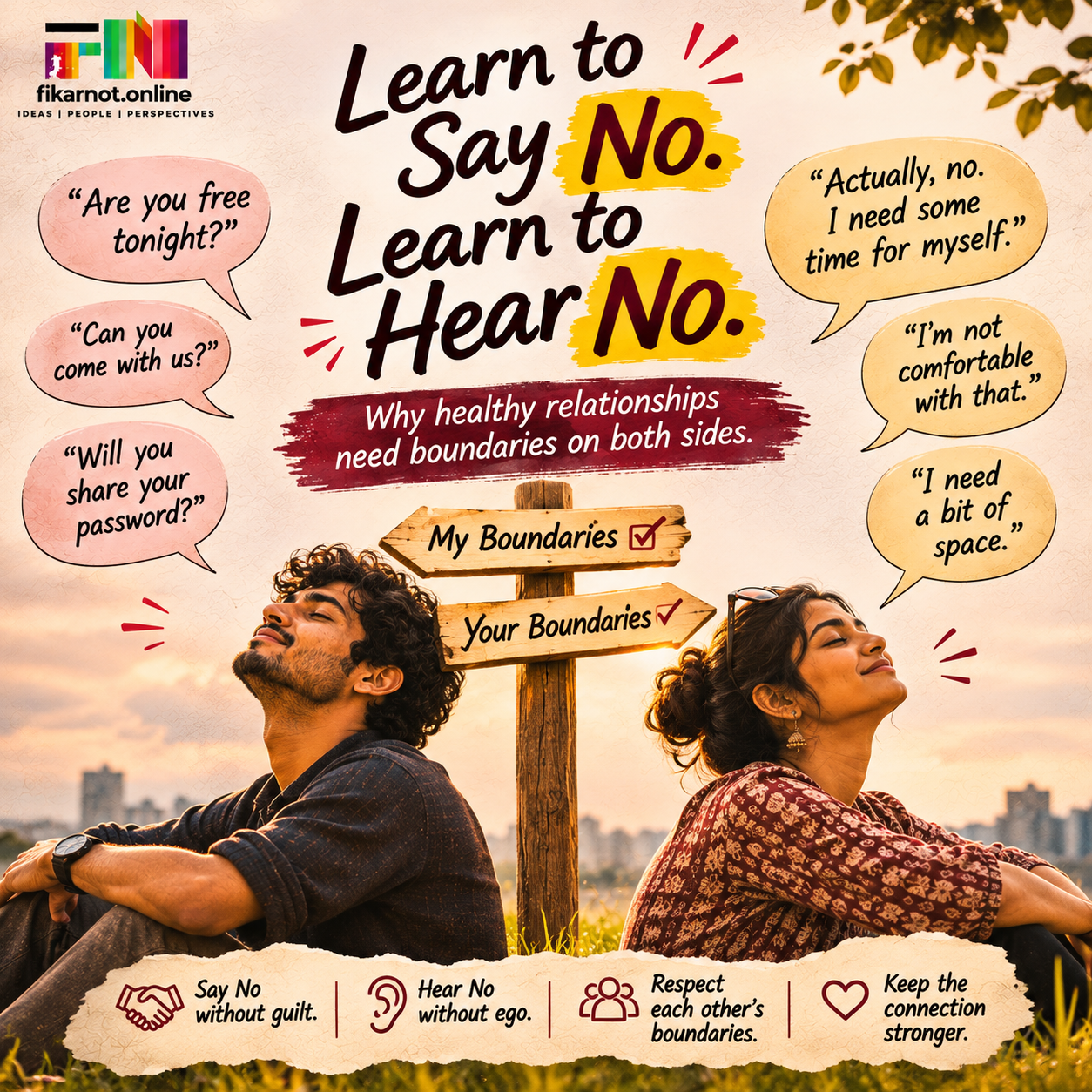
“Are you free tonight?”
“Actually, no. I’m tired. I just want to stay home.”
“Okay… so you don’t want to spend time with me?”
And there it is. A simple no has somehow become a relationship problem. We have become strangely bad at this little word. Someone says, “No, I can’t come.” We hear, “You’re not important to me.” Someone says, “I need some space.” We hear, “You’re becoming a burden.” Someone says, “I don’t want to do that.” We hear, “You don’t love me enough.” And when we want to say no? Suddenly, we prepare a full explanation.
“Actually, I have work…” “Actually, my family is calling…” “Actually, I’m not feeling well…” Why can't we sometimes just say: “No. I don't want to.” And why can't the other person simply say: “Okay.” Maybe that is one of the most underrated relationship skills of our generation.
We Are Terrified of Disappointing People
Think about a very ordinary situation. Your friend calls. “Bhai, Goa chalte next weekend?” You are exhausted. Your bank balance is crying. You have work pending. “Bhai, nahi jamnar.”
“Arre yaar, tu har baar excuse deta hai.” And suddenly you're booking tickets you don't even want to book. Or your partner says: “Come over tonight.” You genuinely need some alone time.
“Actually, today I just want to be by myself.” “Fine. I won't disturb you anymore.” Now you're apologising for needing one evening alone. This is how boundaries disappear. Not through one dramatic event. Through hundreds of tiny moments where someone learns:
If I say no, someone will make me feel guilty. Eventually, saying yes becomes easier.
Interestingly, a YouGov survey of young adults in India found that 36% feared hurting their date or partner's feelings when communicating consent, while 30% said they didn't know how to say no. So sometimes the problem isn't knowing what we want. It is having the confidence to say it.
But Can We Hear No?
This is the part we don't talk about enough. We all want the freedom to say no. But can we hear no? “Can we meet today?” “No, I'm exhausted.” A healthy response: “Okay. Rest. We'll meet tomorrow.” An unhealthy response: “Fine. Clearly you don't want to meet me.” Same question. Same no. Completely different relationship. Because sometimes we don't actually want an answer. We want the answer we already had in our head. And when we don't get it, we turn someone else's boundary into a personal insult.
“If You Loved Me…”
This is where things can get ugly without looking ugly. “If you really loved me, you'd come.” “After everything I've done for you? “Fine. Do whatever you want.” “You always say no.” “It's okay, I won't ask you again.” These sentences may sound small. But imagine hearing them every week. Soon you learn that saying no comes with consequences. So you stop saying it. Not because you agree. Because you're tired of the argument that comes afterward. That's not communication. That's emotional pressure wearing the clothes of love.
Love Doesn't Mean Unlimited Access
We have quietly confused intimacy with access. “If you're my partner, I should know your password.” “If you're my best friend, you should always pick up.” “If you love me, you should tell me everything.” “If we're close, why do you need privacy?” But closeness doesn't cancel individuality. Your partner can love you and still want an evening alone. Your friend can care about you and still not answer your call. Your sibling can love you and still refuse your favour. You can love someone deeply and say: “I'm not comfortable with that.” That's not distance. That's a boundary. A YouGov survey also found that 80% considered telling a partner they need personal space an acceptable boundary, while 70% considered spending time with friends without the partner acceptable. So perhaps we understand boundaries. We just struggle when the boundary inconveniences us.
Your Phone Has Made This Worse
Someone doesn't reply for two hours. You see them online. They've liked a reel. They've posted a story. But they haven't replied to you. Congratulations. Your brain is now writing a Netflix series. “Who are they talking to?” “Why are they ignoring me?” “Did I do something?” We've become so used to constant availability that absence itself feels suspicious. But someone being online isn't an invitation to be available to you. A person can be scrolling Instagram and still not have the emotional energy to talk. That is also a boundary. Not every delayed reply is a relationship crisis. Sometimes the person is simply… busy.
The Real Green Flag
We talk endlessly about relationship green flags. Good morning texts. Flowers. Long calls. Remembering your favourite food. Planning dates. All nice. But perhaps there's another green flag we don't discuss enough: how someone reacts when you say no. Do they respect it? Do they guilt-trip you? Do they become angry? Do they punish you with silence? And equally: How do you react when they say no? Because it is easy to call someone controlling. It is harder to ask whether we sometimes become controlling when we don't get the answer we wanted.
A Healthy Relationship Has Room for No
Maybe we don't need relationships where everyone always says yes. Imagine being able to say: “I'm tired.” “I need some space.” “I don't want to go.” “I've changed my mind.” “I'm not comfortable with that.” And not having to defend yourself like you're standing in court. That is what trust looks like. Not: “Will you always say yes to me?” But: “Can I say no to you and still feel safe?” And equally: “Can you say no to me without me making you feel guilty?” Love doesn't mean unlimited access. Friendship doesn't mean permanent availability. Closeness doesn't mean ownership. A boundary isn't necessarily a wall between two people. Sometimes, it is the thing that allows two people to stay close without losing themselves. So learn to say no. But just as importantly
learn to hear it.