Mard Ko Dard Nahi Hota — But Why Do We Still Believe It?
On International Men’s Day, maybe it is time to ask what happens when we teach boys to hide every emotion behind the words: “I’m fine.”


Mard Ko Dard Nahi Hota — But Why Do We Still Believe It?
On International Men’s Day, maybe it is time to ask what happens when we teach boys to hide every emotion behind the words: “I’m fine.”
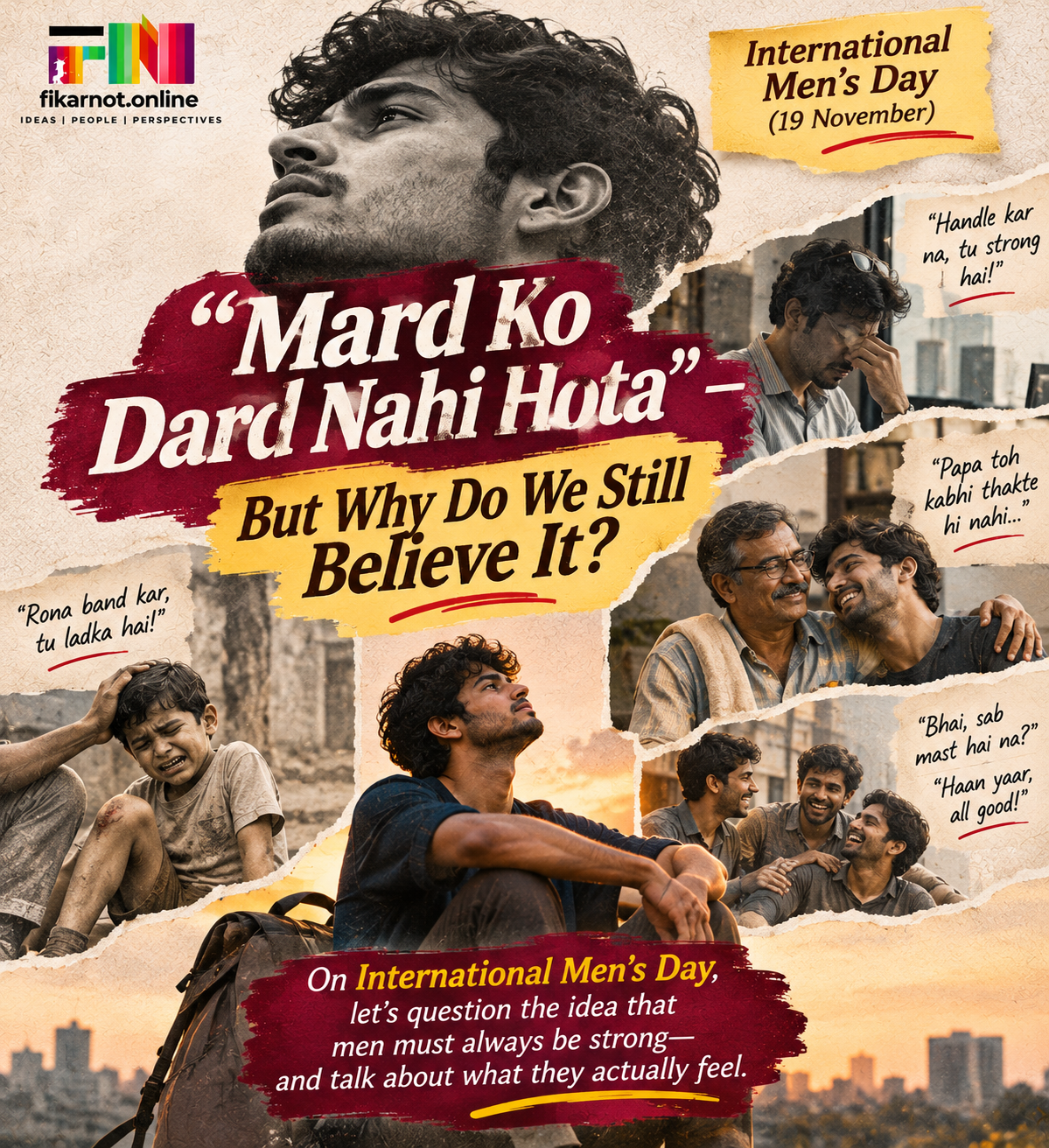
“Mard ko dard nahi hota.” We have heard it in movies. We have heard it from friends. Sometimes, we have heard it at home. A boy falls while playing. “Uth. Kya hua? Rona nahi.” A teenager fails an exam. “Next time better kar. Itna tension kyun leta hai?” A young man loses his job. “Chal, kuch aur mil jayega.” A relationship ends. “Bhai, move on. Ladkiyan aati-jaati rehti hain.” His father asks: “Kaam kasa chalu aahe?” “Chalu aahe.” “Paise?” “Manage hotay.” “Everything okay?” “Haan.” And the conversation is over. Because somehow, men are expected to handle things, not talk about them.
When Did “Be Strong” Become “Don't Feel”?
Being strong is a good thing. But somewhere along the way, we confused strength with silence. A boy is often taught very early that crying is embarrassing. “Tu mulga ahes na.” “Don't behave like a girl.” “Be a man.” So he learns. He learns to swallow disappointment. He learns to hide fear. He learns to laugh when something hurts. He learns to say “I'm okay” even when he isn't. And eventually, he becomes so good at hiding emotions that even the people closest to him may not know what is happening inside his head. That is not always strength. Sometimes, it is simply practice in hiding pain.
The Man Who Has to Figure Everything Out
Think about the expectations placed on an ordinary Indian man. Study well. Get a job. Earn enough. Buy a house. Take care of parents. Get married. Support your family. Be financially stable. Be emotionally mature. Protect everyone. Make the right decisions. And somehow, don't look worried while doing all of it. Imagine a 27-year-old sitting with his friends. “Job kasa aahe?” “Bas, thik.” “Salary?” “Manage hotay.” “Promotion?” “Baghu.” He laughs. Everyone moves on. But perhaps what he actually wanted to say was: “I have no idea what I'm doing with my life.” He just didn't know how to say it.
Men Have Friends. But Do Men Talk?
This is another strange contradiction. A man can have ten friends. A cricket group. A college gang. A WhatsApp group with 147 messages every morning. People who will immediately come if his bike breaks down at 11 PM. People who will stand beside him in a fight. People who will celebrate his birthday. But ask him: “Bro, are you mentally okay?” Suddenly, everyone becomes uncomfortable. “Arre kuch nahi.” “Chal beer peete.” “Don't overthink.” “Life hai, hota rehta hai.” Sometimes friendship becomes a beautiful way of avoiding the actual conversation. We know how to stand beside a friend. We are still learning how to sit with his pain.
And Then There Is the Father
For many Indian men, the first example of masculinity is their father. The father who leaves home early. The father who comes back tired. The father who rarely says, “I'm scared.” The father who may not know how to say “I love you” but asks: “Jevalas ka?” “Paise pahijet ka?” “Bike gheun ja, petrol aahe.” Sometimes love arrives not as a sentence, but as a responsibility. And perhaps our fathers were also products of the same system. Their fathers told them: “Mard ko strong rehna chahiye.” So they became strong. But maybe nobody taught them how to be vulnerable.
But Men Are Not Machines
This doesn't mean men are victims of everything. It doesn't mean every man is silently suffering. And it certainly doesn't mean conversations about women's experiences should be replaced. It simply means that men's experiences deserve space too. International Men's Day exists partly for this reason to highlight men's well-being, positive contributions, positive role models, and the pressures and expectations men face. The 2026 theme, “The Future Is Everyone,” makes the point even more clearly. Equality cannot mean listening to only half the human experience.
Maybe We Need a Different Definition of Strength
Imagine a father telling his son: “Beta, strong rehna.” But also: “Thakla asel tar sang.”
A friend saying: “Tu okay ahes ka? And seriously, I'm asking.” A husband saying: “I don't have the answer right now.” A son telling his parents: “I'm struggling with my career.” A man telling his friends: “Actually, I'm not doing great.” None of these sentences make a man weaker. Perhaps they make him more honest. Because courage isn't always about fighting. Sometimes courage is saying: “This is hurting me.” We Also Need Better Male Role Models
When we talk about role models for boys, we often show them only one version of masculinity. The successful businessman. The muscular athlete. The fearless soldier. The superstar. The rich entrepreneur. There is nothing wrong with these examples. But boys also need to see the ordinary man who works honestly for thirty years. The father who raises his children with patience. The teacher who changes a student's life. The brother who takes care of his family. The friend who shows up. The man who admits he made a mistake. The man who asks for help. A good man doesn't have to be invincible. He just has to be responsible, kind, courageous, and willing to grow.
So, Does “Mard Ko Dard Nahi Hota” Still Work?
Maybe it worked as a movie dialogue. It doesn't work as a life philosophy. Men feel pain. Men feel loneliness. Men experience failure. Men get scared. Men lose people. Men struggle with money, career, relationships, expectations, and identity. And men sometimes need someone to simply say: “Bol na. Kay zala?” Not to fix everything. Not to give advice immediately. Just to listen. Because sometimes a man doesn't need a solution. He needs permission to stop pretending that everything is fine.
Maybe This Is What International Men's Day Should Be About
Not competition. Not “men versus women.” Not proving who has it harder. Just recognition. Recognition that men contribute enormously as fathers, sons, brothers, friends, workers, teachers, soldiers, caregivers, entrepreneurs, and ordinary people trying to build a decent life. And recognition that the same men deserve to be seen as human beings, not just providers, protectors, and problem-solvers. The future is everyone. That means boys should grow up knowing that strength and vulnerability can exist together. That a man can be ambitious and still tired. Confident and still uncertain. Strong and still emotional. Responsible and still capable of asking for help. Maybe the next generation of boys doesn't need us to tell them: “Mard ko dard nahi hota.” Maybe they need to hear: “Dard hoga. Bol. Hum hain.”
And perhaps that is not the end of masculinity.
Perhaps it is the beginning of a healthier one.