Desi Hip Hop and the Hustle That Built a Legacy
Desi Hip Hop and the Hustle That Built a Legacy


Desi Hip Hop and the Hustle That Built a Legacy.
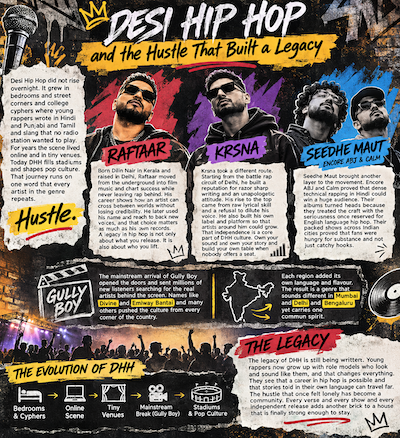
Raftaar is one of the clearest examples of that hustle. Born Dilin Nair in Kerala and raised in Delhi he moved from the underground into film music and chart success while never leaving rap behind. His career shows how an artist can cross between worlds without losing credibility. He later used his name and reach to back new voices and that choice matters as much as his own records. A legacy in hip hop is not only about what you release. It is also about who you lift.
Krsna took a different route. Starting from the battle rap circuit of Delhi he built a reputation for razor sharp writing and an unapologetic attitude. His rise to the top came from raw lyrical skill and a refusal to dilute his voice. He also built his own label and platform so that artists around him could grow. That independence is a core part of DHH culture. Own your sound and own your story and build your own table when nobody offers a seat.
Seedhe Maut brought another layer to the movement. Encore ABJ and Calm proved that dense technical rapping in Hindi could win a huge audience. Their albums turned heads because they treated the craft with the seriousness once reserved for English language hip hop. Their packed shows across Indian cities proved that fans were hungry for substance and not just catchy hooks.
What ties these artists together is a shared understanding that the scene belongs to everyone who sweats for it. The mainstream arrival of Gully Boy opened the doors and sent millions of new listeners searching for the real artists behind the screen. Names like Divine and Emiway Bantai and many others pushed the culture from every corner of the country. Each region added its own language and flavour. The result is a genre that sounds different in Mumbai and Delhi and Bengaluru yet carries one common spirit.
The legacy of DHH is still being written. Young rappers now grow up with role models who look and sound like them and that changes everything. They see that a career in hip hop is possible and that stories told in their own language can travel far. The hustle that once felt lonely has become a community. Every verse and every show and every independent release adds another brick to a house that is finally strong enough to stay.
-Maitrayee Repal