Marathi Natak Is Having a Moment, and Gen Z Is the Reason
Marathi Natak Is Having a Moment, and Gen Z Is the Reason


Marathi Natak Is Having a Moment, and Gen Z Is the Reason
Be honest, when was the last time you sat in a dark auditorium with your phone on silent and actually felt something for two and a half hours straight. If your answer is "ages ago," you might want to pay attention to what is quietly happening in natyagruhas across Maharashtra. A generation that grew up on reels, short videos and endless scrolling is walking back into the world of Marathi natak, and it is not doing it out of obligation. It is doing it because it genuinely feels good.
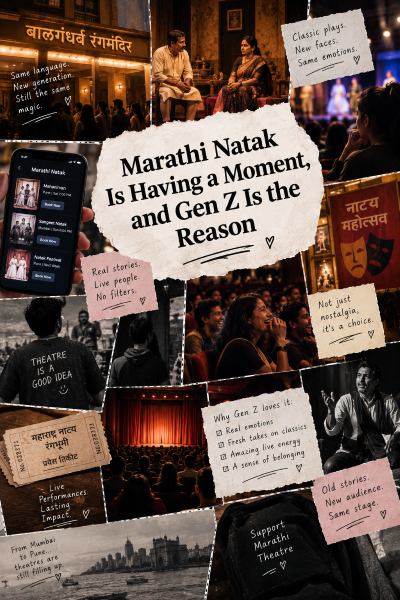
Part of it is the hunger for something real. A young Mumbai professional put it simply in a recent feature on the city's theatre scene, saying young audiences do not just want entertainment anymore, they want to experience something real. Theatre festivals, regional language plays and live performances are drawing exactly that crowd, and Marathi, Gujarati and Hindi productions have been a big reason why. When everything else on your phone is edited, filtered and replayable, a live performance where anything can happen on stage hits completely differently.
There is also a very Pune story hiding in this trend. Natak Company, the Pune based troupe started in 2008 by a group of students from Brihan Maharashtra College of Commerce and Fergusson College, has spent years proving that young people can love old plays. They have staged classics like Satish Alekar's Mahanirvan, a play first written in the seventies and set in a Pune chawl, and audiences are still turning up for it today. Nipun Dharmadhikari, the director behind much of this work and a college theatre kid himself who started with Purushottam Karandak, has become known for reviving sangeet natak and long classic plays for a modern audience. Years ago his team trimmed a hundred year old musical down from five acts to two, keeping the spirit and cutting the length, and that simple idea of respecting the original while meeting people where they are is exactly why it worked.
And honestly, that is the real secret. This is not a nostalgia trip forced on young people by their parents. It is a generation choosing its own roots. Our grandparents talk about queueing for tickets at Balgandharva Rangmandir or Yashwantrao Chavan Natyagruha, and now we are the ones refreshing booking pages and tagging our friends. The venues in Pune and Mumbai are still packed on weekends, and new festivals keep popping up, including long running ones dedicated entirely to Marathi musical theatre.
Here is another question worth sitting with. Why does a language feel warmer on a stage than it does in a textbook. For many of us who grew up code switching between Marathi, Hindi and English, natak is the one place where Marathi feels alive instead of academic. The jokes land differently, the pauses carry meaning, and a single line delivered with the right timing can say what a paragraph of English never could. That feeling of belonging is hard to find in a feed.
Of course, it is not all effortless. Tickets, timings and travel can be a hassle, and theatre still competes with streaming, which is why platforms and channels that bring plays to screens have helped too. But for a lot of young people, watching a recorded play only makes them more curious about seeing one live, which is how a quiet trend turns into a habit.
At the end of the day, getting back to our roots does not mean giving up everything modern. You can love reels and also love Mahanirvan. You can keep your playlists and still get goosebumps when the third bell rings and the curtain goes up. Maybe that is the real glow up here, a generation that realised heritage is not something old, it is something you get to keep choosing.
So here is a small challenge. This weekend, skip the scroll, book one Marathi natak, take your friends or your parents, and see how it feels. Then tell us whether it was worth it. Our guess is you will be back for the next one.