Beyond the Dialogues: The Man Called Nana Patekar
From unforgettable characters to a life beyond the spotlight


Beyond the Dialogues: The Man Called Nana Patekar
From unforgettable characters to a life beyond the spotlight
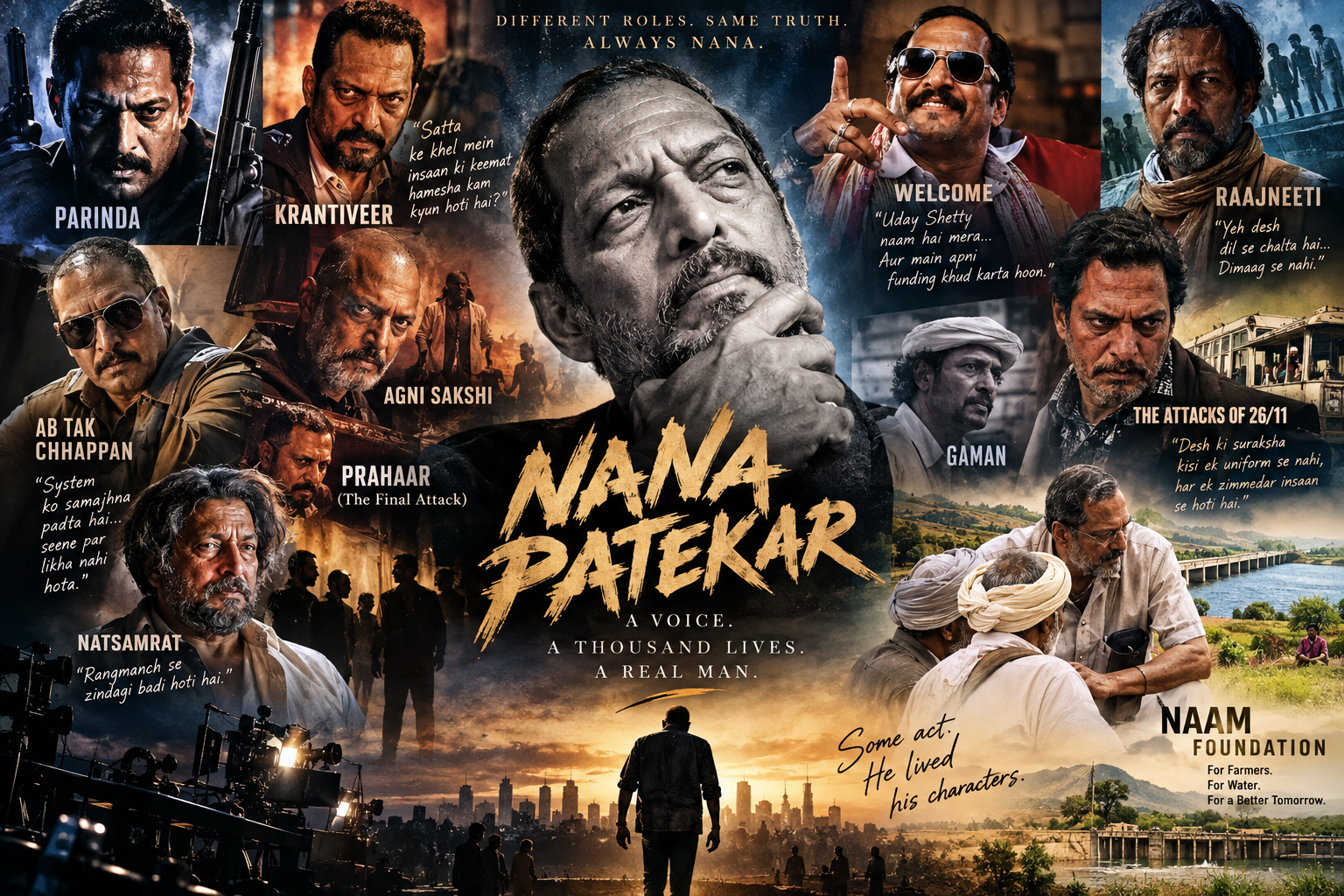
While remembering Nana Patekar from his unforgettable characters and raw cinema to a life beyond the spotlight
Some actors enter our memory through their faces.
Some through their songs.
Some through their glamour.
Nana Patekar entered through his voice.
That voice could sound angry, broken, frightening, funny, or painfully human. Sometimes he didn't even need a long dialogue. Ek pause, ek nazar, aur awaaz ka ek particular modulation bas, scene yaad reh jaata tha. But perhaps the more interesting question is not why Nana Patekar was a great actor.
It is: How did a man who never looked like a conventional Bollywood hero become one of Indian cinema's most unforgettable personalities? Because Nana never seemed interested in becoming what the industry expected a star to be. And maybe that was his greatest strength.
He Didn't Look Like Bollywood. He Made Bollywood Make Space for Him
Nana Patekar began in theatre before moving into Marathi and Hindi cinema. He made his film debut with Gaman in 1978 and gradually built a career across serious cinema, mainstream films, Marathi cinema and comedy. But his journey was never the conventional Bollywood success story. He wasn't introduced as the perfect romantic hero. No carefully manufactured image of glamour surrounded him.
Unke chehre par polish se zyada experience dikhta tha.
Instead of hiding that rawness, he made it his identity. His voice became his signature. His intensity became his screen presence. His pauses became part of his acting.
In Parinda, Krantiveer, Agni Sakshi, Ab Tak Chhappan, Raajneeti and Natsamrat, he showed that acting isn't always about looking attractive or delivering dramatic lines. Sometimes, it is about making the audience feel uncomfortable, angry, helpless, vulnerable.
And then came Welcome. The same actor who could make serious cinema feel painfully real could suddenly make an entire theatre laugh as Uday Shetty.
Yahi toh range hai. He could be terrifying in one film and hilarious in another without losing the essence of who he was as an actor. Awards can tell us that an actor was recognised. They cannot fully explain why an actor is remembered. Nana's presence does.
Sometimes, the Dialogue Wasn't the Dialogue
Watch Nana carefully. Sometimes the most memorable moment wasn't the line he delivered. It was the two seconds before the line. The look. The breathing. The silence. The sudden change in voice.
Kabhi woh dialogue bolne se pehle hi scene jeet lete the.
That's why his performances didn't always feel like performances. They felt lived. Perhaps theatre helped shape that instinct. On stage, an actor cannot depend on cinematic cuts and editing to create every emotion. But Nana developed something distinctly his own: a style that could be rough without being careless, loud without being empty, and emotional without becoming melodramatic. He also moved behind the camera, writing and directing Prahaar: The Final Attack. And yet, for all the fame, there was always something slightly uncomfortable about putting Nana into the category of a conventional “celebrity”.
He never seemed completely comfortable belonging to the glamour machine.
Perhaps because he knew there was a world outside it. And that world would eventually become one of the most meaningful parts of his story.
When the Camera Stopped, Nana Started Listening
Perhaps the most remarkable part of Nana Patekar's journey happened away from the film set. In 2015, Nana Patekar and Makarand Anaspure spearheaded NAAM Foundation, responding to drought, farmer distress, farmer suicides, and the water crisis affecting rural Maharashtra. The Foundation's work has extended across water conservation, farming, education, health, and village welfare.
And this is where Nana's story becomes more than a celebrity success story.
Cinema gave him visibility. But what did he do with that visibility?
NAAM's work has focused strongly on long-term solutions to water scarcity. Its projects have included river and nala rejuvenation, desilting dams and percolation tanks, canal construction, farm ponds and groundwater recharge.
According to the Foundation, its work between 2015 and 2025 included the restoration of thousands of water sources, river rejuvenation, and restoration of percolation tanks.
Its work has also extended into education and farming, including support for children from families affected by farmer suicides and initiatives related to modern farming, soil testing, and irrigation. There is something powerful about that transition. On screen, Nana often played powerful men. Away from the screen, he became associated with work involving people whose problems rarely receive a Bollywood-sized spotlight.
Yeh difference important hai. Because helping someone for a day is one thing. Trying to address the conditions that keep creating the problem is another. NAAM's work doesn't make Nana a saviour, and it shouldn't. But it does tell us something about how he chose to use his public influence. The man who spent decades speaking powerful dialogues on screen also chose to listen to people whose voices were often unheard. And perhaps that is one of the most meaningful chapters of his journey.
So, What Exactly Will We Remember?
We will remember Parinda. We will remember Krantiveer. We will remember Ab Tak Chhappan. We will remember Natsamrat. And yes, we will remember Uday Shetty shouting his way through Welcome. But maybe years from now, people won't remember every release date or every award. They will remember the voice. The intensity. The anger. The humour. The silence. That strange ability to make a fictional character feel like someone we had actually met.
Aur shayad sabse important baat woh yaad rahegi kyunki unhone apne aap ko badal kar star banne ki koshish nahi ki.
He brought his rawness into an industry built around glamour. And somehow, that rawness became his glamour. Today, when social media can turn almost anyone into a celebrity, Nana Patekar's journey offers a different idea of fame.
Being visible is not the same as being memorable. Having followers is not the same as having influence. And being famous is certainly not the same as being meaningful. Nana Patekar played hundreds of emotions through many characters. But perhaps the role he played best was the simplest one:
Being Nana Patekar. Because eventually, the applause stops. The lights go off. The credits roll.
But some voices remain.
And Nana Patekar's is one of them.