You Don't Have to Choose Between All In or Nothing With Toxic Family
You Don"t Have to Choose Between All In or Nothing With Toxic Family


You Don't Have to Choose Between All In or Nothing With Toxic Family
Have you ever answered a family call out of guilt, said the bare minimum, and hung up feeling more drained than before you picked up. If that sounds familiar, you already know the space this article lives in. Somewhere between showing up to every family function pretending everything is fine, and cutting someone off completely, there is a quieter option most people never hear talked about. Low contact.
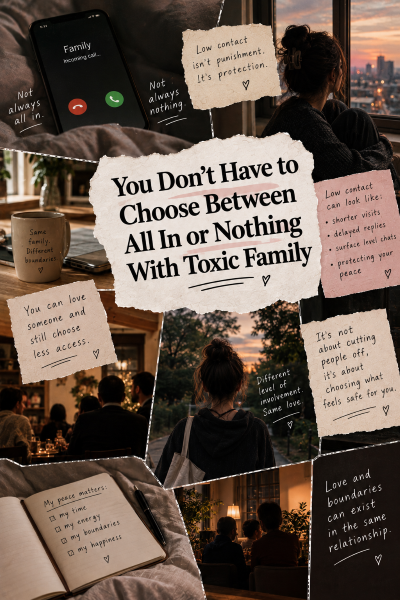
No contact gets all the attention online because it is dramatic and clean, a hard line, a before and after. But for a lot of people, especially with family, full no contact is not realistic, or even what they actually want. Maybe it is a parent who raised you imperfectly but is not entirely unsafe. Maybe it is a sibling you still love but cannot be around for long stretches without it costing your peace. Low contact exists for exactly this, keeping someone in your life on your terms, instead of theirs.
Here is what that actually looks like day to day. Shorter visits instead of full weekends. Replying to messages on your own time instead of immediately. Keeping conversations surface level instead of sharing the parts of your life that used to get criticized or used against you. It is not punishment, it is protection, deciding how much access someone gets based on how they have actually shown up, not based on obligation alone.
A lot of guilt shows up here that nobody really prepares you for. Be honest, have you ever felt like choosing distance from family makes you the villain of the story, even when you know exactly why you needed it. That guilt usually was not really yours to carry in the first place, it was something absorbed from being taught that family loyalty means unlimited access no matter the cost to you.
Low contact also forces you to sit with a complicated kind of grief. You are not mourning someone who died, you are mourning a relationship that could have been different, while still choosing to keep a smaller version of it alive. That is a strange kind of loss, loving someone and protecting yourself from them at the same time, and it does not get talked about nearly enough because it does not fit neatly into either the estranged family narrative or the happy family one.
This approach also gets misunderstood by people outside the situation constantly. Relatives calling you dramatic for not showing up to every gathering. Friends assuming you must hate your family if you are not posting them for every birthday. Low contact rarely comes with a dramatic explanation attached, which means you often end up managing other people's confusion on top of managing the actual relationship, which is exhausting in its own separate way.
What makes low contact worth it, though, is the control it hands back to you. You get to decide how much of yourself is available, instead of defaulting to full access just because of a shared last name or childhood. You can still love someone, still show up in smaller doses, still leave room for things to change, without sacrificing your own stability to prove loyalty that was never required to look a certain way.
If you are in this exact spot right now, quietly keeping someone close but not too close, that is not you failing at family. That is you finally learning that love and boundaries are allowed to exist in the same relationship, even when nobody around you fully understands why.