Bharat Was Never Just a Map. Sardar Patel Understood That.
31 October | Sardar Vallabhbhai Patel’s Birth Anniversary: Remembering the leader who understood that unity never meant uniformity


Bharat Was Never Just a Map. Sardar Patel Understood That.
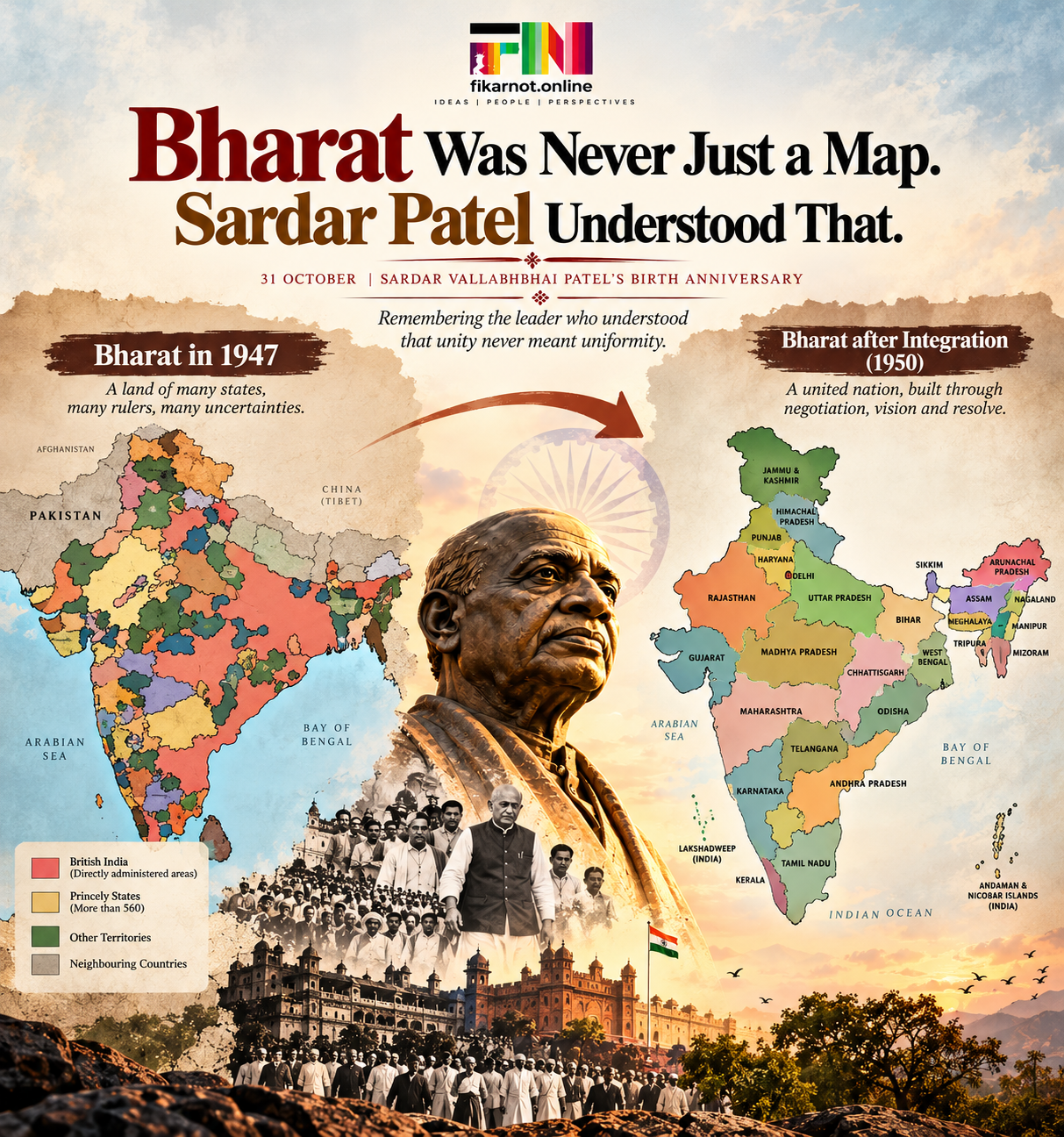
Imagine India in 1947
Today, we open Google Maps and see one India. Maharashtra. Gujarat. Karnataka. Rajasthan. Assam. Kerala. One political Union. It feels obvious. But in 1947, it wasn't. British India existed alongside hundreds of princely states. Their rulers had different interests and different ideas about what should happen after British rule ended. The task of bringing these territories into the new Union was one of the enormous challenges facing independent Bharat. Patel, as Home Minister and the minister handling the States portfolio, became central to that process. Think about the scale of the problem. Imagine starting a college fest and having 10 committees. Now imagine hundreds of powerful stakeholders, each with their own priorities, histories, and egos. And you're trying to convince them: “Guys, we're better off building this together.” Except this isn't a college fest. It's a country. And there is no “let's try again next year.”
But Patel Wasn't Suddenly Born an 'Iron Man'
This is one part of Patel's story we don't talk about enough. Before Delhi. Before the Home Ministry. Before princely states. There was Ahmedabad Municipality. Patel was a successful lawyer. He could have continued comfortably with his legal career. Instead, he increasingly entered public life. In Ahmedabad, his politics became surprisingly practical. Drainage. Sanitation. Water supply.Roads.Schools.Hospitals. Municipal administration.Basically, the stuff we usually find boring until the drainage stops working. As president of the Ahmedabad Municipal Board, Patel pushed town planning and public amenities, and during a plague outbreak, he personally participated in relief and sanitation efforts. That's an important lesson.
Leadership isn't always standing on a stage. Sometimes it's fixing the damn drainage. Patel understood administration from the ground up. Before trying to hold together a country, he had already learned how to make a city work.
And Then Came Bardoli
If you have heard the word “Sardar” all your life, here's something worth knowing: “Sardar” wasn't simply a fancy title given to him by history books. In the Bardoli Satyagraha of 1928, farmers facing an increased land revenue assessment chose Patel to lead them. His organisation, discipline, and leadership turned the movement into a major success. The title “Sardar” became associated with him through the people he led. Contemporary archival research cited by The Indian Express describes how the farmers collectively entrusted him with this leadership.
Think about that. A title that stayed with him for the rest of his life didn't come from a government office. It came from people who trusted him.
The Freedom Struggle Wasn't His Final Chapter
We often remember the freedom movement as the main story. For Patel, independence was almost the beginning of another enormous job. Because getting the British out was one problem. Building a functioning Union was another. Patel worked closely with V. P. Menon on the integration of princely states. The principal legal instrument was the Instrument of Accession, through which rulers initially transferred subjects such as defence, external affairs and communications to the Indian Union. Accession was then followed by the more complicated work of merger and administrative integration.
And this wasn't achieved by one magic speech. There was persuasion. Negotiation. Diplomacy. Political pressure. And, where necessary, the willingness to use force. That is what makes the story interesting. Patel wasn't simply “the strongman.” He was also a negotiator. He knew when to talk. He knew when to wait. And he knew when the situation demanded decisive action.
Unity Didn't Mean Everyone Had to Become the Same
This is probably the most relevant part of Patel's story for today's students. Bharat has never been one giant uniform classroom. We speak different languages. Eat different food. Celebrate different festivals. Follow different customs. Have different regional histories. A person from Kerala doesn't have to become a person from Punjab to be Indian. A Maharashtrian doesn't have to stop being Maharashtrian to be part of Bharat. Unity doesn't require uniformity. That is the interesting idea hidden behind Patel's legacy. The challenge was not to erase differences. The challenge was to create a political framework strong enough to hold those differences together.
The Patel You Probably Didn't Know
Here are a few details that make the man behind the statue more interesting. He was a criminal lawyer before becoming a national leader. He won his first Ahmedabad municipal election by just one vote; the election was later declared void, after which he contested again and won unopposed. During the Gujarat floods of 1927, his relief organisation mobilised volunteers and supplies with remarkable speed. Ahmedabad's Relief Road is linked to Patel's municipal planning; the idea was to create another route as traffic increased on the existing main thoroughfare. And here's another interesting one: Patel's work with cooperative organisation in Gujarat was connected to the development of cooperative thinking that later became important to institutions such as Amul. So the story isn't only about a man who united princely states. It's also about a leader who believed that institutions, administration, and organisation matter.
Maybe That's Why the 'Iron Man' Tag Isn't Enough
“Iron Man” sounds powerful. But it can also make Patel sound like a statue. Cold. Distant. Unchanging. The real Patel was much more interesting. He was a lawyer who entered public life. A municipal leader who dealt with everyday civic problems. A mass organiser who earned the trust of farmers.A freedom fighter. A negotiator. A Home Minister and one of the key figures behind the political integration of the new Union. He wasn't just strong. He was practical. And maybe that's the part young Bharat needs to rediscover.
Because Bharat Is Still a Work in Progress
Remember the Statue of Unity. Remember Rashtriya Ekta Diwas. But maybe also remember the young lawyer who chose public work, the municipal leader who worried about water and sanitation, the organiser who earned the title “Sardar,” and the statesman who faced the enormous question of how a newly independent Bharat could hold together. Because Bharat was never just a map. It was always a civilisation of many identities trying to live within one larger idea. And Sardar Patel understood something remarkably simple: We don't have to become the same to stand together.
We just have to remember what we stand together for.