From Larping to Brainrot: Decoding Gen Alpha Slang and the New Language of Internet Culture.
From Larping to Brainrot: Decoding Gen Alpha Slang and the New Language of Internet Culture.


From Larping to Brainrot: Decoding Gen Alpha Slang and the New Language of Internet Culture.
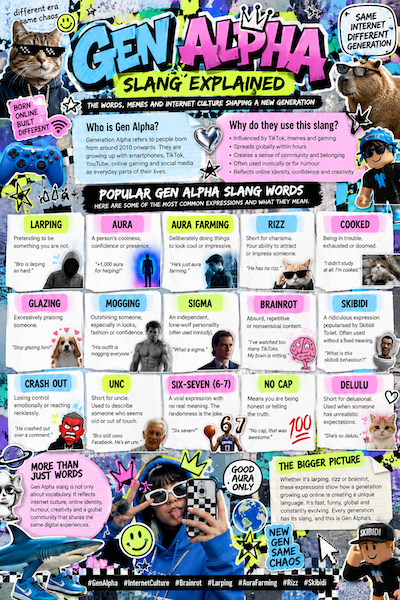
What do words like rizz, aura farming, mogging, cooked and larping tell us about a generation growing up online?
If you have recently come across someone saying "bro is cooked", "stop glazing" or "that's some serious aura farming", you might have wondered when the English language became so confusing. Welcome to the world of Gen Alpha, where a perfectly ordinary conversation can suddenly sound like a collection of TikTok comments.
As someone in my early twenties, I find this shift in internet language quite interesting. I grew up watching internet culture evolve from Facebook statuses, Instagram captions and YouTube comments to short-form videos, viral memes and online communities that create their own vocabulary. However, Gen Alpha seems to have taken this development to another level. Their slang is fast, ironic, exaggerated and, sometimes, completely ridiculous.
Generation Alpha generally refers to people born from around 2010 onwards. They are growing up with smartphones, online gaming, YouTube, TikTok and social media as everyday parts of their lives. Naturally, the language they use reflects these experiences. Their vocabulary is no longer shaped only by conversations at school or among friends. It is influenced by viral videos, influencers, gaming communities and memes that can reach millions of people within hours.
Larping, Aura Farming and the Art of Pretending
One of the more interesting expressions in current internet culture is larping. Originally associated with Live Action Role-Playing, the term has developed another meaning in online conversations. Today, calling someone a larper usually means accusing them of pretending to be something they are not.
Imagine someone constantly presenting themselves as wealthy, mysterious, intellectually superior or emotionally unavailable, despite having very little connection to the image they are trying to create. That is essentially larping.
The expression has become particularly relevant in a social media environment where people carefully construct their online identities. It is increasingly difficult to distinguish genuine personality from a carefully performed version of oneself.
Another popular expression is aura farming. It refers to deliberately doing things that make someone appear cool, confident or impressive. A person walking away from an argument without reacting, wearing an effortlessly stylish outfit or performing an unnecessarily dramatic action might be described as aura farming.
Then there is mogging, which describes outshining someone, particularly in terms of physical appearance, fashion or confidence. Although often used humorously, the term is also connected to online looksmaxxing communities that place considerable emphasis on physical attractiveness.
These expressions reveal something interesting about internet culture. Appearance, confidence and personal identity have become subjects of constant comparison, and younger users have developed an entire vocabulary to make fun of this behaviour.
A Quick Guide to Gen Alpha Slang
Understanding these expressions makes it easier to follow conversations across social media.
Rizz: Short for charisma. It describes someone's ability to attract or charm another person.
Cooked: Used when someone is in serious trouble, exhausted or completely doomed.
Glazing: Excessively praising someone, often without a good reason.
Sigma: Originally associated with the independent, lone-wolf personality. It is now commonly used ironically.
Brainrot: Content or humour that is deliberately absurd, repetitive or nonsensical. It can also describe the feeling of consuming too much internet content.
Skibidi: Popularised by the viral Skibidi Toilet series. It is often used as a deliberately ridiculous expression without a fixed meaning.
Crash Out: Losing control emotionally or reacting recklessly to a situation.
Unc: Short for uncle. Used jokingly to describe someone who seems old or disconnected from current trends.
Six-Seven: A viral expression associated with basketball clips and the song Doot Doot (6 7) by Skrilla. Its appeal largely comes from its randomness.
No Cap: A phrase meaning that someone is being honest or telling the truth.
Lowkey: Something that is slightly, secretly or quietly true.
Delulu: Short for delusional. Often used jokingly when someone has unrealistic expectations or romantic fantasies.
The interesting thing is that these expressions do not always have fixed meanings. Their interpretation depends heavily on context, tone and the online community using them.
Why Does Everything Have to Become a Meme?
One reason Gen Alpha slang spreads so quickly is the changing nature of digital communication. Platforms such as TikTok, YouTube Shorts and Instagram Reels reward content that captures attention within seconds. Short, memorable expressions are particularly useful in this environment.
A phrase can begin as a joke in one online community and become a widely recognised expression almost overnight. It might appear in gaming videos, school conversations, reaction memes and eventually mainstream advertising.
There is also an element of repetition. Internet humour often relies on taking an ordinary expression and using it excessively until it becomes funny simply because it is being repeated. This is particularly noticeable with brainrot content, where absurd characters, strange sounds and nonsensical phrases become recognisable cultural references.
What makes this different from traditional slang is not necessarily the creativity of the words themselves, but the speed at which they travel and the communities that help them spread.
The Psychology Behind Gen Alpha's Internet Language
From a psychological perspective, this shift is worth examining beyond its entertainment value.
Social Identity Theory helps explain why shared slang can become an important part of belonging to a group. People often develop a sense of identity through the communities they associate with. Understanding a particular meme or expression can create a feeling of connection, while not understanding it can sometimes make someone feel excluded.
There is also a connection to impression management. Social media encourages people to present particular versions of themselves. Expressions such as larping and aura farming reflect how users recognise, question and sometimes ridicule these performances.
Irony is another important feature. Many expressions are not intended to be interpreted literally. Calling an ordinary situation skibidi or describing someone as a sigma can be funny precisely because the language is exaggerated and unexpected.
However, it is important not to assume that every member of Gen Alpha communicates this way. Slang differs across regions, schools, interests and online communities. Some expressions also have problematic associations, particularly when they are used to shame people for their appearance or reinforce unrealistic expectations.
Is Gen Alpha Ruining Language or Creating Its Own?
Every generation has had its own vocabulary. Older generations once questioned the slang used by millennials, just