The Thali We Grew Up With: What Should We Order Now?
As cafés, food apps, and global cuisines grow, are we slowly forgetting what a complete Indian meal feels like?


The Thali We Grew Up With: What Should We Order Now?
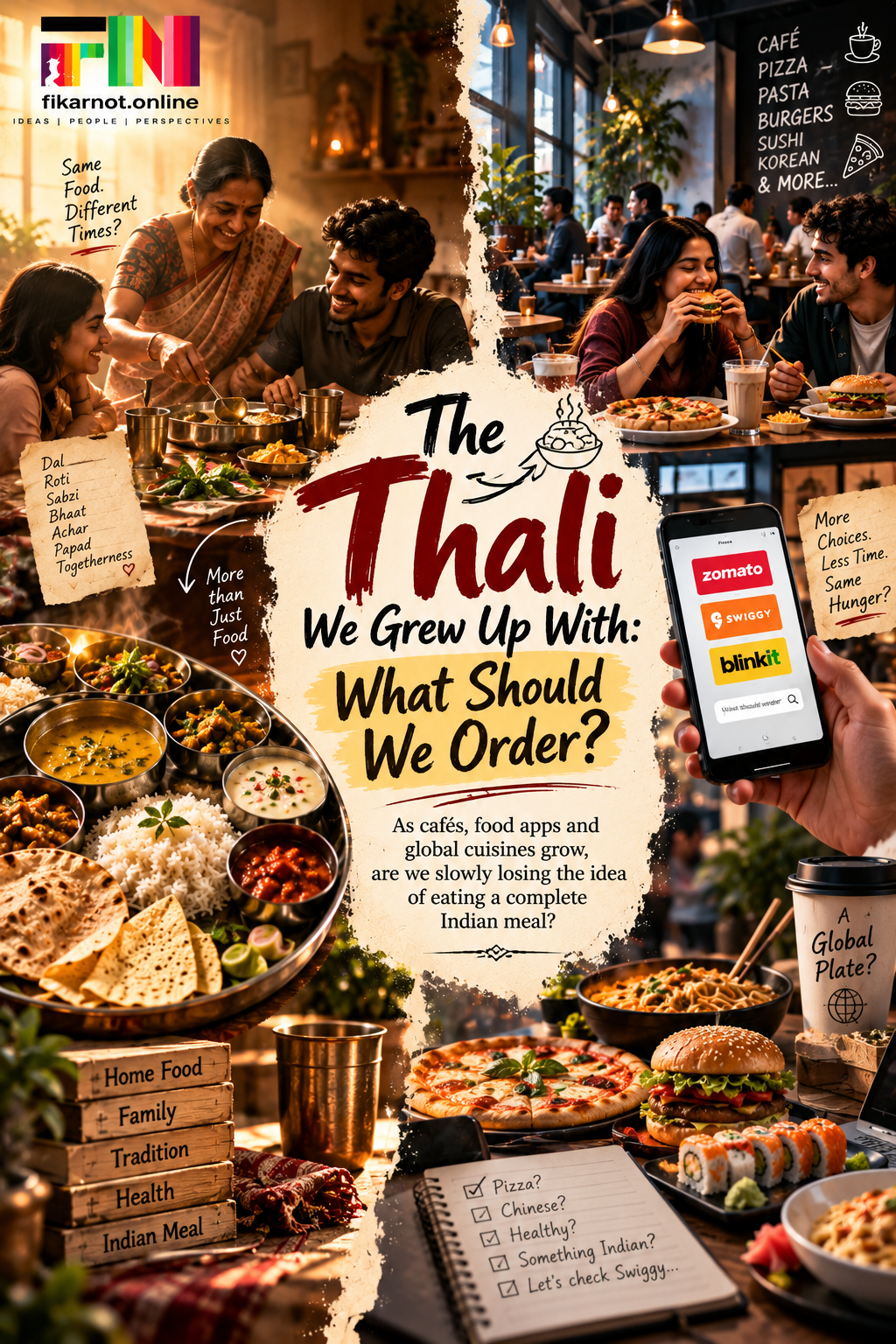
Think about a typical Indian lunch from 15–20 years ago. Roti. Dal. Ek bhaji. Rice. Thoda sa pickle.Maybe papad. And if it was Sunday, something special. Nobody called it a “meal experience.”Nobody took a picture. Nobody rated the plating. It was simply jevan. And somehow, it was complete. Today, things are a little different. We have cafés for coffee, restaurants for pasta, QSRs for burgers, cloud kitchens for literally anything, and food apps that can bring 20 cuisines to your doorstep before you finish deciding what you want.
Convenience has never been this good. But somewhere between “What should we order?” and “Bro, let's try that new place”, something interesting has happened. The Indian meal has become less of a habit and more of an option.
From One Plate to Many Choices
The traditional thali was actually quite a clever idea. It wasn't just a collection of dishes. It had variety. Something spicy. Something mild. Something dry. Something liquid.Something crunchy. Something sweet. Rice and roti. Dal and vegetables. You didn't need to order seven separate things. The meal itself gave you balance. Aaj kal, however, dinner can look very different.
“Tu kya khanar?” “Let's order pizza.” “Pizza nahi yaar.” “Chinese?” “Something healthy?” “Okay, let's check Swiggy.” And 25 minutes later, we are staring at a screen containing 147 possibilities. Choice has exploded. But sometimes, choice itself becomes tiring.
The App Has Changed the Plate
India's food-delivery economy has grown rapidly, and urban consumers are increasingly combining delivery, takeout, and eating out with home cooking. One 2025 consumer study found that 41% of Indian consumers surveyed had ordered takeout and 38% said they ate out at least once a week.
And the numbers tell another interesting story. In 2025, Swiggy recorded about 93 million biryani orders, alongside 44.2 million burgers, 40.1 million pizzas, and 26.2 million dosas. At the same time, regional cuisines such as Pahari, Malabari, Rajasthani, and Malvani were also seeing strong growth. So wait. Are we actually losing Indian food? Not really. We are eating more kinds of it than ever. The real change is how we eat it.
The Thali Was Never Just Food
This is where the story becomes interesting. A thali wasn't only about nutrition. It was about rhythm. Lunch had a time. Dinner had a time. Families sat together. Someone served extra dal. Someone complained that the bhaji was too spicy. Someone stole the last papad. And there was always that one person saying: “Ajun thoda bhaat ghe.” Food was not just something you consumed. It was something you shared. Today, a person can eat dinner alone at 11:30 pm while watching Netflix, replying to WhatsApp, and scrolling Instagram. Technically, you're eating. But is it the same experience?
And Yet, Cafés Aren't the Villain
Let's be fair. Cafés are fun. Global cuisines are exciting. There is nothing wrong with ordering Korean food on Tuesday, Mexican on Friday, and misal on Sunday. In fact, India's food culture has always evolved through exchange. Potatoes, tomatoes, and chillies are ingredients that now feel completely “Indian”- arrived in India from outside. So food culture isn't supposed to remain frozen. And interestingly, today's food revolution is also bringing regional Indian food back into the spotlight. A recent food-industry report noted strong growth in hyper-regional cuisines, while newer consumers are experimenting with everything from Malvani and Rajasthani food to Korean and Mexican cuisines. So maybe the future isn't Indian food vs global food. Maybe it's: Indian food + global curiosity.
But What Happens to Everyday Food?
The bigger concern is not whether people will stop eating dal-rice. They won't. The question is whether everyday cooking slowly becomes a burden. Long working hours. Smaller households. Nuclear families. Living away from home. Two people working full-time. Why spend one hour cooking when an app can bring dinner in thirty minutes? And honestly? Sometimes that's completely reasonable. Life has changed. But convenience has a hidden side effect. When something becomes too easy to replace, we can slowly stop valuing the effort behind it.
Maybe the Thali Doesn't Need Saving
Maybe it simply needs to evolve. A modern thali could look different. A working couple making dal-khichdi together in a hurry. A student eating mess food with friends. A café offering a regional Maharashtrian thali. A young person learning their grandmother's recipe and putting it on YouTube. A restaurant giving forgotten regional dishes a new audience. That's not the death of tradition. That's tradition adapting. Because Indian food has survived precisely because it knows how to change without completely forgetting where it came from.
So, Is the Thali Dying?
Maybe the old format is changing. But the idea behind it? Not yet. Because somewhere, someone is still eating dal-rice after a long day. Someone's mother is still asking, “Jevlas ka?”Someone's grandmother is still making the same recipe she learned decades ago. And someone living 2,000 kilometres away from home is still missing the taste of food that no restaurant can perfectly recreate. Perhaps that's what the thali really represents. Not six bowls arranged perfectly on a steel plate. But the idea that a meal should leave you feeling complete.
We can order anything today. We can taste the world. We can explore cuisines our grandparents had never even heard of. And that's wonderful. But in the middle of all this choice, perhaps we should occasionally return to the simplest question: Not “What can I order?” But— “What does home taste like?”