Why So Many of Us Are Telling Our Feelings to a Chatbot Instead of a Therapist
Why So Many of Us Are Telling Our Feelings to a Chatbot Instead of a Therapist


Why So Many of Us Are Telling Our Feelings to a Chatbot Instead of a Therapist
Be honest, have you ever typed out exactly how you are feeling to an AI at 2am because it felt easier than saying it out loud to an actual person. If yes, you are nowhere close to alone. Scroll through any comment section lately and you will see it everywhere, people saying their AI gets them better than their therapist ever did, or that a chatbot helped them through something real. What used to sound like a joke a few years ago has quietly become an actual coping mechanism for a huge chunk of this generation.
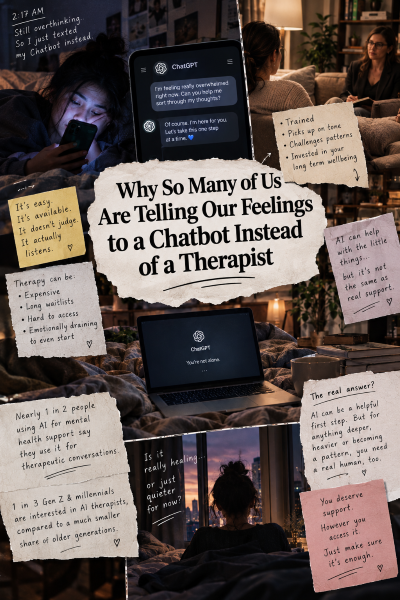
The numbers back this up more than people expect. Nearly half of people using AI for mental health support say they are turning to it specifically for therapeutic conversations, not just venting for fun. And roughly one in three Gen Z and millennials say they are genuinely interested in AI therapists, compared to a much smaller share of older generations who still find the whole idea kind of unsettling. We grew up talking to screens before we grew up talking to therapists, so honestly, this shift tracks.
Here is why it actually makes sense on paper. Therapy is expensive, waitlists are long, and admitting you need help in the first place is already hard enough without the added stress of finding the right therapist, affording sessions, and scheduling around classes or work. An AI is available at 2am when the anxiety spiral hits, it does not judge you, it does not get tired of hearing the same spiral for the fifth time this month, and it costs basically nothing compared to actual therapy. For a generation already stretched thin financially and emotionally, that accessibility is a genuinely big deal.
There is also something about the lack of real time judgment that makes typing feel safer than talking. No facial expressions to read, no pause before someone responds, no fear of being too much for one more person in your life. Sometimes it is just easier to be fully honest with something that has no stake in your life outside of that conversation.
But here is a question worth sitting with for a second. Does feeling heard actually mean you are healing, or does it just mean the discomfort got quieter for a little while. Because those are not always the same thing, even when they feel identical in the moment.
This is where it gets genuinely complicated. AI can reflect your feelings back to you, offer coping tools, and feel comforting in the moment, but it does not actually understand you the way a human who specializes in this does. It cannot pick up on tone shifts the way a trained therapist notices in session, it cannot challenge a thought pattern the way a professional is trained to safely push back on, and it has no real stakes in your long term wellbeing the way a human relationship does. There have already been real, serious cases where people in crisis leaned on AI chatbots instead of getting human intervention, and it did not go the way anyone hoped. That risk is not rare enough to ignore.
So maybe the healthiest answer is not picking one over the other completely. AI can genuinely help with everyday processing, venting, or organizing your thoughts before a real session, almost like a journal that talks back. But for anything heavier, anything that feels like it is becoming a pattern instead of a passing mood, that is exactly where an actual human, trained and present, needs to be part of the picture too.
Needing support is never something to feel weird about, however you access it first. Just remember the goal was never to feel a little better for one night, it was always to actually get better, and that second part usually needs more than a screen can fully give you.