Snakes in the Ganga: Breaking India 2.0?
Who gets to shape the way India understands itself?


Snakes in the Ganga: Breaking India 2.0?
Who gets to shape the way India understands itself? -- Pranay S. Pale
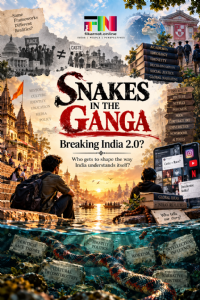
A river can look completely peaceful from the surface. The water flows. People take a dip. Boats move slowly. Life goes on. But what if something is moving underneath? That is the uncomfortable image behind Snakes in the Ganga: Breaking India 2.0. Perhaps the real question isn't about snakes.
It is about ideas.
Because countries can be influenced without being invaded, civilisations can change without a single border being crossed. Sometimes, ideas travel faster than armies. And once they enter universities, institutions, media and popular culture, they can slowly change the way a generation looks at its own society. So, who is shaping the way India understands India?
Breaking India 2.0: What Has Changed?
The earlier idea of “Breaking India” was largely associated with visible fault lines: caste, regional identities, separatism, religious tensions, and social divisions. The newer argument is more subtle. The concern is that the battle has moved from the street to the classroom, the research paper, the institution, and eventually the vocabulary we use to describe ourselves.
Snakes in the Ganga focuses heavily on the influence of Western academic frameworks, particularly Critical Race Theory, identity politics, and what is broadly described as “woke” thought, and argues that these frameworks are increasingly being applied to Indian society.
“The Americanization of Caste,” “Indian Americans Equated with White Racists,” and “Attacking Meritocracy at the Indian Institutes of Technology.” Now, you may agree with that argument. You may strongly disagree. But before taking sides, there is a more interesting question:
Can a framework created to understand one society accurately explain another? Caste Is Not Race. But Can We Compare Them? Take caste. America has its own history of slavery, segregation, and racial discrimination. India has a very different history involving varna, jati, caste hierarchies, untouchability, social exclusion and reform movements. Obviously, the histories are not identical. Yet comparing different forms of inequality isn't automatically wrong.
The problem begins when comparison becomes a shortcut.
For example, American racial categories may help us think about discrimination. But if we simply take the American race-versus-racism framework and paste it onto India's caste history, are we understanding India or making India fit a theory? This is where the debate around “Critical Caste Theory” becomes relevant. The concern is not that Indians should never use Western scholarship.
The concern is: Should an Indian social reality always need an imported intellectual lens before it becomes understandable? Thoda uncomfortable question hai. But uncomfortable questions are usually the useful ones.
Then There Is Harvard. Why does Harvard appear so often in this conversation? Because this isn't really about one university. It is about intellectual authority. A random Instagram account can claim India, and most people will scroll past it. A paper from a globally prestigious university carries a completely different weight. And there is a real example here. Harvard professor Ajantha Subramanian's research examines the relationship between caste, meritocracy, and India's elite engineering institutions. Her book The Caste of Merit argues that the language of merit can sometimes hide the continuing influence of caste privilege within institutions such as the IITs.
Now look at the debate from both sides. One side asks: “Can we really call something pure merit when students have vastly unequal access to schools, coaching, money, and social networks?”
Fair question. The other side asks: “If every achievement is primarily explained through privilege, where do individual talent, discipline, and hard work fit?” Also fair. And this is exactly where India needs better debate, not slogans. Merit and social inequality can both be real. We don't have to erase one to acknowledge the other.
The Bigger Problem: Who Controls the Vocabulary?
Imagine a young Indian discussing caste. They immediately start using words like: privilege, Oppressor, Oppressed, structural power, Intersectionality, Identity. These words can be useful. But language is never completely neutral. The vocabulary we choose influences the questions we ask. If you enter every Indian social problem through the same framework, eventually the framework itself can start deciding what you are allowed to see. History becomes one thing. Religion becomes another. Tradition becomes “oppression.” Community becomes “identity.” Individual achievement becomes “privilege.” And suddenly a complex society becomes a simple equation: oppressor vs oppressed. But India has rarely been that simple. Our society has contradictions within contradictions. A person can be privileged in one context and disadvantaged in another. A community can have a history of oppression and still develop its own internal hierarchies. A tradition can contain something worth preserving and something that desperately needs reform. Reality is messy. Ideology likes clean categories.
But Let's Not Make the Opposite Mistake
Scholar Dheepa Sundaram, for example, criticised the book's framing and argued that its decolonial language could deflect attention from uncomfortable questions around caste and discrimination. Malhotra rejected that criticism and argued that Indian social problems can be examined through frameworks rooted in India's own intellectual traditions.
Good. Let the argument happen. Because the answer to bad ideas is not censorship. It is better ideas. India Has Never Been Afraid of ideas. This is something we sometimes forget. India has never been an intellectual bunker. Indian mathematics travelled across civilisations. Buddhist thought travelled across Asia. Persian influences became part of Indian language and culture. Western science entered Indian education. Democracy, constitutionalism and modern institutions became part of independent India. We absorbed. We debated. We adapted. We rejected some things. We transformed others. So “foreign” does not automatically mean “dangerous.” The better principle is: Learn from everywhere. Depend on nowhere. That's what civilisational confidence should look like.
The Battle Is No Longer Just in Universities
A Civilisation Must Be Able to Describe Itself
This, ultimately, is where the conversation becomes bigger than Snakes in the Ganga. A civilisation isn't protected only by armies. It is also protected by its ability to describe itself. Who tells its history? Who defines its categories? Who decides what is progressive? Who decides what is backward? Who decides which traditions deserve criticism and which deserve preservation? And perhaps most importantly: Can we make those decisions ourselves? India should be confident enough to say: “Yes, this tradition needs reform.” And also: “Yes, this tradition has wisdom worth preserving.” It should be able to say: “Yes, caste discrimination must be confronted.” And: “Yes, caste cannot simply be reduced to an American racial template.” It should be able to listen to Harvard. And then disagree with Harvard. It should be able to listen to its own civilisational thinkers. And disagree with them too. That is intellectual independence.
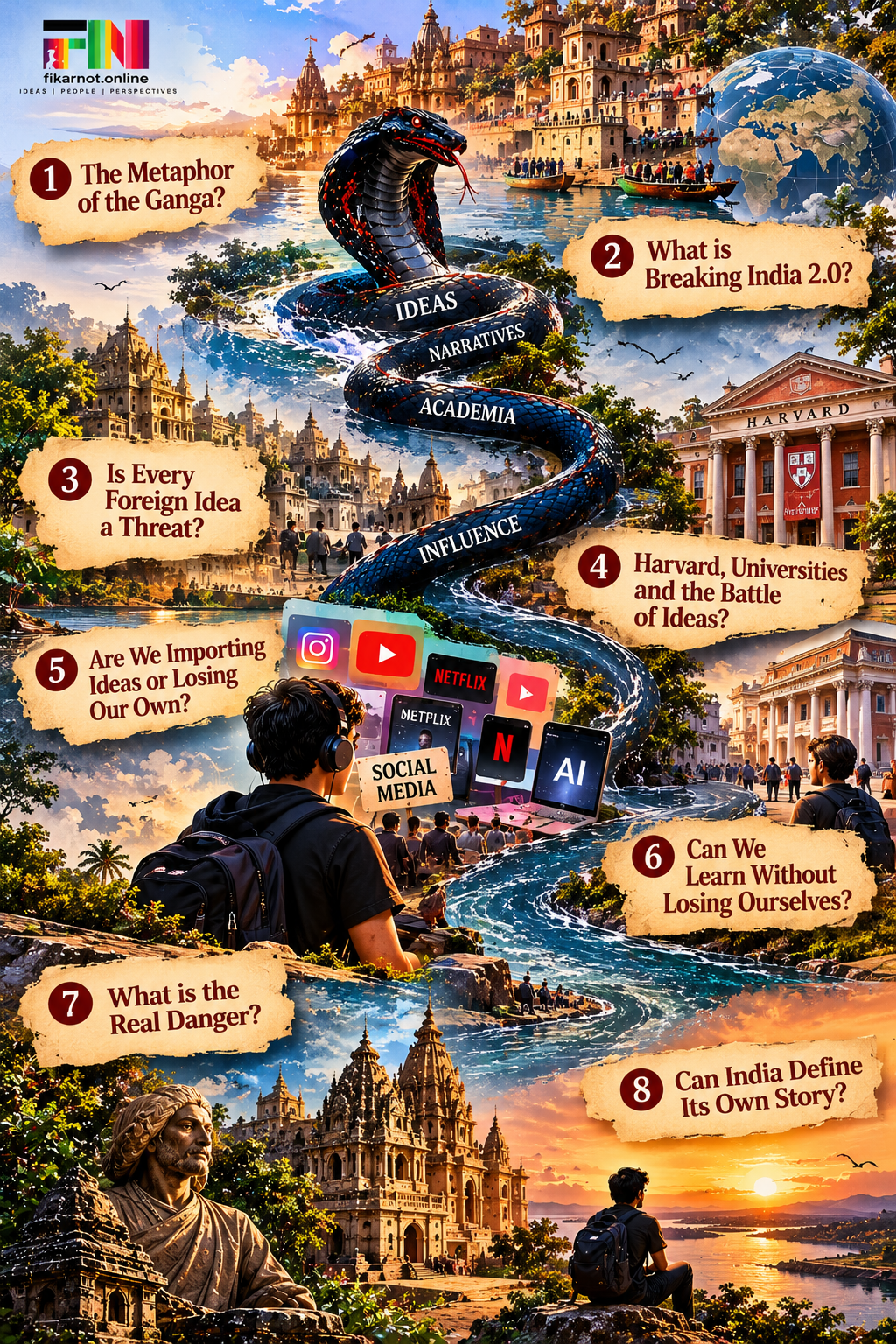
So, Are There Really Snakes in the Ganga?
Maybe. Maybe some are real intellectual pressures. Maybe some are simply shadows created by political fear. Maybe some imported theories genuinely help India understand problems it has struggled with. Maybe some don't fit. Maybe the truth lies somewhere in between. And perhaps that's exactly why this debate matters. Don't blindly worship the West. Don't blindly reject the West.
Question everything. Because civilisational confidence isn't the refusal to learn. It is the confidence to learn without losing yourself. Maybe the real question isn't: “Is the West trying to destroy India?”
Maybe it is:
“Can India become confident enough to engage with the world without outsourcing the definition of India to the world?” Because a civilisation that cannot tell its own story will eventually have someone else tell it for them. And perhaps the smartest response is not to fear every snake.
It is to learn how to recognise one.