Why Our Minds Play Tricks on us with Psychology.
Why Our Minds Play Tricks on us with Psychology.


Why Our Minds Play Tricks on us with Psychology.
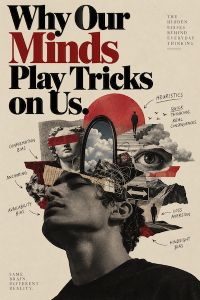
Every day we believe we make choices with a clear and rational mind. Psychology tells a different story. In the 1970s Daniel Kahneman and Amos Tversky showed that human thinking leans on mental shortcuts called heuristics. These shortcuts save time and effort but they also produce predictable errors known as cognitive biases. As a psychology student I find this idea both humbling and exciting. The mind is not a camera that records the world exactly as it is. It is an editor that cuts and rearranges reality before we ever see it. Kahneman went on to win the Nobel Prize in Economic Sciences in 2002 even though he was a psychologist and not an economist. That fact shows how deeply the study of the mind reaches into money and law and medicine and politics. Understanding bias is not a niche hobby. It is a way of understanding why people behave the way they do in every part of life.
Some biases are so common that we live inside them without noticing. Confirmation bias makes us search for information that supports what we already believe and ignore what does not. This is why two people can scroll the same feed and walk away with opposite convictions. Anchoring bias shows up when the first number we hear shapes every judgment that follows. A shirt marked down from three thousand rupees to one thousand feels like a bargain even if it was never worth more than eight hundred. The availability heuristic makes us judge how likely something is by how easily examples come to mind. After watching news about a plane crash many people feel flying is dangerous even though the road is far riskier. The sunk cost fallacy keeps us sitting through a bad film simply because we already paid for the ticket.
Kahneman explained all this through two modes of thinking in his book Thinking Fast and Slow. System 1 is quick and automatic and emotional. System 2 is slow and effortful and logical. Most of life runs on System 1 because System 2 is tiring to use. Students see this clearly during exams. We feel sure of an answer in a flash and only later discover that a careful reading would have changed it. Hindsight bias adds another layer. Once we know an outcome we convince ourselves that we saw it coming all along. Overconfidence then grows from that false memory and we walk into the next decision feeling even more certain. The danger of bias is not that we are foolish. The danger is that we feel completely certain while being wrong.
The good news is that awareness helps even if it cannot erase the problem. We can slow down before big decisions and ask what evidence would prove us wrong. We can invite friends or mentors to challenge our reasoning. We can write down our predictions and check them later to see how often we were right. Teams can appoint someone to argue the opposite side so that weak ideas get tested before they cause damage. None of this makes the mind perfect but it makes it more honest. Understanding cognitive bias taught me a quiet lesson. Wisdom is not about having no blind spots. It is about knowing roughly where they are and having the humility to look there first.