"Log Kya Kahenge": How Society Silences Women After Molestation, Assault and Rape
"Log Kya Kahenge": How Society Silences Women After Molestation, Assault and Rape


"Log Kya Kahenge": How Society Silences Women After Molestation, Assault and Rape
Content note: this article talks about sexual violence in a non graphic way. Please read it gently, and step away whenever you need to.
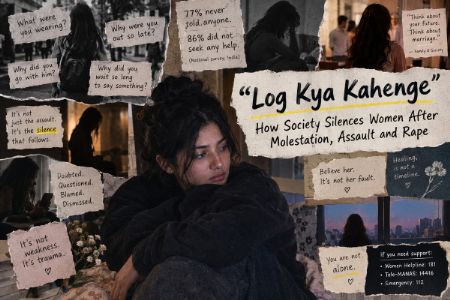
Imagine carrying something so heavy that you cannot set it down, and being told every day to smile and keep walking. For many women who have survived molestation, sexual assault or rape, that is not a metaphor. It is a Tuesday. The assault is often only the first harm. The second one is the silence that follows, and that silence is rarely a personal choice. It is built, carefully and quietly, by the world around them.
Think about the questions a survivor learns to expect before she even speaks. What were you wearing. Why were you out so late. Why did you go with him. Why did you wait so long to say something. Each one carries the same hidden message, that she is somehow responsible for what was done to her. When a person has already spent months blaming themselves, hearing it from others can feel like confirmation. So she stays quiet, not because nothing happened, but because speaking feels more dangerous than silence.
Then there is the pressure of reputation. In many families, a woman's "izzat" gets tied to what happens to her body, as if she is a symbol of the family instead of a person. The fear of "log kya kahenge" can push relatives to say, "let it go, think about your future, think about marriage." It is often said out of fear, not cruelty. But the result is the same. The survivor learns that protecting appearances matters more than her pain. In some cases the person who harmed her is someone the family knows and trusts, which makes speaking up even harder.
The numbers hint at how deep this silence runs. In a national survey of women in India who had experienced physical or sexual violence, about 77 percent never told anyone about it, and around 86 percent did not seek any help. Researchers also point out that police statistics are only a partial picture, because stigma and fear of reprisal keep many cases from ever being filed. Behind each of those percentages is a person who decided it was safer to carry it alone.
And for those who do speak, the process can be its own ordeal. Being doubted, asked to retell the story again and again, facing delays, or watching people take sides. Some are told to settle, to marry the person, or to forget it. Others are quietly pushed out of friend groups or workplaces. When the response to telling the truth is more pain, silence starts to look like survival.
Then comes the expectation that hurts the most, that she should simply move on. It is usually framed as kindness. "It happened a long time ago." "Be strong." "Don't let it ruin your life." But healing does not run on other people's timelines. Many survivors live with anxiety, trouble sleeping, difficulty trusting, feeling unsafe in their own body, guilt that is not theirs to carry, or a heaviness that comes without warning. Some days they feel fine, and then a smell, a place or a word brings it all back. That is not weakness. It is how the mind and body respond to being harmed.
So, is moving on really that easy. No, and it should not be treated as a test of strength. Moving forward does not mean forgetting, and it does not mean being okay by a certain date. Healing is uneven. Some people find it through therapy, some through trusted friends or family, some through writing or movement, and some simply through being believed. And no survivor is obligated to report, to tell anyone, or to explain herself. Choosing when and whether to speak is her right.
If someone ever confides in you, you do not have to say the perfect thing. Believe her. Tell her it is not her fault. Listen without asking why or how. Let her decide what happens next. A calm, steady "I am here, and I believe you" can matter more than any advice.
And for the rest of us, the work is to change what we say at dinner tables, in group chats and in comment sections. Stop asking what she wore. Start asking why anyone thought they could do this.
If any of this feels close to home, you are not alone and it was not your fault. You can reach out to someone you trust, a counsellor, or support lines such as the Women Helpline (181), or Tele-MANAS (14416) for free mental health support. In an emergency, call 112.