Blind Admiration: The Danger of Glorifying Wrongdoers
Why Social Media Trends Can Make Us Overlook Wrongdoing and Glorify Flawed Individuals


When Admiration Becomes Blindness: The Danger of Glorifying Wrongdoers
Sahil Sharma
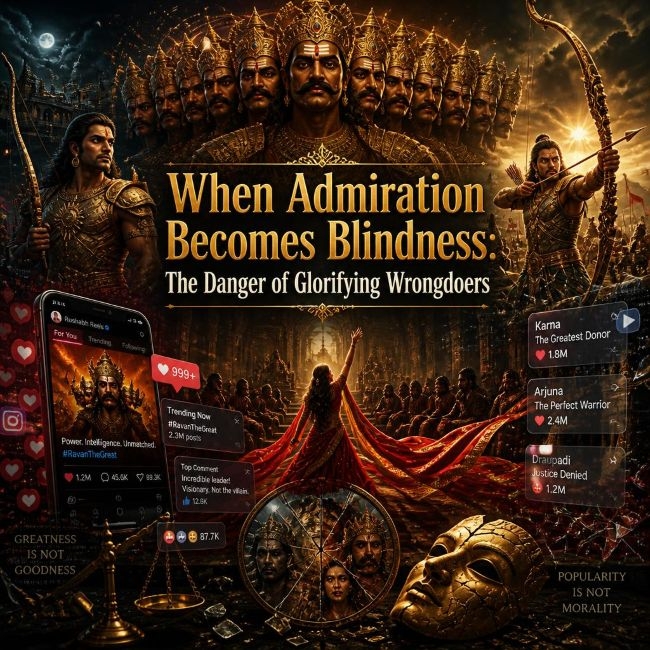
Blind admiration can influence how we judge people, especially when social media trends encourage us to glorify individuals without questioning their actions.
Recently, I wrote a few articles on AI from a student’s point of view. This one is different. It isn’t about algorithms or technology. It is about something happening on our screens, and in our minds, every single day.
It began on Dussehra evening. I had woken up late from a nap, the day hadn’t been very productive, and I was scrolling through Instagram stories. Then I saw one from my cousin: an AI-edited photo of himself standing with folded hands in front of Ravana, captioned “Jai Dada Ravan.” I come from Haryana, where Brahmins are respectfully addressed as “Dada,” so the caption was meant as reverence. My first reaction was anger. I typed a harsh message, then deleted it, and decided to talk to him in person. But that pause made me realise the issue was bigger than one story.
The Trend Problem
On social media, whatever trends, people follow, right or wrong. Algorithms reward what is catchy, not what is correct. A bold contrarian take like “everything you were taught about Ravana is wrong” travels faster than the honest, boring truth. And once a trend picks up speed, very few people stop to ask whether it deserves to be followed.
My cousin says Ravana was a learned Brahmin and a devoted follower of Lord Shiva. That is true, and truth should be accepted even when it comes from a villain. But there is a second half we conveniently skip: Ravana abducted Sita by deceit and held her captive in Lanka. A man who kidnaps a woman is not a hero, no matter how many scriptures he knew.
Some defend him by saying, “He never touched her.” This is exactly the kind of justification that bothers me. When a wrong act needs to look acceptable, people search for a technicality. But the crime is the kidnapping and the imprisonment. It does not shrink because it could have been worse.
The Karna Example
A few months ago, my feed was full of reels calling Karna the “GOAT,” usually in the Karna vs. Arjun debate. Yes, he was an exceptional archer, perhaps Arjun’s equal. Yes, he was famous for his generosity. Those qualities are real, and nobody should deny them.
But where was Karna when Draupadi was being humiliated in the royal court? He stood with those who did it, and he watched. Can someone who supports injustice at the moment it matters most be called the greatest?
Greatness is not measured by skill or charity alone. It is measured by what you do when your values are tested. And Karna is not the only one. Characters like Duryodhan and many others are also being repackaged as “misunderstood” or “loyal” figures, with their good traits highlighted and their worst deeds quietly pushed aside.
The Modern Version
This is not only about mythology. Think of any public figure who donates generously or makes entertaining content, yet cheats or harms the people who trust him. His supporters say, “But look at all the good he has done.”
If that logic works, then every wrongdoer simply needs a few good deeds as a shield. We would never accept this excuse in our own lives, so why do we accept it for characters we like?
Appreciate, But Don’t Glorify
I am not saying we should erase the good in anyone. Ravana’s knowledge and Karna’s generosity are worth studying. A mature mind can say, “This person had remarkable qualities, and he also did something unforgivable.” Both can be true at once.
What we must not do is let the good become a shield for the bad. Admiring a quality is one thing. Worshipping the whole person is another.
I believe in a simple idea: wrong is wrong, even if the person did some things right. In the end, karma is not calculated on selective highlights. It is calculated on the whole account.
A Note to My Generation
We are the first generation raised on endless short videos and AI-generated images. It has never been easier to create a flattering edit of a villain or a convincing version of history. That makes thinking for ourselves more important, not less.
Before we repost, share, or caption something, we should ask: is this actually true, or is it just trending?
Questioning a trend does not make us outdated. It makes us responsible.