The People Who Make Life Beautiful
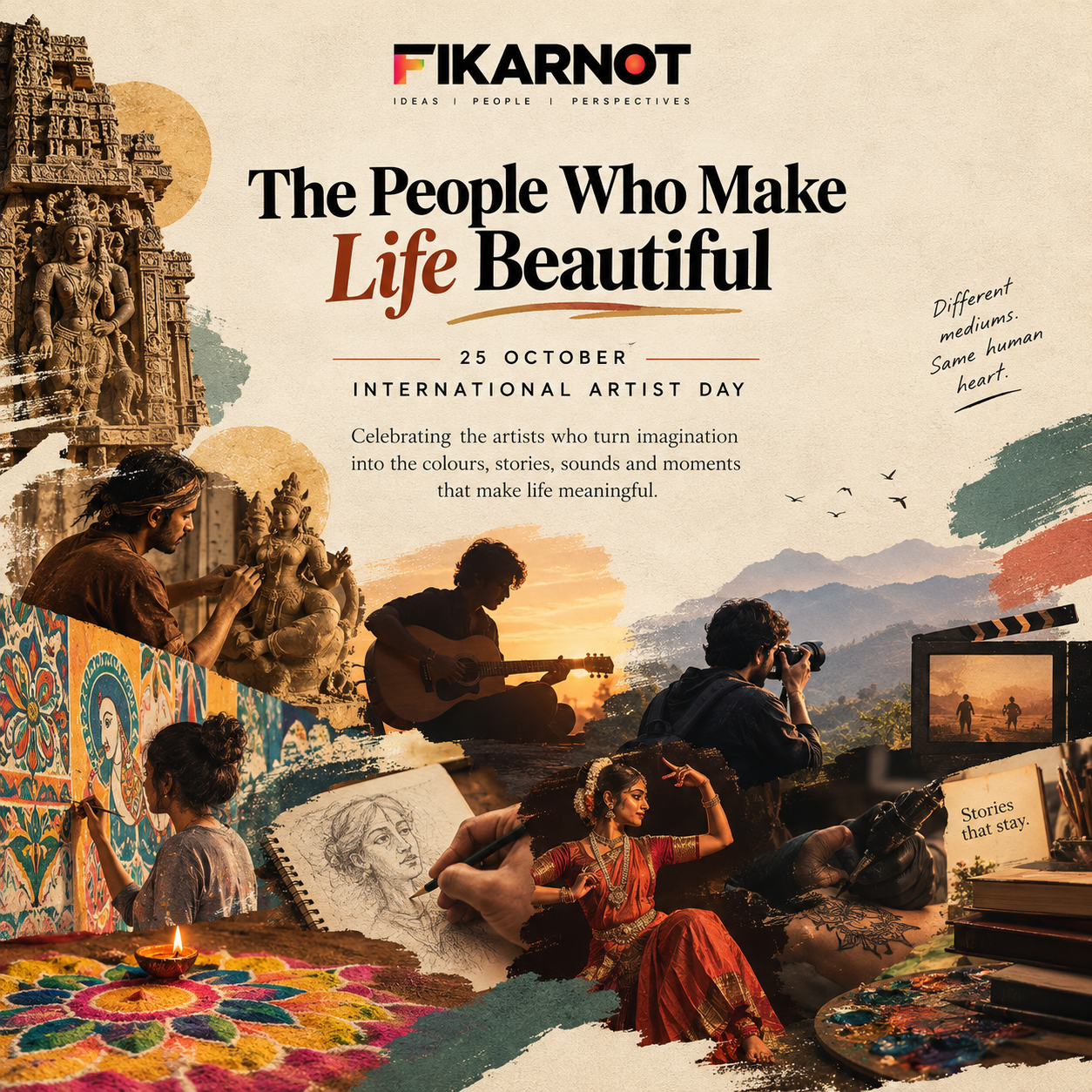
25 October | International Artist Day — Celebrating the artists who turn imagination into colours, stories, sounds, and moments that make life meaningful.


The People Who Make Life Beautiful
25 October | International Artist Day — Celebrating the artists who turn imagination into colours, stories, sounds, and moments that make life meaningful.
Think about the last time something beautiful made you stop. Maybe it was a Durga idol whose eyes looked almost alive. Maybe it was a song you played on repeat because somehow the lyrics said exactly what you couldn't.
Maybe it was a photograph from a trip that made you want to go back.
Maybe it was a beautifully painted wall you passed every morning without knowing who painted it.
Or maybe, years ago, a schoolteacher put a pencil in your hand and said,
“Draw whatever you want.”
You probably don't remember the pencil.
But you remember what you drew.
That is the strange power of art.
It enters our lives so quietly that we often don't notice it.
Today, on International Artist Day, perhaps we should.
Because artists don't simply make things beautiful.
They give shape to feelings, memories, ideas, and imagination.
And in a civilisation like India, that role has always been much bigger than aesthetics.
India Has Never Seen Art as “Just Art”
Walk into an old Indian temple.
Look at the sculptures.
Look at the walls.
Look at the pillars.
Look at the dancers carved into stone, the stories from epics, the animals, musicians, gods, and ordinary people.
Ask yourself something:
Were these created simply to decorate a building?
Probably not.
For centuries, Indian art has been a way of telling stories, expressing devotion, preserving knowledge, and connecting generations.
Before smartphones, before printing presses, before cinema, before social media, people still had stories to tell.
And artists helped tell them.
A sculpture could communicate a story to someone who could not read.
A temple wall could preserve a tradition.
A folk song could carry the memory of a community.
A dance could transmit a story from one generation to the next.
A painting could capture an entire worldview.
In that sense, artists were not merely creators.
They were civilisational storytellers.
Look Around. Art Is Still Everywhere.
Look around your own neighbourhood.
The person making a Ganpati idol months before Ganesh Chaturthi.
The woman creating an intricate rangoli outside her house.
The photographer standing in the middle of a wedding, trying to capture one moment that a family will keep for decades.
The tattoo artist turning someone's memory into a permanent image.
The musician practising the same four lines until they finally sound right.
The local theatre group rehearsing in a small hall with almost no audience.
The designer sitting in front of a laptop, moving a logo two pixels because “something doesn't feel right.”
The child drawing a house with five windows, three trees, and a sun much bigger than the house.
All of them are creating.
And creation is one of the most human things we do.
Remember That One Song?
There is probably a song that immediately takes you somewhere.
A school farewell.
Your first college trip.
A breakup.
A friendship.
A festival.
A person you don't talk to anymore.
The song may be ten years old.
But the moment isn't.
That is what a musician can do.
They can take something as ordinary as sound and attach it to a memory.
Years later, a few seconds of that song can bring an entire chapter of your life back.
The artist created the music.
But you created the memory around it.
And this is where art becomes more than entertainment.
It becomes part of how human beings remember.
From Cave Walls to Instagram Reels
Human beings have been making art for thousands of years.
We painted on cave walls before we had written histories.
We carved stories into stone before we had cameras.
We sang before we had recording studios.
We danced before we had stages.
The tools changed.
The instinct didn't.
Today, the canvas might be a phone screen.
The brush might be a stylus.
The gallery might be Instagram.
The audience might be sitting on the other side of the world.
But the basic human impulse remains the same:
“I saw something. I felt something. I imagined something. I want someone else to see it too.”
That is what connects a prehistoric drawing to a digital illustration.
Different technology.
Same human instinct.
We Make the Artwork Famous. We Forget the Artist.
Recently, beautiful Durga idols have been going viral across social media.
People zoom in on the eyes.
They admire the expressions.
They share reels.
They write:
“Sakshat Maa Durga!”
And they aren't wrong.
Some of these idols really are extraordinary.
But behind every viral idol is an artisan who may have spent months getting that one expression right.
Someone shaped the face.
Someone painted the eyes.
Someone created the jewellery.
Someone decided exactly how the Goddess should look.
And sometimes that person comes from a family where the same craft has been passed down for generations.
We celebrate the final image.
But the hands behind it remain invisible.
This is not a new problem.
Civilisations often remember the monuments and forget the hands that built them.
We remember masterpieces.
We sometimes forget the craftsmen.
International Artist Day gives us a chance to reverse that habit.
Don't just admire the creation. Remember the creator.
Art Is How a Civilisation Remembers Itself
Think about what would happen if every artist disappeared tomorrow.
No photographs.
No films.
No music.
No paintings.
No sculptures.
No theatre.
No folk performances.
No stories.
We would still have technology.
We would still have buildings.
We would still have economies.
But something essential would disappear.
Because civilisation is not only about what human beings build.
It is also about what they remember, what they believe, what they imagine and what they choose to pass on.
Art carries all four.
That is why a folk song can matter.
That is why a traditional dance matters.
That is why a family of sculptors continuing an old craft matters.
That is why a rangoli made outside a house matters.
They may appear small.
But civilisations survive through thousands of such small acts of continuity.
And Yet, We Often Ask Artists: “Is It a Real Career?”
There is an irony here.
We proudly celebrate India's artistic heritage.
We speak about our classical traditions.
We photograph our temples.
We admire handicrafts.
We share beautiful artwork online.
But when someone actually says,
“I want to become an artist,”
the response can quickly become:
“But what will you do for a living?”
Of course, artists need financial stability.
Talent alone does not pay rent.
But perhaps we should stop treating artistic work as something less serious simply because it is creative.
An artist is also a professional.
A sculptor has a skill.
A musician has trained.
A dancer has rehearsed for years.
A photographer has developed an eye.
A designer solves problems visually.
A writer works with language.
Creativity does not mean the absence of work.
Often, creativity is the result of years of disciplined work that nobody sees.
You Don't Have to Be “An Artist”
And you don't have to be Picasso to create something.
Draw something.
Write something.
Take a photograph.
Learn a dance.
Play an instrument.
Make a terrible painting.
Write a terrible poem.
Try again.
Because somewhere along the way, adulthood teaches us to ask:
“What is the use?”
Children don't ask that.
They create because they want to.
Maybe we should occasionally do the same.
Not everything we love has to become a business.
Not everything we create has to become content.
Not everything needs likes.
Some things can simply belong to us.
Perhaps This Is Why Artists Matter
An artist looks at something ordinary and says:
“I see something more here.”
A blank canvas becomes a story.
Clay becomes a Goddess.
A camera becomes a memory.
Words become an emotion.
Movement becomes dance.
Sound becomes a feeling.
A wall becomes a painting.
And across generations, these creations become something even bigger.
They become memory.
They become identity.
They become culture.
They become part of how one generation speaks to another.
That is the civilisational power of art.
So today, don't just wish an artist “Happy International Artist Day.”
If you know an artist, tell them what their work meant to you.
Share their work.
Buy something they created if you can.
Give them credit.
Visit a local exhibition.
Listen to an independent musician.
Watch a local theatre performance.
Or simply pick up a pencil and create something yourself.
Because art is not some luxury added to life after everything important is finished.
Art is one of the things that makes life worth remembering.
Our monuments may tell us where a civilisation stood.
Our books may tell us what it thought.
But its art tells us what it felt.
And perhaps that is why artists matter.
They don't merely add beauty to the world.
They help a civilisation remember who it is.
And they help the rest of us notice that the world was beautiful in the first place.
-Pranay S. Pale