Are We Becoming Too Convenient in Our Relationships?
Always available when it suits us, emotionally absent when it doesn"t.


Are We Becoming Too Convenient in Our Relationships?
Always available when it suits us, emotionally absent when it doesn't.
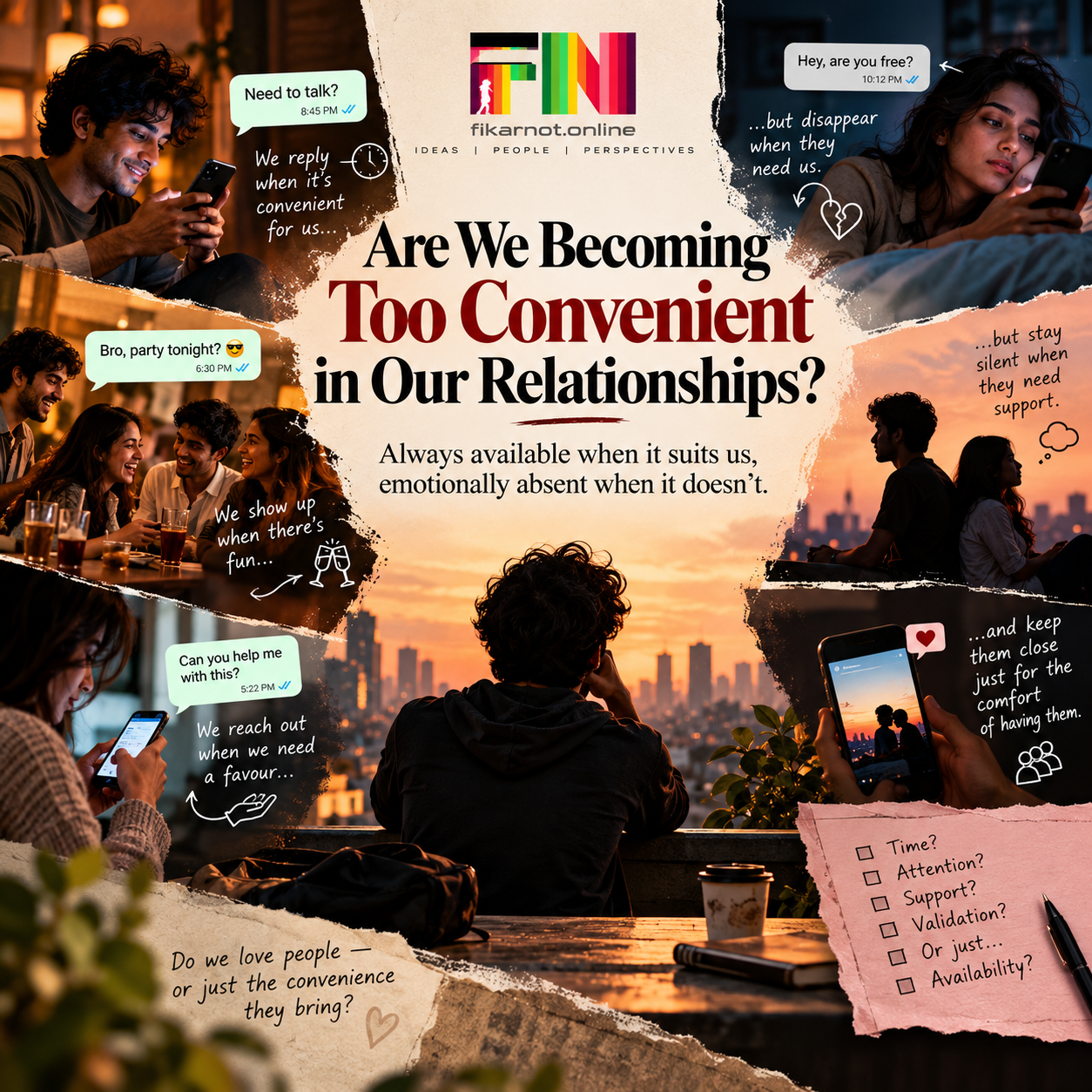
A strange habit is quietly growing in our relationships. We want people to understand our busy schedules. We want them to respect our space. We want them to reply when we need them. We want them to be there when we are lonely. But when they need the same things from us? Suddenly, we are busy. Maybe we are becoming too convenient in our relationships. Not necessarily cruel. Not necessarily selfish. Just… convenient. We keep people close when they fit comfortably into our lives, and we create distance when they demand time, attention, patience, or emotional effort. And perhaps the uncomfortable question is:
Do we love people or do we sometimes just love the convenience of having them?
The “I'll Call You When I'm Free” Relationship
Take something very ordinary. You message a friend: “Bro, free ahes ka? Need to talk.” They don't reply. Two hours later: “Sorry yaar, was busy.” Fair enough. Everyone gets busy. But then you need something from them. Suddenly, they are available. You need advice. You need a favour. You are bored. You want company. You need someone to listen. And you expect them to pick up. The problem isn't being busy. The problem is expecting emotional availability from people while offering them only leftover availability in return. Relationships can't always be perfectly equal. But they cannot always be one-way either.
The Partner We Remember When We're Lonely
Dating makes this even more interesting. You have had a terrible day. You want someone to talk to. You call your partner. You want reassurance. You want attention. You want them to listen. But when their day has been terrible? You are suddenly tired. “Can we talk tomorrow?” Sometimes, of course, tomorrow really is better. But if “tomorrow” becomes a permanent answer, something has changed. A relationship isn't just having someone available when you need emotional support. It is also occasionally becoming that person when they need it. Otherwise, the relationship slowly becomes a service. One person provides comfort. The other consumes it.
The Friend Who Exists Only When There Is a Plan
We all know this person. They don't call for months. They don't ask how you are. They don't know what's happening in your life. But suddenly: “Bro, party tonight?” “Coming for the trip?”Need one favour.” And somehow, the friendship becomes active again. We laugh about it. “Arre, this guy only remembers me when he needs something.” But maybe we should ask ourselves:
Are we doing the same thing to someone else? Perhaps not with money. Perhaps not with favours. Maybe we only message certain people when we need entertainment. Maybe we call someone only when our other friends are unavailable. Maybe we keep someone emotionally close because it feels good to know that someone is always there. That is also a form of convenience.
The Backup Person
Modern dating has created another uncomfortable possibility. The backup person. You aren't really together. You aren't really apart. You don't commit. You don't completely disappear either. You reply occasionally. You react to stories. You send a “Hey, long time!” You keep the connection alive just enough. Why? Because you don't want them. But you also don't want someone else to have them. This isn't always intentional. Sometimes people genuinely don't know what they want. But sometimes we keep people around because having options feels safer than making a decision. And a person is not an option. They are a person.
“I Need Space” Is Not the Same as “I Don't Care”
There is an important distinction here. Being unavailable sometimes is normal. Having boundaries is healthy. Not replying immediately doesn't mean you don't care. You don't have to answer every call. You don't have to be emotionally available 24/7. You are allowed to say: “I can't talk right now.” You are allowed to protect your time. You are allowed to have a life outside your relationship. The problem begins when your boundaries exist only for you. You want your partner to respect your space. But you become angry when they need space. You want understanding for your silence. But you interpret their silence as rejection. You want them to forgive your mistakes. But you remember theirs forever. That's not a boundary. That's convenience wearing the clothes of self-care.
Social Media Has Made This Even Stranger
We can now maintain relationships without actually participating in them. A birthday story. A heart reaction. A heart on someone's photograph. A reel sent at midnight. “Brooo smiley. And suddenly we feel like we are still connected. But sometimes, a reaction is easier than a conversation.
A like is easier than asking: “How are you actually doing?” We have never had so many ways to stay connected. And yet, genuine emotional presence can feel increasingly rare.
Maybe We Don't Want Relationships. We Want Access.
This may be the harshest question. Do we want people in our lives? Or do we simply want access to them? Access to their attention. Access to their affection. Access to their advice. Access to their body. Access to their social circle. Access to their emotional support. And when we don't need these things? We disappear. Then return whenever convenient. A relationship becomes transactional without ever discussing the transaction.
But Convenience Isn't Always Bad
This is where we need to be fair. Life itself is inconvenient. People have jobs. Exams. Families. Mental exhaustion. Different schedules. Different priorities. You cannot measure love by response time. Someone can love you deeply and still miss your call. Someone can care about you and need three days alone. Someone can be your closest friend and not speak to you every day. Consistency does not mean constant availability. The question is not: “Are you always there?” The better question is: “When it really matters, do you make an effort to be there?” That's the difference.
Relationships Need Effort, Not Performance
We have become very good at performing relationships. Posting birthdays. Uploading anniversary stories. Sharing friendship reels. Writing “my person with an emoji heart.”But real relationships are usually much less Instagrammable. They look like calling someone after a difficult day. Remembering something they told you three weeks ago. Checking on a friend without needing anything. Sitting silently with someone who doesn't know what to say. Apologising even when your ego doesn't want to. Making time when it isn't convenient. And sometimes simply saying: “I don't have the energy today, but I don't want you to think I don't care.” That one sentence can save more relationships than a hundred romantic posts.
So, Are We Becoming Too Convenient?
Maybe. But perhaps the answer isn't to become available to everyone all the time. That's impossible. The answer is to become more intentional. If someone matters, let them know. If you need space, communicate it. If you cannot show up, don't pretend you can. If a friendship has become one-sided, acknowledge it. If you don't want a relationship, don't keep someone hanging because you enjoy their attention. And if someone has been there for you repeatedly, don't remember them only when you need something. Because eventually, people notice patterns. They notice who calls. Who disappears. Who returns only when lonely. Who listens. Who remembers. Who asks for everything but gives little. And sometimes, people don't leave because they stopped caring. They leave because they finally understood that they were only convenient. Maybe that is the question worth asking ourselves tonight: If we stopped needing something from the people around us, would we still choose to keep them in our lives? Because real relationships are not built around convenience. They are built around choice. Choosing to stay. Choosing to listen. Choosing to make an effort.
Even when it isn't convenient.
-Pranay S. Pale