The Underrated Sense That Can Calm Your Mood.
The Underrated Sense That Can Calm Your Mood.
|


The Underrated Sense That Can Calm Your Mood.
-Maitrayee Repal
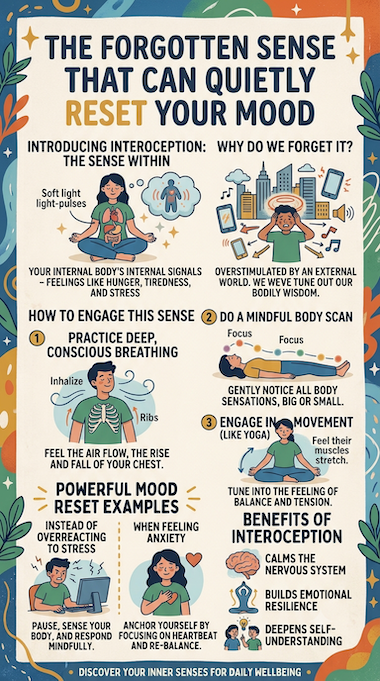
Most conversations about mental wellbeing start with thoughts. We talk about reframing worries naming emotions and challenging the voice in our heads. These ideas are useful but they leave out a simple fact. The mind lives inside a body and the body meets the world through the senses. One sense gets far less attention than the others and it may be the most underrated tool for calm mood. That sense is smell. Signals from the nose travel to brain regions tied to emotion and memory by a short route with very few stops. This helps explain why the scent of rain on dry soil or a spice from a family kitchen can carry a person back to childhood in less than a second.
Psychologists have studied this link between odour and personal memory for decades. Memories sparked by a scent often feel more vivid and more emotional than those sparked by words or pictures. For anyone managing stress this opens an unusual door. Instead of arguing with an anxious thought a person can change the sensory backdrop of the moment. Picture a student who studies in the same room where worry has built up for weeks. The air itself carries no signal that anything is different. Now imagine that the same student lights a particular candle or brews a particular tea only during slow evening breaks. After enough repetition the smell becomes a cue that tells the mind it is safe to ease off. The scent is not magic.
Its power comes from repetition and from the calm that gets paired with it. This is the same logic behind any habit cue. It also explains why a scent chosen by the person usually works better than an expensive one chosen by someone else. Personal association matters far more than the price or the label on the bottle. Even everyday chores can serve this role. The smell of fresh laundry or ground coffee at a fixed time of day can mark the line between work and rest. The effect can also travel. A small cloth or balm with the same scent can bring a thread of home to a hostel room or an exam hall. There are limits worth stating plainly. Scent is a support and not a treatment. It cannot replace therapy medicine or the care of people who know you well. Some people react badly to strong fragrances and may get headaches or feel unwell. Others find that a certain smell drags up painful memories rather than soothing ones. The sensible approach is to test gently with small amounts and to drop any scent that stirs distress. It also helps to notice what the nose already offers for free. A slow walk after rain a bite of orange peel or the steam from a cup of tea can serve as a short pause that asks nothing from you. People who lose their sense of smell often describe a flattening of daily life which hints at how much quiet pleasure it normally supplies. Treating smell as a part of wellbeing therefore starts with attention. Try pairing one scent with one calming act such as five slow breaths.
Keep another scent for focused work so that the mind learns two different signals. Let a third belong to sleep. Over a few weeks watch whether the cues begin to work before the act itself begins. Parents and teachers can borrow the idea too. A child who carries a scented band to a stressful test has a tiny anchor that no one else even notices. Caregivers who spend long hours in tense rooms can keep a familiar scent for their own breaks. None of this needs money or special skill. It needs only a willingness to treat an overlooked sense as a partner. In a culture that treats the screen as the main window to the world a quiet scent can pull a person back into the room and into the present. That return to the present moment is the heart of many proven approaches to calm. Sometimes the smallest door opens onto the biggest room.