Being Bad at Something on Purpose Can Quiet Your Inner Critic
Being Bad at Something on Purpose Can Quiet Your Inner Critic .
|


Being Bad at Something on Purpose Can Quiet Your Inner Critic
.
-Maitrayee Repal
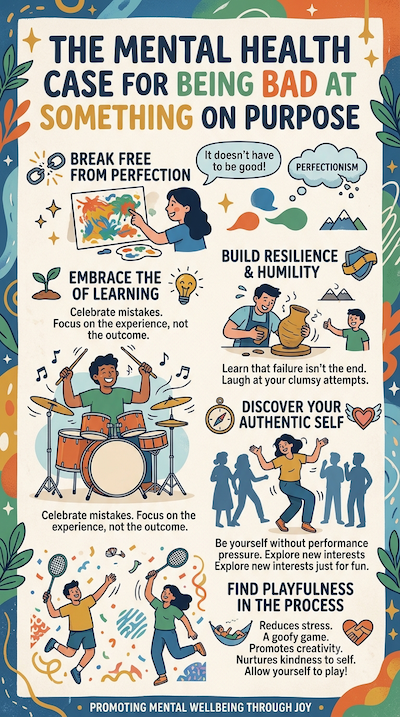
Adult life rewards competence. We are praised for being quick accurate and reliable and over time many of us start to treat our worth as a score. Every task becomes a small test and every slip becomes evidence against us. Psychologists have a name for the extreme version of this habit and it is perfectionism. It is linked with stress burnout and a harsh inner critic. One surprising way to loosen its grip is to choose something and be bad at it on purpose. Think of a person who joins a pottery class and produces a lopsided bowl. Or someone who picks up a ukulele and plays three chords badly for a month.
Or a person who starts a new language and mixes up every verb. In each case there is no standard to meet and nobody to impress so the critic has no job. What remains is curiosity. Children live in this state all the time because they are beginners at nearly everything. As adults we rarely allow it. The rules of the experiment are simple. The activity must have no audience no income and no public post. It must not feel like homework. Progress is welcome but not required. The point is to practise being a person who tries without needing to win. This can be especially helpful for students and young professionals who feel that every choice must build a career.
A hobby with no use is a gift in such a life. It tells the brain that effort can exist without a reward. It also builds tolerance for the awkward feeling of not knowing which is a skill that carries over into exams interviews and new relationships. Many people report that laughing at their own clumsy first attempts brings a lightness they had not felt in months. That reaction is worth noticing because it shows how tightly the pressure had been wound.
Making this work takes a little care. Pick an activity that has no easy scoreboard so that you cannot rank yourself by the week. Keep sessions short at first perhaps twenty minutes and stop while it still feels pleasant. Save the ugly results rather than throwing them away. A shelf of wobbly cups or a page of crooked drawings becomes a record of courage. Beginner groups add another benefit because shared clumsiness builds connection fast. Watch your self talk as you go. If you hear phrases such as I am hopeless or this is a waste of time treat them as the same inner critic in new clothes and carry on anyway.
Be alert to a common trap. Many hobbies drift into performance once a person starts posting results or chasing improvement for its own sake. If the joy fades and the pressure returns change the activity or change the rules. It is also important to be honest about limits. A new hobby can support wellbeing but it cannot replace professional help. If low mood anxiety or exhaustion lasts for weeks a conversation with a counsellor or doctor is the right next step. Used in the right spirit being bad at something offers a gentle rehearsal for life.
It shows that mistakes can be survived and that worth does not rise and fall with output. Over time that lesson can soften how we treat ourselves at work at home and in the quiet hours between. The goal is not to become good at the ukulele. The goal is to become kinder to the person holding it.