Your career is no longer a Ladder. It’s a Jungle.
Degrees → internships → freelancing → AI → side hustles → startups → career switches. What happened to the simple idea of “get a degree, get a job, grow”?


Your career is no longer a Ladder. It’s a Jungle
Degrees → internships → freelancing → AI → side hustles → startups → career switches. What happened to the simple idea of “get a degree, get a job, grow”?
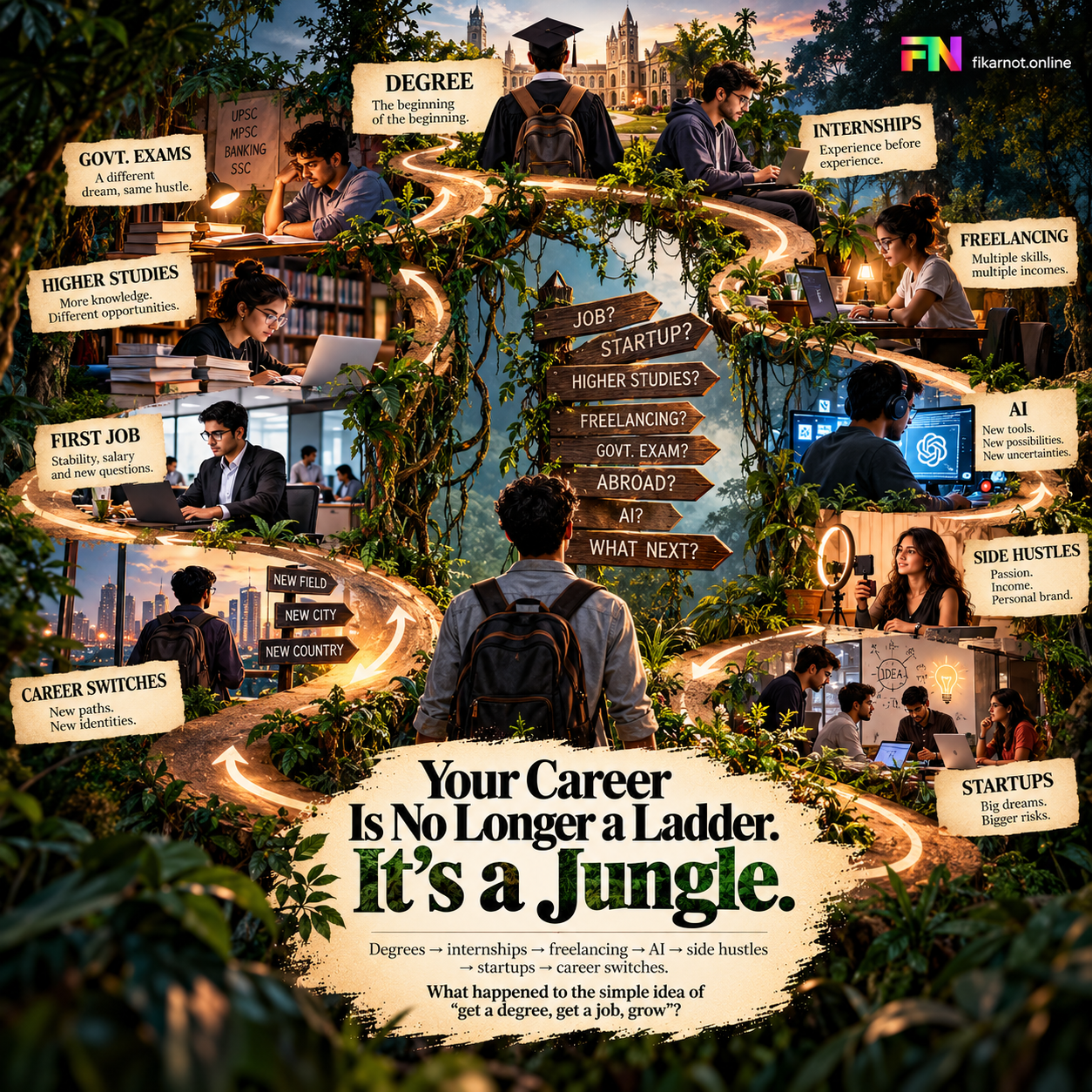
Once upon a time, the career plan sounded almost suspiciously simple. Get a good degree. Get a job. Work hard. Get promoted. Buy a house. Retire. Done. Your parents probably grew up believing in this ladder. You climbed one step at a time, and if you didn't fall off, eventually you reached somewhere comfortable. Today? There is no ladder. There is a jungle. And somewhere between LinkedIn, Instagram, AI, internships, startups, freelancing, competitive exams, and “five side hustles you should start before 25,” young people are trying to figure out which direction is actually forward.
What Happened to “Just Get a Job”?
The funny thing is that getting a degree was once treated almost like buying a ticket. You study. You graduate. A company hires you. Then you spend the next few years becoming better at that job. Today, a degree is often just the beginning of the beginning. Your college asks you to do internships. The company wants experience. The internship wants skills. The skills require certifications. The certification asks for projects. The projects require experience. And somewhere in between, LinkedIn tells you that a 22-year-old has already founded a startup, built an AI company, travelled to 17 countries, and become a “thought leader.”Meanwhile, you're sitting at home wondering whether your resume should be one page or two. Relax. You're not necessarily behind. The rules changed.
The Career Has Become a Portfolio
Earlier, your identity could be: “I am an engineer.” Or: “I am a teacher.” Or: “I work in a bank.” Today, it increasingly sounds like: “I work in marketing, freelance as a content strategist, run an Instagram page, invest on the side, and I'm learning AI.” Welcome to the portfolio career. One job may no longer define your entire professional identity. You might work full-time and freelance. You might be a designer and content creator. You might study anthropology and work in development. You might be an engineer who builds a startup on weekends. You might leave your first job after two years and move into something completely different. And honestly? That's not necessarily instability. Sometimes, it is exploration. The problem is that we haven't yet learned how to distinguish between the two.
The Pressure to Have a “Backup Plan” Has Changed Too
Earlier, having a Plan B sometimes felt like admitting that Plan A might fail. Today, having multiple options can actually be a survival skill. One person is preparing for UPSC. Another is learning coding. Someone else is preparing for an MBA. Another is building a YouTube channel. Someone is applying for jobs while freelancing at night. Someone is preparing for a government examination while secretly thinking about starting a business. And everyone is wondering: “What if I choose wrong?” That's the terrifying part of today's career jungle. There are more opportunities than ever. But there are also more ways to feel that you chose the wrong one.
And Then AI Walked In
Just when young people thought they had finally understood the job market, AI entered the room. Suddenly, the question isn't only: “What job should I choose?” It is also: “Will this job look the same five years from now?” Skills that once felt specialised can now be assisted by AI. Writing. Design. Research. Coding. Data analysis. Customer support. Marketing. The answer isn't to panic and decide that humans are finished. The bigger lesson is this: Knowing something is no longer enough. Knowing how to use what you know is becoming equally important. A degree may tell an employer what you studied. Your ability to learn, adapt, communicate, and solve problems tells them what you can actually do.
But Here’s the Problem With the Hustle Culture
There is another side to this jungle. We have somehow convinced young people that if they are not doing something after work, they are wasting their life. Job by day. Gym. Online course. Freelancing. Startup idea. Reading. Networking. Content creation. Investing. And don't forget to “build your personal brand.” At some point, you have to ask: When exactly are we supposed to live? Not every hobby needs to become a business. Not every skill needs to become a monetisable asset. Not every evening needs to produce something. A career should give your life meaning and stability. It shouldn't consume your entire identity.
Maybe We Need to Stop Asking “What Do You Want to Become?”
This is perhaps the biggest change. For years, children were asked: “What do you want to become?” Doctor? Engineer? IAS officer? Teacher? Today, that question feels strangely incomplete. Maybe the better question is: “What problems do you want to be good at solving?” Because careers are changing faster than job titles. Someone who learns to communicate, think critically, understand technology, work with people, and keep learning may have more long-term flexibility than someone who simply memorises one professional identity. The goal isn't to predict the future perfectly. It is to become adaptable enough to survive when the future changes.
The Jungle Isn't Necessarily Bad
Something is exciting about this new uncertainty too. You are no longer completely trapped by the career you chose at 21. You can switch. You can learn. You can start again. You can build something on the side. You can leave a toxic workplace. You can discover that the subject you studied isn't the work you actually love. You can turn a hobby into a profession. You can create opportunities that didn't exist when your parents started working. The old ladder offered predictability. The new jungle offers possibility. But possibility comes with responsibility. Nobody can hand you a perfectly marked route anymore. You have to learn how to navigate.
So, What Should Young People Actually Do?
You don't need to know exactly where you'll be at 40. You just need to make sure that the person you become at 30 is capable of handling a world that the person you were at 20 couldn't even imagine. Because perhaps the biggest career mistake today isn't choosing the wrong path. It's believing there is only one path. Your career isn't a ladder anymore. It is a jungle. And maybe the goal isn't to find the perfect route. Maybe the goal is to become the kind of person who can find a route wherever they are.
- Pranay S. Pale