AI Bias: Can Artificial Intelligence Be Fair Without Personal Opinions?
How Training Data, Human Decisions, and Hidden Assumptions Can Make AI Systems Unfair


Can AI Be Biased If It Has No Opinions?
Sahil Sharma
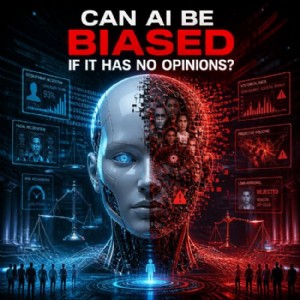
We often assume that artificial intelligence is fair because it does not have feelings. However, AI bias can still influence decisions even when a system has no personal opinions. It does not get jealous, hold grudges, or judge people based on personal experiences. Unlike humans, AI does not wake up in a bad mood or dislike someone because of an argument. So, naturally, we expect it to make decisions without personal bias.
But here is something worth thinking about: if AI has no opinions of its own, how can it still be biased?
As an engineering student, I have spent time exploring AI tools for studying, coding, and solving everyday problems. Their capabilities are impressive, but the more we depend on them, the more important one question becomes: are we getting objective answers, or are we trusting a machine that has learned from a world full of human prejudices?
AI Learns From Us, Not an Ideal World
To understand AI bias, we first need to understand how AI learns.
AI models are trained using enormous amounts of data, including books, websites, articles, and information created by humans. During training, they identify patterns in this data and use them to generate predictions or responses.
The problem is that human-created data is not always fair.
Our history contains discrimination based on gender, caste, race, and financial background. These biases can appear in hiring records, educational opportunities, and the way people are represented in society.
Imagine a company training an AI system to shortlist job applicants using records of previous employees. If the company has historically hired more men for technical positions, the system might learn to favour male candidates. Nobody needs to explicitly instruct it to discriminate against women. It might simply reproduce patterns found in its training data.
The AI does not need to hate women to produce an unfair result. A system can create discriminatory outcomes without having discriminatory intentions.
The Problem Is Bigger Than Bad Data
It would be convenient if we could solve AI bias simply by cleaning the training data. Unfortunately, the problem is more complicated.
Bias can also enter through the way a problem is defined, the information selected for training, and the goals used to evaluate a model.
Imagine a college using AI to predict which students are likely to perform well academically. If the model relies heavily on previous grades, attendance, and access to expensive coaching, it might favour students who already have better resources.
But does having fewer resources automatically mean someone has less potential?
A student studying in difficult circumstances might have excellent problem-solving skills but limited access to guidance. Another student might have every possible advantage. If the system only considers historical performance, it could confuse opportunity with ability.
As students, we understand that marks do not always tell the complete story. One difficult semester can affect an otherwise capable student's academic record.
AI systems can make similar mistakes, except their decisions may affect thousands of people.
The issue is not just whether the data is biased. It is also whether we are asking the right questions and measuring the right things.
Can We Blame a Machine?
If an AI system makes an unfair decision, who should be held responsible? The developer who built it? The company that deployed it? Or the people who trusted its output without checking it?
I do not think the machine itself is the right place to stop looking for responsibility.
Humans choose an AI system's training objectives, select its data, establish its limits, and decide where to use it. Even developers who genuinely try to build fair systems can overlook problems that appear in specific situations.
Good intentions are not enough. If AI is used to make decisions about jobs, education, loans, or healthcare, its results need to be tested carefully.
We should ask whether it treats different groups fairly, whether its mistakes disproportionately affect certain people, and whether humans can review questionable decisions.
Trusting AI simply because it is technology is not very different from believing everything a person says just because they sound confident.
What This Means for Us
As engineering students, we often focus on accuracy, performance, and efficiency when building software. We want our models to make better predictions and our applications to run faster.
But perhaps we should also ask a less comfortable question: better for whom?
A model with 95% accuracy might still perform poorly for a particular group. A recruitment system might save time while unfairly rejecting qualified applicants. A recommendation algorithm might work efficiently while repeatedly showing users the same narrow range of ideas.
Technical success does not automatically guarantee social fairness.
This is why AI ethics should not be treated as an optional topic that developers can ignore once their code works. Understanding how technology affects people should be part of building technology itself.
We do not need every engineer to become a philosopher. But we do need engineers who understand that their decisions can have consequences beyond the screen.
The Final Question
So, can AI be biased if it has no opinions?
Absolutely.
An opinion is not necessary for bias to exist. Sometimes, all it takes is incomplete data, unfair historical patterns, or a system built around assumptions that nobody thought to question.
AI may not have personal beliefs, but it can still reflect the beliefs and inequalities present in the world that created it.
Perhaps the biggest mistake we can make is assuming that removing human emotions automatically removes human prejudice.
The goal should not be to build AI that blindly replaces human judgment. It should be to build AI that supports better decisions while remaining open to scrutiny, correction, and accountability.
Because, at the end of the day, AI might not have opinions of its own.
But the world it learns from certainly does.