You Saw Maa Durga. Did You See the Artist?
Behind every viral idol is an artisan whose story deserves to go viral too.


You Saw Maa Durga. Did You See the Artist?
Behind every viral idol is an artisan whose story deserves to go viral too.
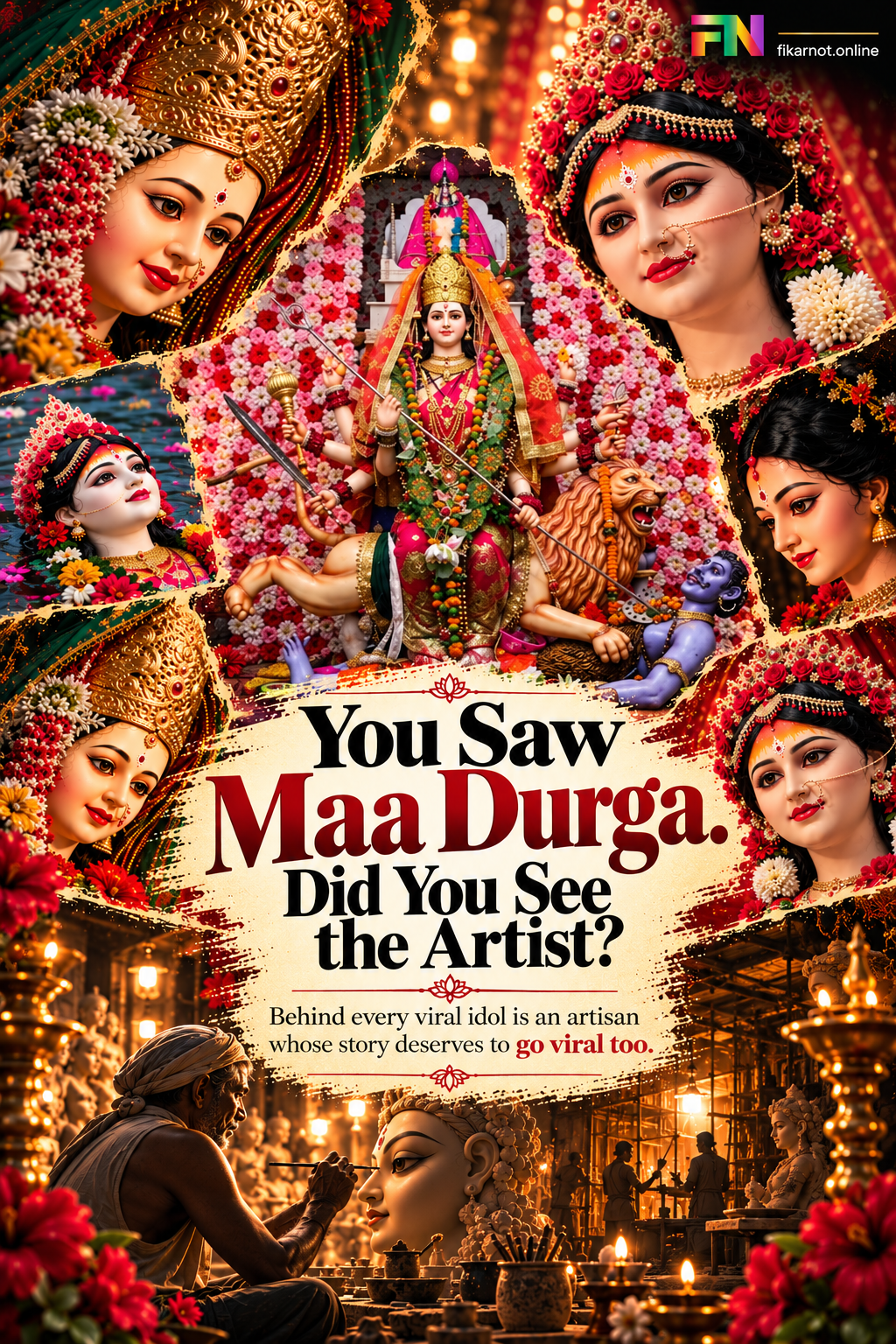
This Navratri, you probably saw Maa Durga everywhere.
On your Instagram feed. On WhatsApp statuses. In reels shot outside crowded pandals. In photographs where thousands of people stopped for a moment and said
“Sakshat Maa Durga lag rahi hain.”
We admired the eyes. The expression. The jewellery. The terrifying beauty of Mahishasura’s defeat. We shared the photograph. But almost nobody asked the simplest question:
Who made her? Who spent months shaping that face from clay? Who knew exactly how much pressure a finger needed to give the Goddess her expression? Who worked quietly while we celebrated loudly? Somewhere in Bengal, a blind sculptor creates idols by feeling their forms with his hands. Somewhere in Raipur, two brothers create a Durga idol so lifelike that it becomes a social-media sensation.
In Yavatmal, generations of artisan families have kept the city’s distinctive idol-making tradition alive. In Siliguri, an artist’s work travelled through social media all the way to Busan, South Korea. And in Assam, one artist spent nearly a hundred days creating a towering Durga idol using thousands of safety pins.
These are not just stories about idols. They are stories about hands, inheritance, imagination, and devotion. And perhaps that is the strange thing about the internet. We have become incredibly good at making the Goddess go viral. But somehow, we still forget to make the artist visible. So this Navratri, before you scroll past another beautiful photograph of Maa Durga, pause for a second.
Look beyond the face of the Goddess. There is a human story behind it. And some of those stories are extraordinary. The Sculptor Who Creates Through Touch. In Basti, Uttar Pradesh, there is an artist whose story almost sounds impossible until you realise that this is simply how he has worked for decades.
Ram Pal was born blind. Yet for around 25 years, he has been travelling to Basti during the idol-making season and creating Durga and Ganesha idols largely through touch.
For him, sculpture is not primarily about looking. It is about feeling. His fingers understand the shape of a face, the curve of a body, and the details of an idol that many of us would struggle to reproduce even after looking at photographs. He learned the craft from his father and continues the tradition with his family. Think about that for a moment. We live in a world where artists use cameras, 3D modelling, digital references and endless visual inspiration. And here is a sculptor who creates the face of the Goddess without seeing it. His hands are his eyes. And perhaps that is the first reminder these artists give us: Art is not always created by what we see. Sometimes, it is created by what we feel.
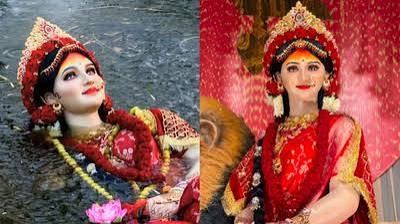 Raipur trending maa durga Idol
When Two Brothers Made a Goddess Go Viral
Then some stories remind us how quickly traditional craftsmanship can meet the modern internet. Two brothers in Raipur created a Durga idol that became a social-media sensation because of its remarkably lifelike appearance. People stopped. They stared. They clicked photographs. They made reels. And once again, the Goddess became viral. But behind the viral image were two brothers who had spent their time, skill, and patience creating something that could make thousands of strangers pause while scrolling. That is the interesting relationship between social media and traditional art. Instagram can make an artist famous overnight. But it cannot create the years of practice that made the artist capable of producing that work in the first place. The viral moment may last a few days. The craft behind it may have taken decades.
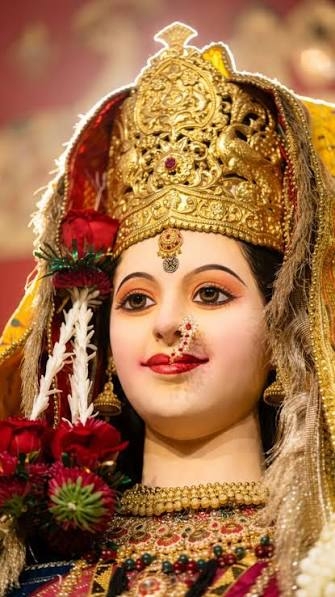 Yavatmal's famous Gol Bangla wali Ma Durga
Yavatmal Has Been Doing This for Generations
If you know Yavatmal during Navratri, you know the festival there is more than just another religious celebration. The city has hundreds of pandals, dramatic Durga idols and a distinctive local style of idol-making. And behind that tradition are families who have spent generations doing this work. Families such as the Manekars, Chindhes, Wankars and Sambajwars have carried the craft forward, with third and fourth generations continuing the tradition.
The Manekar family is one such example. For them, idol-making isn't simply something that happens before Navratri and disappears afterwards. It is a family inheritance. A skill passed from one generation to another. A relationship between the artisan and the deity. Sunil Manekar has described their work as more than a profession, calling it a service to the Almighty. And that line explains something modern conversations about “artisans” often miss. For many traditional Indian craftsmen, the work is not merely about producing a product. It is about seva. The object they create may eventually stand under thousands of lights, surrounded by music and crowds. But its journey begins quietly in a workshop, in the hands of a family that has been doing this for generations. That is the India we often don't photograph.
From Siliguri to South Korea
Then comes one of the most interesting stories of how social media is changing the possibilities for traditional artists. Sanjib Saha, an artisan from Siliguri, had been sharing his work on social media for around a year and a half. No giant marketing campaign. No multinational art gallery. Just photographs and posts showcasing his craftsmanship. Someone noticed. The Bengali community in South Korea came across his work and eventually commissioned him to create a Durga idol for Busan. Imagine that journey. An idol takes shape in a workshop in Siliguri. Photographs are uploaded online. Someone thousands of kilometres away sees them. And suddenly, the work travels across borders.
The idol, made from fibre and weighing around 65 kilograms, eventually made its way by sea to Busan. This is where social media becomes more than entertainment. For a traditional artisan, it can become a marketplace without borders. A person who may never have had access to an international gallery can now put his work in front of an audience sitting on another continent. The internet didn't create Sanjib's talent. It simply helped the world discover it.
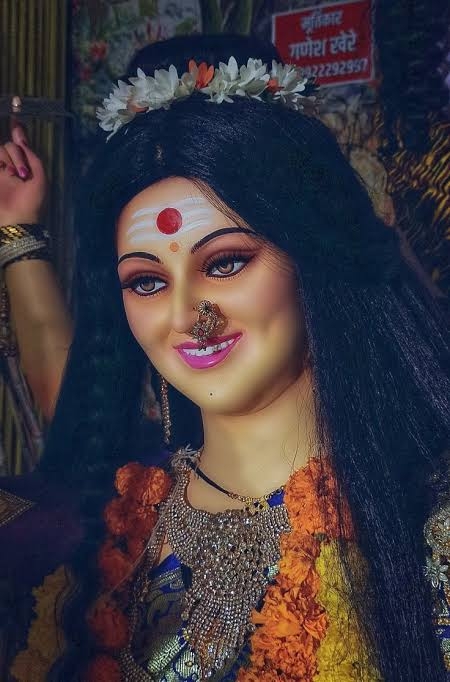
And then there is Assam. Artist Sanjib Basak created a Durga idol using approximately 50,000 safety pins, working for nearly three months. Think about the patience required. One pin. Then another. And another. Thousands of tiny pieces eventually became something large enough to command attention. It is exactly the kind of work that social media loves, and understandably so. But beyond the visual shock is something more interesting. The artist took an ordinary household object and transformed it into an extraordinary piece of art. That is what craftsmanship does. It looks at something everyone else considers ordinary and asks: “What else can this become?”
And perhaps that is why these viral idols matter. They are not simply beautiful objects. They show what happens when imagination meets patience. We Know the Idol. We Rarely Know the Hands. There is something almost ironic about the way we consume these stories. We will spend ten minutes deciding which photograph of the Goddess looks best. We will discuss the eyes. The smile. The jewellery. The detailing. We will debate which pandal has the most beautiful idol. But how many of us know the name of the sculptor? How many know how long the idol took to make? How many know whether it is the first generation or fourth generation of that family doing the work? How many know what happens to these artisans after the festival ends? The answer, unfortunately, is very few.
Because we have built a culture where the final product gets the spotlight, while the person behind it remains invisible. And this is not just about Durga idols. It happens everywhere. We admire the building but forget the mason. We praise the food but forget the farmer. We celebrate the handloom but rarely know the weaver. We buy the handicraft but negotiate aggressively with the person who made it. We love “Indian culture” as an aesthetic. But sometimes we forget the Indians who keep that culture alive. Maybe This Is the India We Need to See More Often. There is a lot of discussion about India's “soft power.” We talk about yoga. Ayurveda. Indian cuisine. Bollywood. Classical dance. Spirituality. But traditional craftsmanship deserves to be part of that conversation too. Because India's cultural strength is not sitting only inside museums. It is alive in workshops. In villages.In small towns. In family businesses where knowledge moves from father to son, mother to daughter, guru to student. It survives because somebody keeps practising. Somebody keeps teaching. Somebody refuses to let the craft disappear. And increasingly, social media is giving these people something they rarely had before: visibility.
A reel can travel farther than a shop sign. A photograph can reach another country. A viral post can bring a new customer. A young artisan can build an audience without waiting for an institution to discover them. That is powerful. But visibility should not stop at the viral moment.
We should learn the names. Know the stories. Understand the labour. And, when possible, support the people behind the craft. Because appreciation without recognition is incomplete.
The Next Time You See Maa Durga
So the next time a Durga idol stops you mid-scroll, don't just look at the Goddess. Look at the details. The eyes. The hands. The expression. The texture. And then ask: Who made this? Maybe there is a blind sculptor behind it who learned the craft from his father. Maybe it is the work of two brothers who spent months perfecting every detail. Maybe it comes from a family that has been making idols for three or four generations. Maybe a photograph of it travelled from a small workshop in India to a community in South Korea. Maybe thousands of ordinary safety pins became a Goddess because one artist had the patience to imagine something nobody else saw. These stories deserve to travel too. Because we have become very good at making the idol viral. Maybe it is time we made the hands behind the idol visible too. Because sometimes, the most extraordinary stories in India are not standing under the spotlight.
They are standing quietly behind the Goddess.
- Pranay S. Pale