The Ravana We Keep Rebuilding
We burn Ravana every Dussehra. But maybe the real question is: why do we keep creating new versions of him?


The Ravana We Keep Rebuilding
We burn Ravana every Dussehra. But maybe the real question is: why do we keep creating new versions of him?
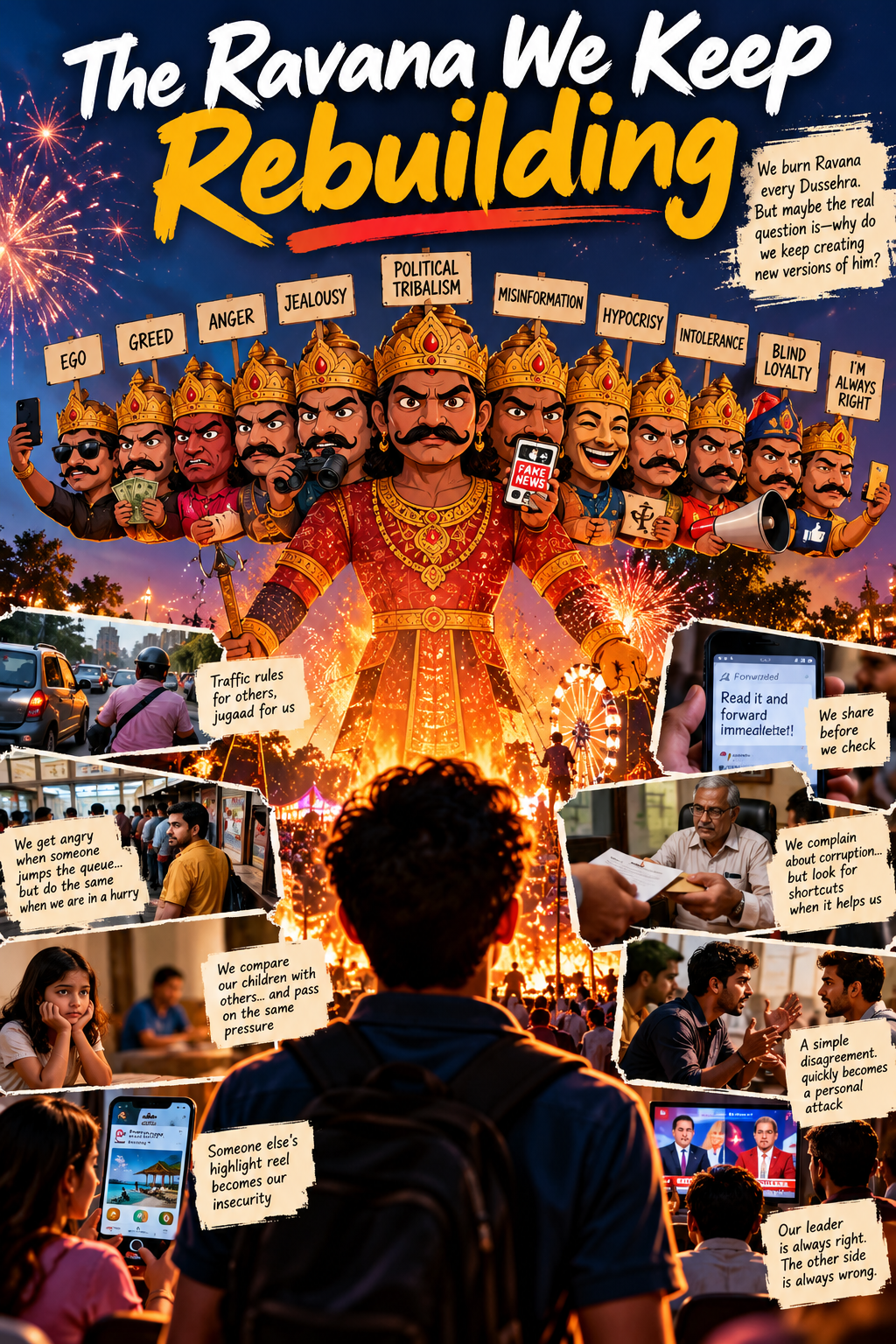
Every year, Dussehra comes with the same scene.
Big Ravana. Bigger crowd. Firecrackers. Loud music. Someone recording everything on their phone. And then boom! Ravana burns.
We clap, we celebrate, we go home.
But ek simple sa question hai: Ravana jal gaya… but did the Ravana inside us?
Because honestly, aaj ka Ravana ten heads lekar thodi na ghoomta hai. He looks much more normal.
Kabhi ego ke form mein.
Kabhi greed ke form mein.
Kabhi anger ke form mein.
Kabhi jealousy ke form mein.
Aur kabhi simply “Meri galti ho hi nahi sakti” wale attitude mein.
Think about daily life.
Road par kisi ne wrong side se bike nikali. We immediately start shouting.
But five minutes later, traffic jam mein hum khud divider ke thoda sa side se gaadi ghusavte.
“Arey sab karte hain.”
Someone jumps the queue at a railway station or a ticket counter, and we get angry.
But when we're in a hurry?
“Bhai, sirf ek minute ka kaam hai.”
Someone gets a government service through a shortcut, and we call it corruption.
But when our own file needs to move faster?
“Thoda setting lagel ka?”
Bas. Ravana ne ek aur head grow kar liya.
Then there is social media.
We see someone posting a luxurious holiday, a new car, or a promotion, and suddenly comparison starts.
“Iska life kitna sorted hai yaar.”
But we don't see their problems. We only see the highlight reel.
And then comes jealousy disguised as humour.
“Haan haan, paisa hai toh sab possible hai.”
Instead of being happy for someone, we find a reason to reduce their achievement.
Another head.
Even at home, we see it.
Parents sometimes compare their children with someone else's son or daughter.
“Bagh, tyacha mulga kuthe pohochla.”
And then those same children grow up and compare their parents with someone else's parents.
“Tyanchya ghari sagla allow asta.”
Nobody wins.
Everyone just passes the comparison forward.
Then there is anger.
A small disagreement with a friend becomes an ego battle.
A message isn't replied to immediately, and suddenly we think, “Attitude आला याचा.”
Someone disagrees with us in a WhatsApp group, and within three messages the discussion has gone from a normal opinion to a personal attack.
We don't even know when the argument stopped being about the issue.
We just wanted to win.
And politics has taken this habit to another level.
We don't simply disagree anymore. We want the other side to be completely wrong.
Apna leader kuch kare toh masterstroke.
Dusra kare toh democracy in danger.
Kya convenient morality hai yaar.
We've created a Ravana called political tribalism.
But the bigger problem is that we carry the same mentality into everyday life.
We want honesty from politicians, but sometimes lie on a form because “kya farak padta hai?”
We complain about bad traffic discipline but park wherever we want because “bas do minute ke liye.”
We demand respect from others but interrupt people when they speak.
We want people to understand our struggles but sometimes don't have five minutes to listen to someone else's.
This is where Dussehra becomes much more than a festival.
Ravana wasn't defeated simply because he was powerful or intelligent. His biggest problem was that his ego became bigger than his wisdom.
And honestly, that lesson is still relevant.
You can be educated and arrogant.
Successful and insecure.
Powerful and irresponsible.
Religious and still intolerant.
Progressive and still unable to accept disagreement.
Political and still completely unwilling to question your own side.
And perhaps the most dangerous Ravana is the one who convinces us that evil always exists in someone else.
Because once we become certain that “I am on the good side,” we stop checking ourselves.
So this Dussehra, instead of only asking
“Aaj ka Ravana kaun hai?”
Maybe ask something more uncomfortable:
“Mere andar Ravana ka kaunsa head zinda hai?”
Ego?
Anger?
Greed?
Jealousy?
Hypocrisy?
Blind loyalty?
The inability to say “I was wrong”?
Ravana burns in a few minutes.
But these habits don't.
They take years to recognise and even longer to defeat.
So yes, celebrate Dussehra. Enjoy the fireworks. Celebrate the victory of good over evil.
But when the crowd goes home, and the smoke disappears, remember—
Ravana doesn't always need someone else to build him.
Sometimes, without even realising it, we rebuild him ourselves.
--Pranay S. Pale