Musk Said Oligarchs Blocked Starlink. Here’s What Actually Happened
|


Musk Said Oligarchs Blocked Starlink. Here’s What Actually Happened
- Shardul Apte
Okay, so Elon Musk has been saying Indian oligarchs are blocking Starlink just to protect their own companies. Rahul Gandhi quickly used that to attack the government. The story being pushed is that rich guys are stopping regular Indians from getting better internet. Sounds neat until you check the price and the actual rules.
Reports put Starlink at around ₹3,500 for 100 Mbps. Jio has talked about ₹999 for 150 Mbps. That is a big gap. If the “better internet for ordinary people” version is three times more expensive for less speed, it needs more explaining than a tweet.
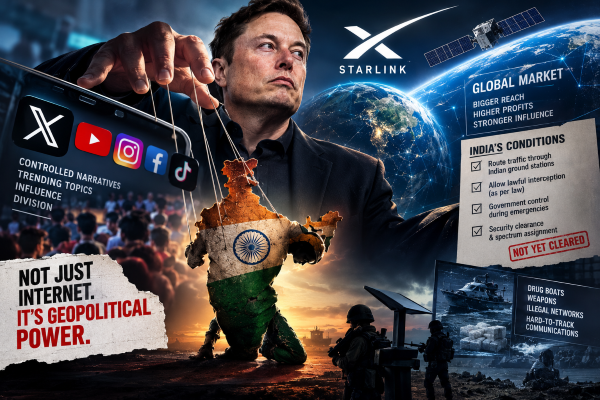
India wants satellite operators to send domestic user traffic through Indian ground stations, allow lawful interception under proper legal process, and let the government take control during emergencies. These are normal asks for a country with long borders and existing telecom rules. Starlink uses inter-satellite laser links, so data can jump from satellite to satellite before it reaches any ground station. That raises a simple question: can Indian agencies still monitor and control Indian traffic the way the law requires, or does the design make it harder? That is what needs answering.
Security worries are not made up. In November 2024, authorities seized about 6,000 kg of methamphetamine from a boat near the Andaman and Nicobar Islands and found a Starlink terminal on it. In Manipur, Starlink gear was recovered along with weapons. In Sri Lanka, October 2026 reports linked a Starlink system to a seizure of roughly 120 kg of heroin. None of this proves SpaceX deliberately helped criminals. It does show that small satellite terminals are useful for people who want hard-to-track communication. The same kind of terminals have been used in the Ukraine war, which made clear that satellite internet can matter in real military situations. When a device can move data across borders without touching local networks, security agencies will want tighter checks before they approve it.
This is not a claim that Starlink is funding drug boats. It is a claim that the product has already appeared in places where agencies do not want surprise high-speed links. India is applying the same checklist to Starlink that it is applying to Jio and OneWeb. If the whole process existed only to keep one American company out so two Indian groups stay comfortable, it is not working very well—because the Indian players are still waiting as well.
Being Elon Musk does not give anyone a free pass on another country’s laws. Before the Ambani-Adani conspiracy story becomes the main version, the basic question is simpler: has the company actually met the security and licensing conditions that everyone else must meet? If the answer is no, the delay is just the rules doing their job, not oligarchs writing the script.
If a company cannot route traffic the way the law says, allow interception the way the law says, or give the government emergency control the way the law says, it has two straightforward choices. Change the setup so it follows the rules, or decide the market is not worth the effort. Calling the government sellouts because the checklist is long is not a third option. Other countries have also put conditions on Starlink. India is not inventing the idea of national security rules for satellite broadband. The problem here is that the talk keeps turning into “who is protecting whose business” instead of “have the technical and legal requirements actually been met?” That part is still pending. Until it is sorted, the “oligarchs blocked us” version stays a claim, not a fact.