How Digital Lifestyles Are Reshaping Modern Life in the Age of AI and Constant Connection
How Digital Lifestyles Are Reshaping Modern Life in the Age of AI and Constant Connection


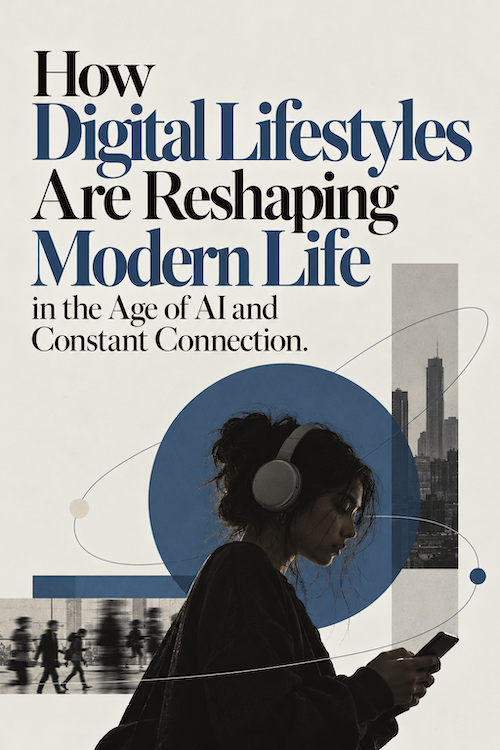
Not very long ago a morning began with an alarm clock and a newspaper on the doorstep. Today it begins with a glowing screen. We check messages before we check the weather. We order breakfast with a thumb swipe and join meetings from our bedrooms. The digital lifestyle has quietly become the default setting of human existence. A decade ago smartphones felt like shiny luxuries but now they are extensions of memory and identity. Our photographs and finances live inside them and so do our friendships and our ambitions. What was once optional has become woven into the fabric of daily routine. The pace of this transformation is staggering because digital change that once took generations now unfolds within a few years. Cashless payments went from curiosity to habit almost overnight and video calls turned from a stopgap into a standard. Artificial intelligence moved from science fiction into the pocket of every curious student and busy professional.
Perhaps nowhere is the shift more visible than in the way people work. Remote work and hybrid models have dissolved the old boundary between office and home. A designer in a small town can serve clients across oceans while a counsellor can support someone hundreds of miles away through a screen. Learning has followed the same path. Online courses and virtual mentoring let ambitious minds grow without waiting for a classroom seat and professionals can now upskill between meetings or after dinner. This freedom is liberating yet it carries a hidden cost. When the laptop sits on the dining table the workday has no natural ending. Many people now find that flexibility has quietly turned into permanent availability. The quiet pride of finishing a task has been replaced by the endless ping of one more request waiting for a reply.
Social media promised a world of closeness and in many ways it delivered. Families separated by distance share daily moments. Communities form around the rarest of interests and voices that were once unheard now find global audiences. Yet the paradox is real. We are more connected than any generation before us and still many feel lonely. Curated feeds invite endless comparison and notifications fragment our attention into tiny pieces. The ceaseless scroll leaves us informed but strangely unsettled. Psychologists continue to study how constant stimulation shapes mood and concentration and sleep and self worth. Early findings suggest that the quality of online interaction matters far more than the quantity of hours spent and that passive consumption tends to leave people feeling emptier than active conversation does. Meaningful connection still requires presence and effort even when it travels through a screen.
A hopeful counter movement is growing. People are learning to treat attention as a precious resource rather than a free commodity. Screen time trackers and focus modes and mindful technology habits are entering everyday conversation. Digital detox weekends are no longer eccentric and are becoming acts of self care. The goal is not to reject technology but to use it with intention. A healthy digital lifestyle asks simple questions. Does this app serve me or do I serve it. Does this connection nourish me or drain me. Small honest answers can reshape an entire routine. Some families now keep phone free dinners and some workplaces protect evenings from messages. These modest boundaries show that digital wellbeing is built through everyday choices rather than dramatic escapes. Balance is not a destination reached once but a habit renewed each day.
The next chapter will move even faster. Artificial intelligence will personalize learning and healthcare and entertainment in ways we are only beginning to imagine. Smart homes and wearable devices and immersive virtual spaces will blur the line between physical and digital life further still. With each leap come fresh questions about privacy and ethics and what it means to remain human in a world of algorithms. Who owns our data and who decides what we see. How do we teach children to think critically when answers arrive instantly. These questions will define public debate for years and societies that engage with them early will be better prepared than those that wait. Digital literacy will become as essential as reading and writing and the ability to question a source will matter as much as the ability to find one.
The people who thrive will not be those who simply adopt every new tool. They will be those who stay curious and adaptable and grounded. Technology can amplify our potential but only humans can decide what that potential is for. The evolution of digital lifestyles is not a distant forecast. It is happening in every glance at a screen and every message sent across time zones. The challenge of our era is to build a digital life that feels spacious rather than suffocating and purposeful rather than perpetual. Every notification is an invitation and we remain free to decline. Let us choose our tools with care and protect the hours that belong to rest and family and reflection. Technology should be the bridge and never the destination.