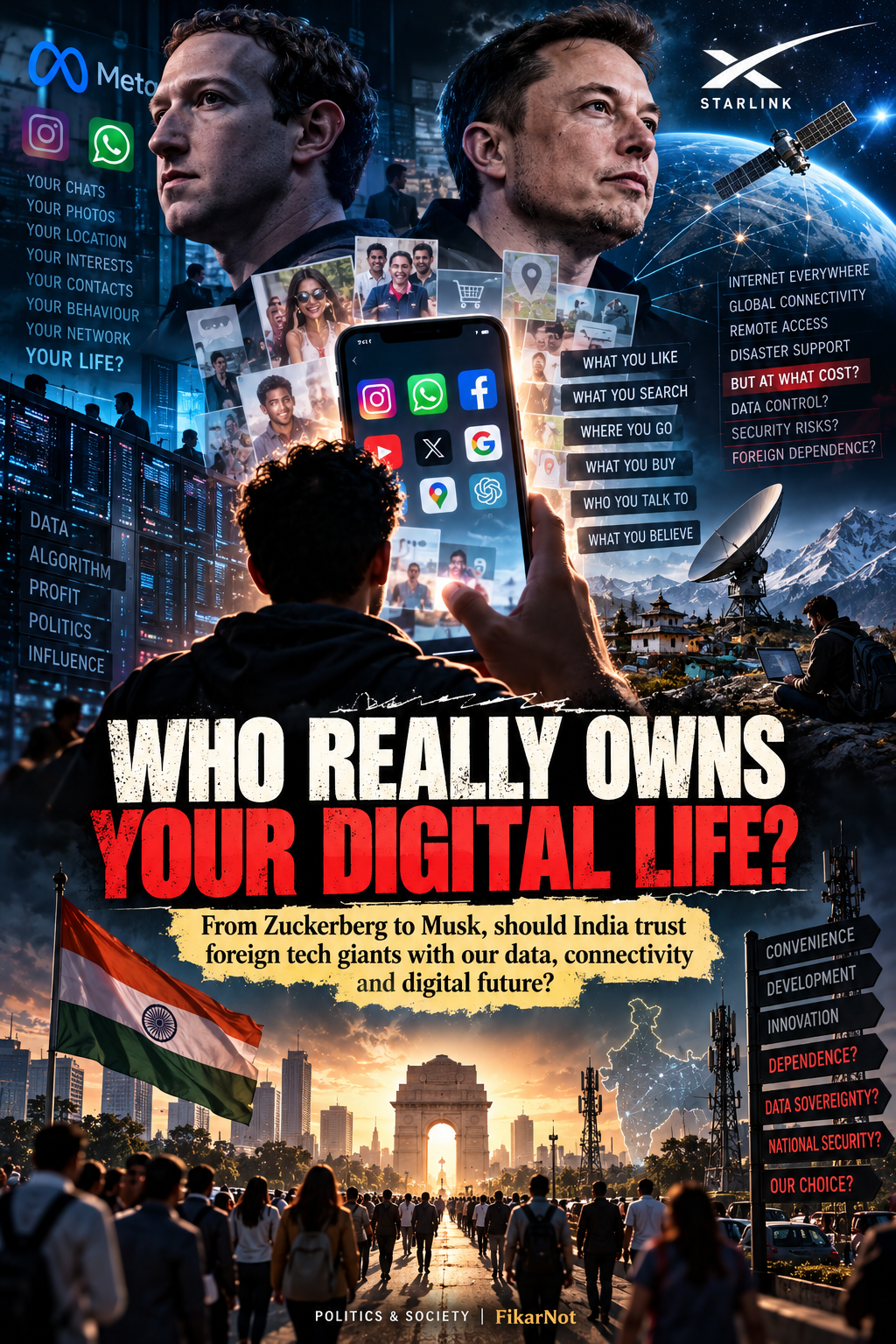
WHO REALLY OWNS YOUR DIGITAL LIFE?
From Zuckerberg to Musk, should India trust foreign tech giants with our data, connectivity, and digital future?


WHO REALLY OWNS YOUR DIGITAL LIFE?
From Zuckerberg to Musk, should India trust foreign tech giants with our data, connectivity, and digital future?
You probably don't know what your phone knows about you. And honestly, you probably don't want to know. Your Instagram knows what makes you stop scrolling. WhatsApp knows who you talk to. Google knows what you search. Your phone knows where you've been. And soon, satellite internet could know where you are connecting from.
Thoda scary lag raha hai? It should.
Because somewhere between “technology makes life easier” and “technology runs our lives”, we crossed a line without really noticing. For years, India's technology conversation was mostly about convenience. Faster internet. Cheaper smartphones. Instagram reels. WhatsApp calls. Online payments. Now the conversation needs to become slightly more uncomfortable:
Who controls the infrastructure behind all this convenience?
Take Meta. For most of us, Zuckerberg isn't some powerful figure in Washington or Delhi. He's simply the guy whose companies run Instagram and WhatsApp. But look at the scale of the relationship. India's Competition Commission imposed a ₹213.14 crore penalty on Meta in 2024 over the way WhatsApp's 2021 privacy-policy changes handled user data and data sharing with other Meta companies. The regulator also directed that such sharing for certain purposes could not be made a condition of using WhatsApp in India.
That should make us pause. Because WhatsApp isn't some optional luxury app for many Indians. For families, businesses, colleges, journalists, political workers, small shops and everyday conversations, it has become part of daily infrastructure. So when a private company changes the rules around data, the question isn't merely: “Did I click Accept?” The bigger question is: “Did I really have a choice?” Delete WhatsApp? Fine. Tell your family group first. Tell your office. Tell your college group. Tell the local shopkeeper. Good luck. And that is where digital dependence becomes more interesting than digital convenience. We often talk about India's strategic independence in terms of oil, defence equipment, semiconductors, or energy. But there is another kind of sovereignty emerging: data sovereignty. Who holds our data? Where is it processed? Who can access it? What happens if a foreign company changes its policies? And what happens when the interests of that company and the interests of India don't perfectly align? These aren't imaginary questions anymore.
India itself has been building a national data-governance framework around consent, security, purpose limitation, and citizen trust, recognising data as a strategic resource. Now enter Elon Musk. Starlink isn't Meta. It isn't a social-media platform. It is a satellite internet service. But the underlying question is surprisingly similar: How much strategic dependence should India have on a foreign-controlled technology network? India's security requirements for satellite internet providers include domestic routing of Indian traffic, local infrastructure, lawful interception capabilities, and other monitoring and security provisions.
And analysts have raised concerns about foreign control, data handling and the difficulty of independently enforcing some security conditions. A 2026 Takshashila assessment, for instance, highlighted concerns about Starlink's foreign-government exposure and its updated privacy policy, which permits certain customer data to be used for AI training and shared with third parties.
Again, this doesn't mean: “Starlink is dangerous, ban it.” That's too simplistic. Satellite internet could be genuinely useful for remote regions, disaster response, connectivity, and competition. But useful does not mean harmless. And that is exactly the conversation India needs. We should be able to say:
Yes, bring the technology.
Yes, bring the investment.
Yes, give Indians more choices.
But the rules cannot disappear just because the technology is exciting. Because the biggest mistake a developing digital economy can make is confusing innovation with immunity. A billionaire can be a genius entrepreneur and still have interests that don't perfectly match India's. A company can provide an excellent service and still have aggressive data practices. A technology can transform lives and still create strategic vulnerabilities. These things can all be true at the same time. And perhaps this is where India's relationship with Silicon Valley needs to mature. For years, the attitude was almost: “Aap technology lao, hum use kar lenge.”
Now it needs to become: “Technology lao. But tell us the rules.” What data are you collecting?
Why? Where is it stored? Who gets access? Can Indian regulators audit you? What happens during a national-security emergency? Can the service be switched off? What happens if the company changes ownership? What happens if its home country's government pressures it? These are not anti-business questions. They are pro-sovereignty questions. And there is an important difference between being anti-globalisation and being pro-India in a globalised economy. India doesn't need to shut the door on American technology. It needs to stop entering the room without reading the contract. Because the next generation of sovereignty won't only be about who controls territory.
It will also be about who controls networks, data, algorithms, satellites, and digital infrastructure. And Gen Z should care about this more than anyone. Because this is not some distant government policy debate. This is your WhatsApp. Your Instagram. Your location. Your search history. Your digital identity. Your future workplace.Your AI assistant. Basically, your digital life. So maybe the question isn't: “Is Zuckerberg good or bad?” Or: “Is Musk good or bad?” That's celebrity politics. The serious question is much bigger:
Should any individual entrepreneur or foreign corporation become so important to a country's digital life that saying “no” becomes practically impossible?
Because technology should make citizens more powerful. It should not quietly make citizens dependent.
India doesn't have to reject Silicon Valley. It doesn't have to reject Starlink. It doesn't have to reject foreign technology. But it should have one very Indian answer to every technology giant knocking at the door: “Welcome. But this is India. The rules apply here.”
And perhaps that is what digital sovereignty should really mean. Not building a wall around the internet. Not fearing innovation. But making sure that India's data, citizens, and strategic interests don't become someone else's business model. Because yesterday, sovereignty meant controlling your land. Today, it also means controlling your data. Tomorrow? It might mean controlling who controls your connection to the world.
And that is a conversation we should probably have before, rather than after, we hand over the keys.