The Mind Reading Myth Every Psychology Student Has Heard
The Mind Reading Myth Every Psychology Student Has Heard


The Mind Reading Myth Every Psychology Student Has Heard
Every psychology student knows the moment. You tell someone at a family function or a party that you are studying psychology and their eyes go wide. Then comes the joke that never gets old for them but has definitely gotten old for us. So can you read my mind right now. Or the classic one where they cover their face and say please do not analyse me. I usually smile and nod but honestly this tiny conversation says a lot about how the world sees our field. Somewhere along the way people decided that psychologists walk around with a hidden superpower. The truth is far less magical and far more interesting.
So where did this idea even come from. A big part of it is pop culture. Think about every crime show where a brilliant profiler glances at a suspect and declares exactly what childhood trauma made them do it. Think about movies where a calm therapist in a cozy chair sees through every lie in two minutes. Add the legacy of Sigmund Freud and his dream interpretations and you get a picture of psychology as a field of secret decoding. Social media makes it worse. Reels promising that you can spot a liar by watching their eyes or know someone likes you through one gesture are everywhere. These make psychology look like a cheat code for people when it is actually a science of patterns and probabilities.
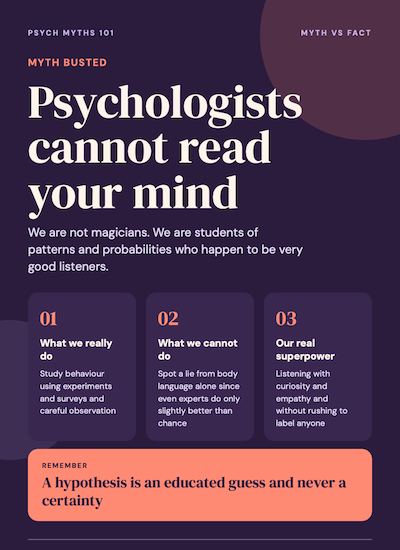
Here is what psychologists really do. We study how people behave and think and feel using research methods like experiments and surveys and observation and standardised assessments. When a clinical psychologist works with a client they gather information over many sessions. They listen carefully and ask questions and notice patterns in what the person shares and how they share it. Then they form hypotheses that they keep testing and revising. Notice the word hypothesis. It means an educated guess and not a certainty. A psychologist can say that a certain pattern of behaviour is commonly linked with anxiety or avoidant attachment. They cannot say exactly what you are thinking about at 3 pm on a Tuesday.
Even our best skills have limits. Research on lie detection shows that most people including trained professionals perform only slightly better than chance when trying to spot lies from behaviour alone. Body language is also messy. Crossed arms might mean defensiveness or it might simply mean the room is cold. Avoiding eye contact could signal dishonesty or shyness or even cultural norms about respect. Psychologists are also humans with biases like confirmation bias which makes us notice only what supports what we already believe. This is exactly why good practice depends on evidence and context and consent instead of gut feeling. Therapy works because a client chooses to share and not because a therapist magically extracts secrets.
This myth is not harmless either. When people believe psychologists can read minds they get scared of therapy. They worry they will be judged or exposed the second they walk in. Others expect a therapist to diagnose them in one meeting and fix everything in two sessions and then feel disappointed when healing turns out to be slow and collaborative. Psychology students also feel the pressure. Friends hand us their relationship drama and expect a perfect verdict. Our field can start to look like fortune telling which damages trust in real research and real mental health support. In a world where talking about mental health is still stigmatised these misunderstandings matter even more.
So what is the real superpower of psychology. Honestly it is listening. It is staying curious about people without rushing to label them. It is understanding that every person has a story that cannot be guessed from a single glance. The next time someone asks whether you are reading their mind you can smile and tell them the truth. You are not reading anything. You are paying attention and that is a skill anyone can learn. Psychology does not give us access to hidden thoughts. It gives us the tools to ask better questions and to hear the answers with empathy. That is not magic and it is far better.