The Love Myth That Is Quietly Messing With Our Heads
The Love Myth That Is Quietly Messing With Our Heads


The Love Myth That Is Quietly Messing With Our Heads
Every girl has been there. It is midnight and you are scrolling and you land on a couple that looks absolutely perfect. Matching outfits and sunset trips and captions about never having had a single fight. Suddenly you look at your own situation and start to wonder what is wrong with it. You and your partner argued last week over something as small as a reply that took six hours. So maybe you are just not meant to be. This thought is far more common than you think and it comes from one of the most popular myths about love. The myth says that real love should feel effortless and that fighting means you are incompatible. As a psychology student I can tell you that science does not back this up at all.
So where did we even learn this. Fairy tales and rom coms are the obvious culprits. Think about every movie that ends with the big kiss in the rain or the wedding. Nobody shows the couple negotiating chores or surviving a stressful month. Then there is the soulmate idea which suggests that one perfect person exists who will understand us without us ever explaining. Social media puts a filter on top of all this because people post the highlight reel and keep the messy conversations offline. Research on relationship beliefs shows that people who think love is about perfect fit tend to give up sooner when problems appear. People who think love grows with effort are more likely to work through them. In other words what you believe about love changes how you act when it gets hard.
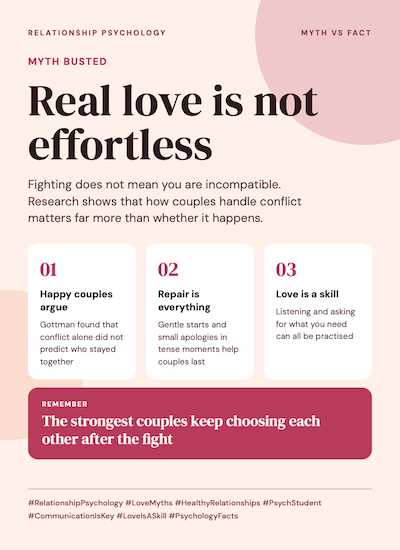
Psychologist John Gottman spent decades observing real couples in his lab and following them over the years. One of his biggest takeaways was that happy couples still argue. Conflict itself was not what predicted who stayed together. What mattered was how they handled it. Couples who lasted tended to start difficult conversations gently instead of with harsh attacks. They made small repair attempts like a joke or a soft apology in the middle of a tense moment. They also filled their everyday life with warmth so that one argument could not wipe out all the goodwill. Gottman often described a ratio of about five positive moments for every negative one during conflict.
Of course this does not mean every fight is healthy. Gottman also named four patterns he called the four horsemen which are criticism and contempt and defensiveness and stonewalling. Contempt such as eye rolling and mockery was seen as the strongest warning sign. So the real question is not whether you fight but how you fight. Disagreeing about plans or chores or texting habits is completely normal. Feeling scared or belittled or controlled is not. Your safety matters most and if you ever feel unsafe in a relationship please reach out to someone you trust or a professional.
This myth hurts us in sneaky ways. It makes us walk away from good relationships at the first rough patch because we assume love should always be easy. It also keeps us quiet about our needs because we think a real partner should simply know. Attachment research tells us that feeling secure with someone grows through responsiveness over time. Nobody is born knowing how to love perfectly. We pick it up from our families and friends and past relationships. That also means skills like listening and apologising and asking for what you need can be practised. Love is a lot closer to a skill than to a lucky draw.
So here is the takeaway. Stop comparing your real life to somebody else highlight reel. A healthy relationship is not one with zero conflict. It is one where both people feel safe enough to be honest and care enough to repair. The next time you and your partner disagree you do not have to panic and wonder whether it is over. Take a breath and speak kindly and listen to understand. Measure your relationship by effort and not by perfection. The strongest couples are not the ones who never fight. They are the ones who keep choosing each other after the fight.