FOMO vs JOMO Which One Is Really Good For You
FOMO vs JOMO Which One Is Really Good For You


FOMO vs JOMO Which One Is Really Good For You
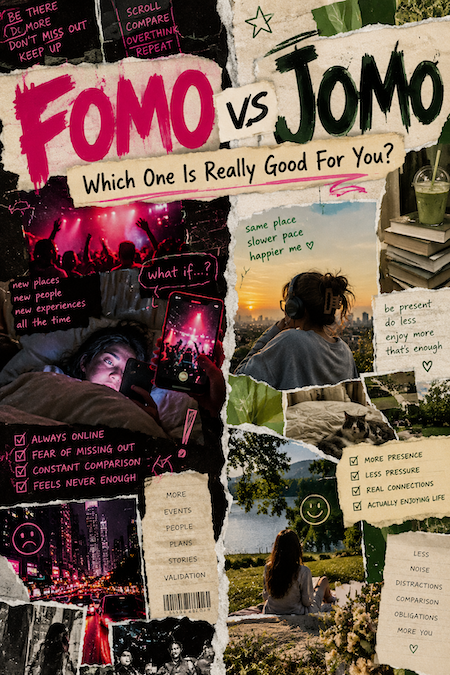
Picture this. It is Saturday night and you are in bed in your comfiest pyjamas feeling genuinely cozy. Then you open Instagram and see your friends at a rooftop party laughing in perfect lighting. Suddenly your cozy night feels like a failure. That tiny sting has a name and it is FOMO or the fear of missing out. Its calmer cousin is JOMO or the joy of missing out. Both have become Gen Z buzzwords but there is real psychology behind them. Let us break down why FOMO hits so hard and whether JOMO is the cure or just another trend.
The term FOMO was popularised in the early 2000s but researchers started studying it seriously around 2013. Andrew Przybylski and his team described it as a worry that others are having rewarding experiences without you along with a strong urge to stay connected to what they are doing. Their work suggested that people feel it more when basic needs like feeling close to others and feeling in control of their lives are not being met. In other words FOMO is less about the party and more about what the party represents. It represents belonging. Belonging is one of the deepest human needs and evolution has trained us to fear being left out of the group. Social media simply gives that old fear a stage that never closes.
Studies have linked higher FOMO with heavier social media use and more phone checking and lower mood and even poorer sleep. Many of these studies are correlational so we cannot say for sure which causes which. Maybe people who already feel left out check their phones more or maybe checking makes people feel more left out. Probably both feed each other in a loop. Another big piece is social comparison. We see the curated highlights of other people and compare them with our own behind the scenes. That comparison is never fair because we are judging our full reality against everyone else’s best moments.
Now enter JOMO. It is the idea that choosing to stay in or log off can feel peaceful and even joyful. Fans of JOMO say it is about being present with what you are actually doing instead of wondering what else you could be doing. This connects with mindfulness research which suggests that paying attention to the present moment can reduce stress and overthinking. It also connects with the idea that we feel better when our choices come from our own values and not from pressure. Psychologists call this autonomy. Skipping an event because you truly want rest feels very different from skipping because you were not invited.
But here is where I want to push back a little. JOMO can become its own pressure. If every night in gets posted with a candle and a face mask and a caption about self care then it is just another performance. There is also a risk that JOMO turns into an excuse to avoid every social situation. For people who are already isolated or anxious withdrawing even more may make things worse because real connection is one of the strongest protectors of mental health. It is also worth knowing that research on JOMO is very new and much smaller than research on FOMO so we should hold big claims lightly.
So what can you actually do. Start by treating FOMO as information instead of an enemy. Ask yourself what it is pointing to. Do you need more time with friends or more fun or simply more rest. Say yes to plans that genuinely excite you and no to plans you would attend only out of fear. Mute the accounts that make you feel small and message a friend directly instead of watching from afar. The healthiest goal is not FOMO or JOMO. It is choice. When you choose where your time goes there is nothing to miss. And if constant fear of being left out leaves you anxious or low please talk to someone you trust or a mental health professional.