Why AI Productivity Feels Greater Than It Really Is
How AI Tools Can Make Students Feel Productive Without Building Real Skills


Why AI Makes Us Feel More Productive Than We Actually Are
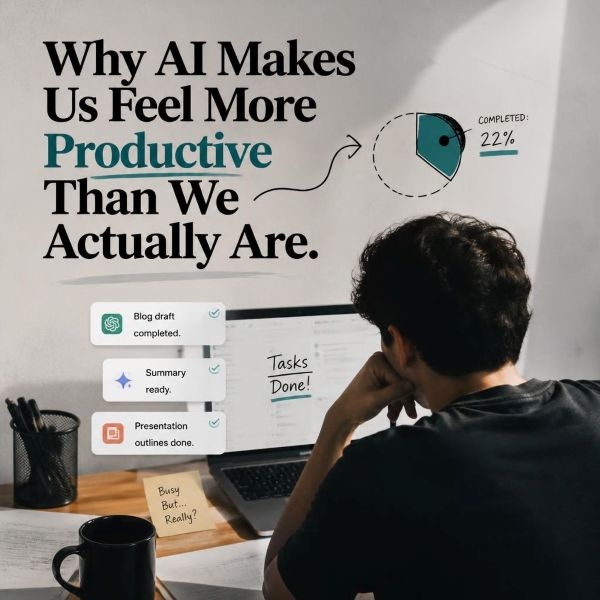
AI productivity has changed how I approach college assignments and projects. In my first year of B.Tech, I got my first personal laptop and, almost at the same time, an AI coding assistant. I was learning programming nearly from zero, so I used it for everything. A missing colon. A forgotten scope resolution operator. A file I had moved outside the environment where the dependencies were installed. The routine became automatic: screenshot, paste into AI, read the explanation, apply the fix. None of these mistakes were deep. Most of them I could have caught by reading the error message slowly.
Did I, though?
I was in first year when our ASEP (Applied Science and Engineering Project) work started. If you are from my college, you know the drill: the FF180 form, the presentation, the poster, the documentation, everything. Earlier, these things would have eaten up days. But now we had ChatGPT, Claude, and a bunch of other tools. I would type a rough idea, get a full structure back, paste it into PPT, change the font a little, and done. The FF180 form got edited with AI. The poster content came from AI. Even the course projects for different subjects were built almost completely by AI.
And honestly, it felt crazy. It felt like I had found a cheat code.
But when I think about it now, what did I actually do? I copy-pasted. That's it. If there was an error in the code, I would not even read it properly. I would take a screenshot, paste it into the chat, and wait for the fix. If the fix gave another error, again screenshot, again paste. At no point did I sit down and think, "Okay, what is this error actually saying?" I never tried debugging on my own, not even for five minutes. My brain was basically a middleman between the error and the chatbot.
And the dangerous part is that it did not feel like laziness. It felt like work. I was busy the whole time, typing, pasting, switching tabs, downloading files. That busyness tricked me into believing I was being productive.
Busy Is Not the Same as Productive
I think this is the core problem. AI gives us a quick feeling of progress. You ask something, you get a big, confident, well-formatted answer in seconds. Your brain goes, "Nice, task done." But the learning part, the struggling part, the part where you actually become better at something, got skipped completely.
I have seen this in my own life. Things I "built" with AI in first year, I cannot explain today if someone asks me one basic question about them. That is a scary thought for someone studying data science.
The Strange Guilt of a "Lazy" Day
Here is something funny I noticed, and I think many of you will relate. Think about a day when you did no academic work at all. You met your friends, sat in the canteen, gossiped about who did what, talked about career plans, maybe discussed internships, placements, or what skills to learn. Then you came back to your hostel or home in the evening and felt guilty. "I wasted the whole day. I did nothing."
But then think about the days when you spent six hours copy-pasting from AI. You felt great about those days. You felt like a topper.
Now be honest, which day was actually more useful?
Those conversations with friends about the future often clear your mind more than any AI-generated assignment. You hear about opportunities, you share ideas, you get perspective. Meanwhile, the "productive" day left you with files you cannot explain and skills that did not grow. We are feeling guilty about the wrong days and proud of the wrong days.
Is It Always Bad, Then?
No, and I do not want to sound like those people who say AI is ruining everything. Let's be practical. Some subjects in our college exist only for attendance and marks. Nobody in the industry is going to ask you about that presentation. If I use AI to make a PPT for such a subject, I think it is completely fine. Saving time on useless work is smart, not lazy.
The problem begins when we start doing this with everything. Data structures, programming, machine learning, math, the subjects that actually decide where we will be in three years. If you hand over those to AI too, you are not saving time. You are borrowing it from your future self, and the interest is heavy. It will show up in interviews, in technical rounds, in your first job when your senior asks you to fix a bug and there is no chatbot sitting next to you.
What I Try to Do Now
I am not perfect at this, but I have made some small rules for myself. First, I try to debug for at least fifteen to twenty minutes before asking AI. I read the error, Google it, and try something. Second, when AI gives me code, I make sure I can explain every line to a friend. If I cannot, I did not really finish the task. Third, I use AI like a senior who guides me, not like a servant who does my homework.
It is slower, yes. Sometimes it is irritating too. But the feeling after solving something on my own is completely different, and it is real.
Final Thoughts
AI is a powerful tool, and I am not going to stop using it. But I have learned that the feeling of being productive and actually being productive are two different things. If at the end of the day you cannot explain what you made or what you learned, then maybe the day was not as productive as it felt.
So next time you finish a task in ten minutes and feel like a genius, just ask yourself one simple question:
"Could I do this again without AI?"
If the answer is no, then you did not build something. You just borrowed it.