WHEN META BECOMES THE POLITICAL BATTLEFIELD
Did social media amplify the CJP protesters, or did algorithmic visibility shape the perception of the movement?


WHEN META BECOMES THE POLITICAL BATTLEFIELD
Did social media amplify the CJP protesters, or did algorithmic visibility shape the perception of the movement?
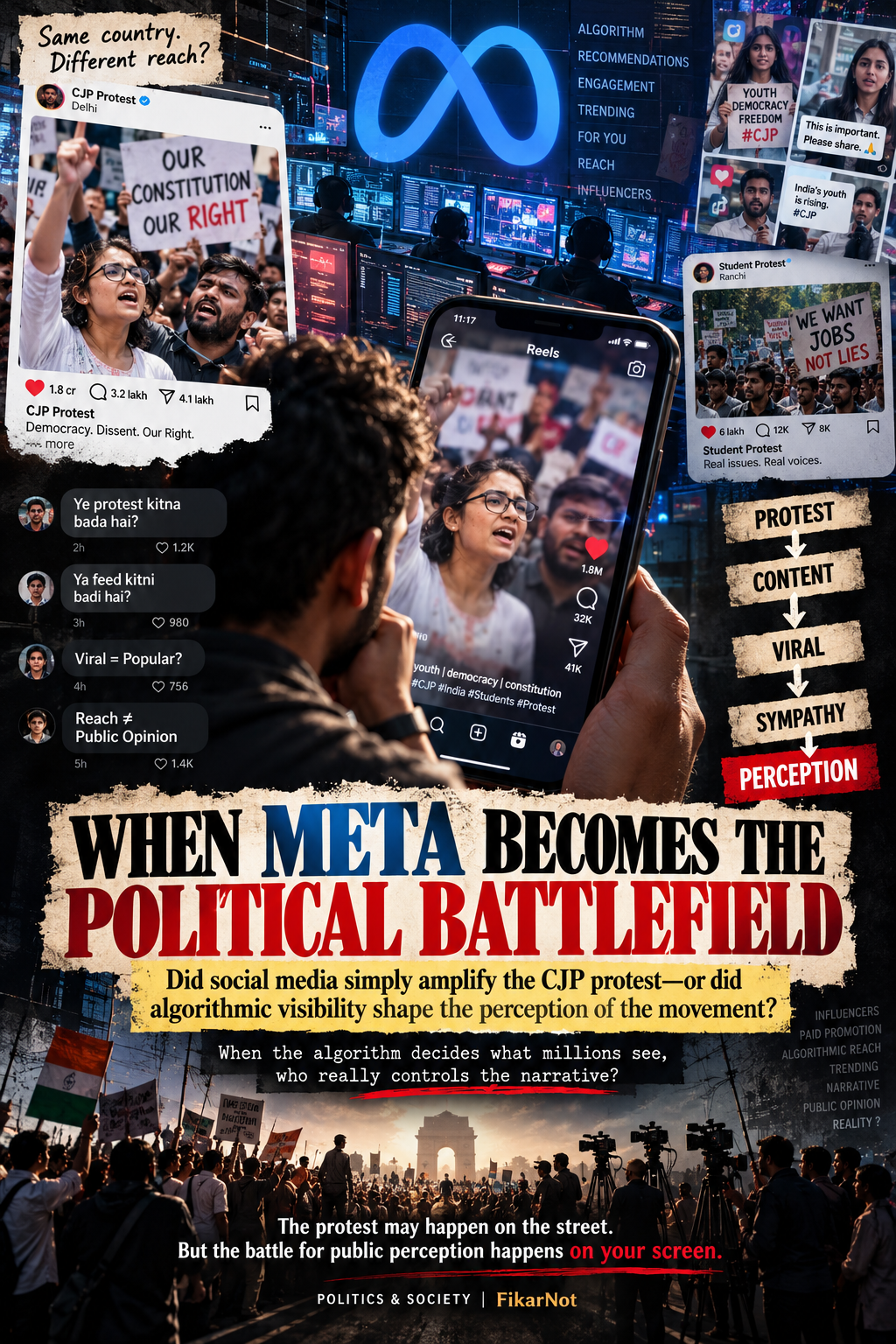
“Bhai, Instagram khol raha hoon ya CJP ka live channel?”
That joke started making sense during the Delhi protests.
You open Instagram for a cricket reel.
CJP protest. Scroll. Another CJP reel. Scroll again. Someone explaining the protest. Another person making a funny video about it. Then a dramatic police confrontation. Then an emotional student story. Then another reel. At some point, you start wondering:
“Wait… itna bada protest hai kya, ya mera algorithm hi mujhe baar-baar wahi dikha raha hai?” And that is actually a much more important political question than it sounds. Because protests today don't happen only on roads. They happen on screens. The street gives a movement its physical presence. Instagram gives it its perception.
And sometimes, those two things can be very different.
The CJP protests showed this new reality quite clearly. The movement was exceptionally good at converting protest into social-media content: short videos, humour, emotional clips, confrontations, slogans, and highly shareable moments. NDTV's analysis of Instagram data found that more than 5,200 posts associated with the Delhi CJP protest came from around 3,100 accounts and reached roughly 1.8 crore people.
Now stop for a second. 1.8 crore reach sounds like a massive public movement. But reach is not the same thing as support. A person can watch a reel because they support the protest. Another can watch because they oppose it. Someone else may simply want to understand what is happening. And someone might just stop because the thumbnail looks dramatic. The algorithm doesn't really care about your political philosophy.
Usko bas engagement chahiye. You watched. You paused. You commented. You shared. Congratulations. The algorithm has now decided: “Bhai ko aur CJP dikhao.”
And this is where the political game becomes interesting. Meta's recommendation systems can use signals such as likes, follows, reactions, and viewing behaviour to determine what political content users may see. That means you don't necessarily have to actively support a political movement for its content to start appearing repeatedly in your feed.
Kabhi-kabhi aap protest dekh rahe hote ho. Algorithm samajhta hai ki aap protest mein interested ho.
And then it gives you more protests. Then more outrage. Then more emotional content. And suddenly, your Instagram feed starts looking like the entire country has only one political issue.
But outside your phone? India is still India. People are going to work. Students are attending classes. Someone is preparing for UPSC. Someone is getting married. Someone is watching cricket. Someone doesn't even know what happened at Jantar Mantar. Your feed is not a referendum. This is perhaps the biggest mistake of digital politics. We confuse visibility with popularity. If something is everywhere on our screen, we instinctively assume it must be everywhere in society. But that is not necessarily true. And here the CJP story becomes particularly interesting from a political perspective. CJP initially presented itself as a youth-led pressure movement rather than a conventional political party. Its founder Abhijeet Dipke himself said the organisation intended to remain a pressure group. That model makes sense in the social-media age. You don't necessarily need ten lakh people physically standing behind you. You need enough people creating enough content that ten crore people feel like ten lakh people are standing behind you. That's the difference between mobilisation and amplification. And there is another layer.
Reports have alleged the involvement of paid influencer networks in promoting CJP-related content. Those allegations have appeared in reports from Organiser, including claims about influencer agencies and paid promotional posts. These claims should be treated as allegations rather than fact.
But even without accepting every allegation, the larger question remains completely legitimate: When protest becomes content, who is producing the content, who is paying for its distribution, and who benefits when it goes viral? Because political communication has changed. Earlier, a political movement needed workers, pamphlets, meetings, local networks, and physical organisation. Today? One influencer. One phone. One emotional caption.One trending audio. And suddenly, political communication has become a creator economy. And this isn't only about CJP. It is bigger than CJP. It is about the future of political mobilisation itself.
Congress, opposition groups, student organisations and activist networks have all understood that a movement which dominates the digital conversation can create political pressure far beyond its physical strength.
And Congress's recent outreach to CJP makes this even more politically interesting. Rahul Gandhi publicly backed CJP-linked protesters in October, while Congress also invited Abhijeet Dipke to a high-tea interaction with INDIA bloc leaders.
That doesn't automatically prove that CJP is a “Congress project.” In fact, Dipke has repeatedly described CJP as politically independent. But politics doesn't always require formal ownership. Sometimes all you need is shared political interest. A youth movement creates pressure. Opposition parties amplify the pressure. Social media amplifies the amplification. And suddenly, an issue that began with a group of young protesters becomes a national political narrative. Welcome to Politics 2.0. But here comes the uncomfortable part. If algorithms can amplify a protest, they can also bury another one. And we actually have a useful comparison.
NDTV's analysis compared the Delhi CJP protest with student protests in Ranchi. While the Delhi protest content reached around 1.8 crore people, the Ranchi protest was reported to have reached roughly six lakh. Both involved young people and protest activity, but their digital visibility was dramatically different. So what happened? Was one protest genuinely more important? Was one better organised online? Did one have stronger influencer networks? Did the algorithm behave differently? Or was it simply that one story was more emotionally engaging? We don't know completely. And that uncertainty is precisely the problem.
Because when an algorithm decides what millions of people repeatedly see, it becomes an invisible participant in political communication. Interestingly, the story becomes even more complicated because Meta has also faced criticism from the opposite direction.
The Internet Freedom Foundation reported complaints that CJP-related protest content was being marked as sensitive or experiencing sudden drops in reach, and demanded greater transparency from Meta. So wait. First, people say: “Meta is boosting CJP.” Others say: “Meta is suppressing CJP.” Both cannot simply be assumed to be true. And that is exactly why transparency matters. The real issue is not whether Meta is “Left” or “Right.” The issue is whether any private platform should have this much invisible power over what becomes politically visible. Because tomorrow it could be CJP.
Democracy works through public debate.
But increasingly, public debate is passing through private algorithms. That should concern the Right. And honestly, it should concern anyone who believes in democracy. Because a protest can be genuine. The grievance can be genuine. The young people can be genuine.
But the digital perception surrounding them can still be engineered, amplified, monetised or distorted. Those are four different things. And Gen Z needs to learn the difference. Because the next time your feed shows you twenty reels saying: “Everyone is angry.” Don't immediately ask: “Why is everyone angry?” First ask: “Who decided that I should see these twenty reels?” The protest may happen on the street. But the battle for public perception is happening on your screen.
And perhaps the most important political literacy lesson of the Instagram generation is this:
Viral doesn't mean majority.
Reach doesn't mean support. And your feed is definitely not the country.
-- Pranay S. Pale