What If You Cannot See Pictures in Your Mind
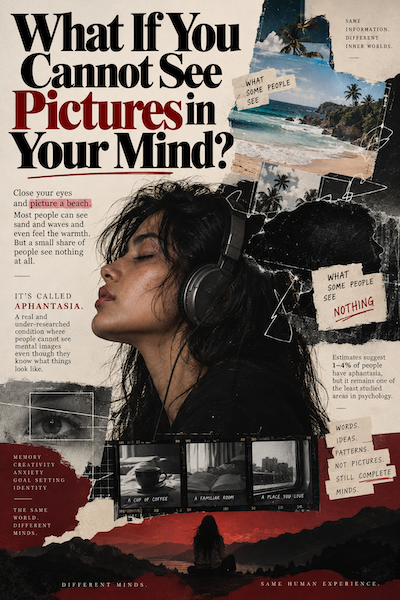
Close your eyes and picture a beach. Most people can see sand and waves and some can almost feel the warmth in their mind. But a small share of people see nothing at all. They know what a beach is and can describe one but no picture appears. I am 21 and when I first read about this I could not believe it. It is called aphantasia and it is one of the least studied corners of psychology. The idea is older than most people think. In 1880 the scientist Francis Galton asked people to picture their breakfast table and noticed that some reported almost no imagery. Then the topic went quiet for well over a century. In 2010 neurologist Adam Zeman described a man who lost mental imagery after a medical procedure and in 2015 he and colleagues named the condition aphantasia after studying people who had never had it.
Estimates suggest that somewhere between one and four percent of people have aphantasia though numbers vary between studies. At the other end some people report imagery so vivid it feels almost like seeing. This is called hyperphantasia. Researchers often measure the difference with a questionnaire that asks people to rate how clear their mental pictures are. That means the whole field depends on self report because we cannot look inside another mind. What do we know so far? Many people with aphantasia still report visual dreams which suggests the brain can make images in some states even when they cannot call them up on purpose. Some studies suggest differences in autobiographical memory such as fewer sensory details when recalling the past. One experiment found that people with aphantasia showed a weaker body reaction to frightening written stories than other people did. Brain imaging work points to differences in how visual and other areas communicate. Every one of these findings comes from small studies and needs repeating. Importantly aphantasia is not currently treated as a disorder. Many people live full lives and work in creative and scientific fields and never notice anything unusual until someone asks them to picture an apple. Some may find certain things harder such as recognising faces or recalling scenes while others think in words and ideas and patterns and do just fine. It is a difference and not necessarily a deficit.
You can try a simple test at home. Imagine a red apple and rate how clear it is from one to five. Then ask a friend to do the same. You may discover that your friend sees something very different from what you see. Many people say they were shocked to learn that others really do see pictures in their heads. This everyday discovery is part of why the topic spreads so quickly online.
As a 21 year old woman I find the social side most interesting. We grow up in a visual culture where vision boards and manifestation videos and aesthetic feeds tell us to visualise our dream life. Advice like picture yourself succeeding is everywhere. What does that advice feel like if you cannot picture anything? Research on mental imagery in goal setting and anxiety and memory of painful events is still thin so we do not know how aphantasia shapes those experiences. Some people report that it protects them from intrusive images while others say it makes memories feel distant. Both could be true. Why is it so under researched? Partly because it was invisible. Nobody complains about a missing ability they never knew existed. Partly because it is not a disorder so it attracts little funding. And partly because the only expert on your inner experience is you. That makes people with aphantasia valuable partners in research and not just subjects. I hope more students will ask them about their minds and listen carefully. Every mind that works differently teaches us what a mind really is.
-Maitrayee Repal