The Two Faces of the Left
When the battle moves from class to culture, what exactly changes?
|


The Two Faces of the Left
When the battle moves from class to culture, what exactly changes?
“Bro, politics is everywhere now.”
The conversation started like any other college canteen discussion. Jobs. Salaries. Inflation. Inequality. Someone complained about how difficult it has become for young people to build a stable life.“Obviously, politics is about money and power,” one guy said.“Not anymore,” another replied. Everyone looked at him. “Politics is also about what we watch, what we learn, how we speak, what is considered acceptable, whose identity gets representation… even which ideas are celebrated and which are treated as problematic.” For a few seconds, nobody said anything. Because suddenly, the conversation had moved from jobs and salaries to culture. And that shift tells us something important about how the political Left has evolved. Traditionally, the Left had a very visible battlefield: class, labour, capital, wages, ownership and economic inequality. The question was straightforward: Who controls economic power? The factory floor was political. The relationship between worker and owner was political. Wages and working conditions were political. Wealth distribution was political. But today, another battlefield has become equally important:
culture.
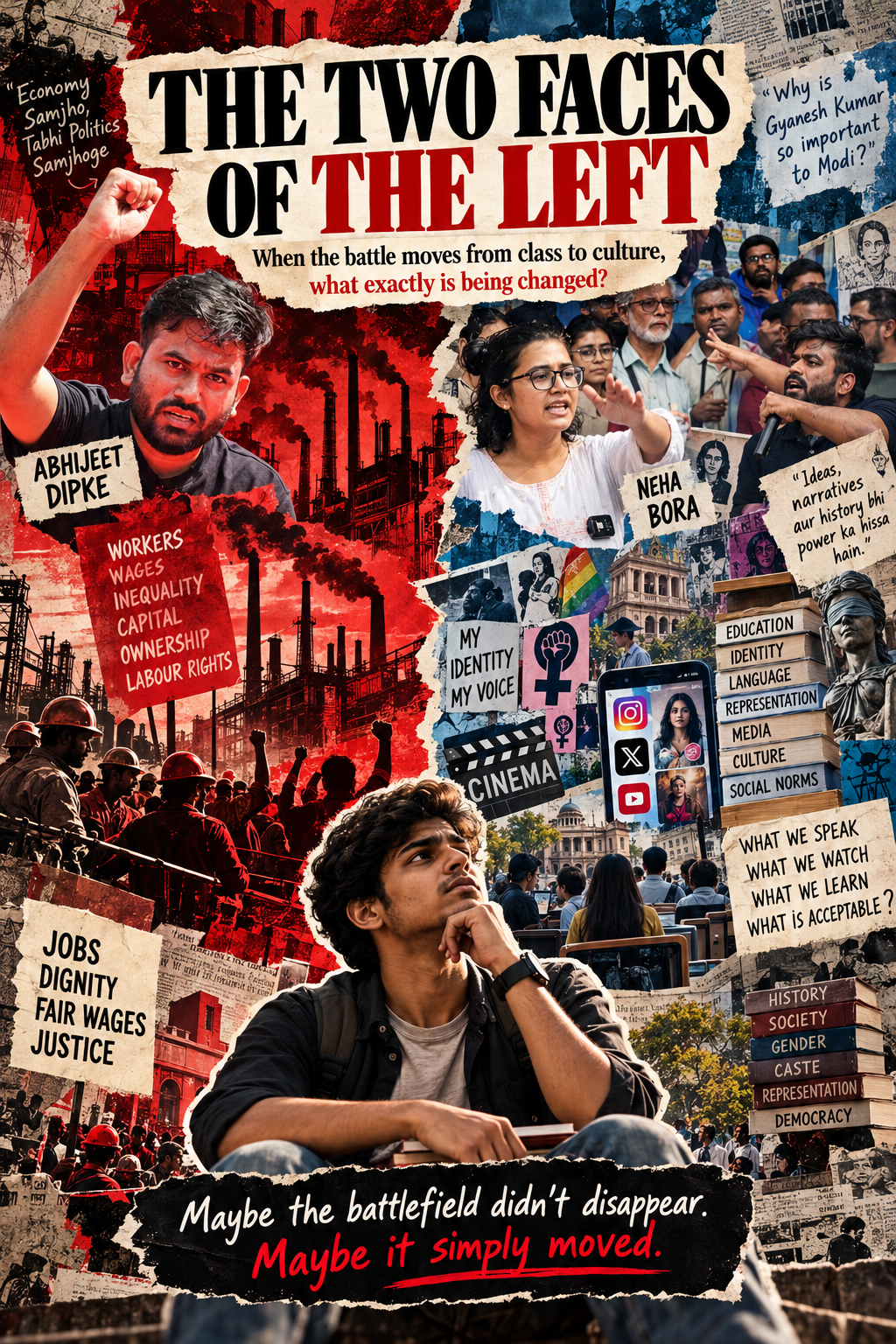
And this is where the Left increasingly appears to have two faces. The first is the familiar Economic Left focused on workers, wages, wealth, capital, and redistribution. The second is the Cultural Left, where the political struggle moves into identity, representation, language, education, media, social norms, and even the way society defines what is acceptable. For Gen Z, this second face is often far more visible. You may never attend a political rally. But you will watch a film. Scroll Instagram. Sit in a classroom. Enter a workplace. Join an online community. And sooner or later, you will encounter debates about gender, caste, religion, representation, language, identity, and social norms. Politics doesn't always arrive wearing a political banner anymore. Kabhi-kabhi woh ek meme ke form mein aata hai. Kabhi classroom discussion mein. Kabhi ek sentence ke through. Take caste politics in India. Caste is no longer discussed only as a social identity. It has also become a political identity, with communities seeking representation, dignity, resources, and opportunities.
Yaani political battle sirf paisa kiske paas hai tak limited nahi rahi. Ab sawaal yeh bhi hai ki identity ko kaun define karega, kaun represent karega, aur kiski voice ko legitimacy milegi.
The same shift can be seen in education. India's National Curriculum Framework discusses culture, education, media, identity, and the politics of culture and cultural power. Think about that for a moment. What children learn, kaise learn karte hain, kaunse examples classroom mein aate hain aur kaunse perspectives ko space milta hai, yeh sab society ko dekhne ka lens shape kar sakta hai. And this is precisely why the cultural battlefield matters.
If power exists not only through money and property but also through ideas, institutions, language, and culture, then controlling or reshaping those spaces can also become a form of political influence. This is where the controversial phrase “Cultural Marxism” enters the conversation. The term is contested, and it should not be presented as some secret conspiracy in which a hidden group is controlling society. But dismissing the entire discussion simply because the terminology is controversial is equally convenient. The underlying question remains: What happens when politics stops asking only who owns the factory and starts asking who controls the cultural narrative? What should children learn? How should history be interpreted? Which identities receive representation? Which words are acceptable? Which traditions are criticised? Which social behaviours are celebrated as progressive? And which ones are labelled regressive?
Pehle political power ka matlab tha who owns the factory, who controls the capital, who gets the wages.
Aaj ek aur question hai: who gets to shape the story? This is where the cultural Left deserves serious scrutiny. Because there is a major difference between correcting genuine injustice and assuming that every difference is evidence of oppression. Yes, culture can exclude people. Yes, institutions can carry prejudice. Yes, some traditions deserve reform. But somewhere along the way, a dangerous intellectual shortcut can appear: difference becomes discrimination, disagreement becomes oppression, tradition becomes backwardness, and ideological conformity starts looking like social progress. And that is where the Right has an important question to ask.
Who decides what “progressive” actually means? Because if one side gets to define what is progressive, what is regressive, what is acceptable and what is offensive, then the debate is no longer completely open. It becomes a question of cultural power. And Gen Z lives inside this battlefield every day. A sentence can become controversial within minutes. A film can become a debate about representation. A meme can become ideological. A campus discussion can become a question of identity and power. A person can be told that their opinion is outdated before the actual argument has even begun.
Aur yahin problem shuru hoti hai.
Because a free society cannot survive if people are afraid to question ideas simply because those ideas have been given the label of progressive. Not every tradition is automatically good. But not every tradition deserves to be dismantled simply because it is old.
Not every cultural change is progress. And not every resistance to cultural change is regressive. A society needs reform, but it also needs memory. It needs individual freedom, but it also needs cultural continuity. It needs new ideas, but it must retain the freedom to reject them. Change ko accept karna freedom hai. Lekin change ko question karna bhi freedom hi hona chahiye.
That is where the strongest argument enters this debate. The answer to cultural politics cannot be another form of cultural authoritarianism. The answer cannot be replacing one ideology with another. It should be pluralism: the ability to live with different beliefs, traditions, identities, and opinions without demanding ideological conformity. Because the real danger is not simply that the Left has entered culture. The real danger is when one ideological interpretation of culture becomes so dominant that questioning it becomes socially unacceptable. Maybe the Left did not disappear. Maybe the battlefield simply changed. Yesterday, the argument was about factories, wages, ownership, and economic power. Today, some of the biggest political battles are happening in classrooms, on screens, in workplaces, through language and around culture.
And that makes the right to question even more important. Because the most powerful politics may not always tell you what to vote for. Sometimes, it tells you what is worth thinking about. Sometimes, it tells you which opinion is enlightened and which one is backward. Sometimes, it doesn't silence you. It simply makes you afraid to speak. So perhaps the question Gen Z should ask is not simply
“Left or Right?” It is “Who is shaping the way we think, and do we still have the freedom to disagree?” Because perhaps the most rebellious thing today is not accepting every new idea. Perhaps it is having the courage to say:
“I understand your argument.
But I still have the right to question it.”
--Pranay S. Pale