The Lockdown That Never Came and Why It Still Hit Us Hard
The Lockdown That Never Came and Why It Still Hit Us Hard


The Lockdown That Never Came and Why It Still Hit Us Hard
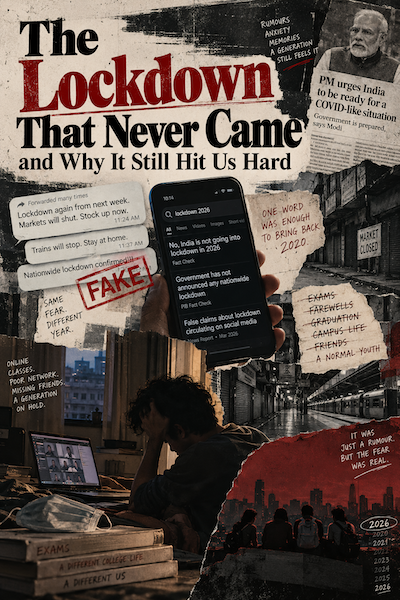
I am 23 years old and a student. In March 2026 my phone started buzzing with a word I had hoped never to see again. Lockdown. Forwarded messages claimed that markets would shut and trains would stop and that the whole country would be told to stay home within days. None of it was true. India did not go into lockdown in 2026. Yet the fear was real and it taught my generation something important about what the pandemic left behind.
The rumours grew after Prime Minister Narendra Modi spoke about the need to be ready for a COVID like situation. He was urging the country to prepare its economy for difficult global times and he said the government was ready. But the word COVID was enough. Many people heard preparation and understood shutdown. Social media did the rest. Within hours panic was spreading across timelines and family groups. No nationwide lockdown had been announced and none followed.
For students like me the reaction was instant because we are the lockdown generation. In March 2020 many of us were still in school or in our first year of college. We lost exams and farewells and graduation days. We learned from tiny phone screens and sat through classes where the network dropped every ten minutes. Some classmates had no smartphone at home and simply vanished from the classroom. So when the rumours spread in 2026 our bodies remembered before our minds could check the facts. My stomach dropped and I am sure I was not alone.
As a psychology student I find this both fascinating and a little sad. Memory does not replay the past like a video. It carries feelings with it. A single word can bring back the loneliness and uncertainty of those long months. Many young people felt anxious even after the news was shown to be false. That is not weakness. It is what happens when a shared experience leaves a mark long after the danger has passed. Emotional memory is powerful and it does not wait for confirmation.
There were practical worries too. Hostel residents wondered whether they should rush home before transport stopped. Many parents living far away must have called every hour. Those preparing for competitive exams feared losing months of study all over again. Students who depend on tuition or part time work worried about income vanishing overnight. Even a rumour can cost sleep and money. It can also cost trust. When a real warning comes one day people may not believe it.
The biggest lesson for me was about information. We live on forwards and reels. One unverified message can reach thousands of people in minutes. I caught myself about to share it in my family group. That moment taught me more than any lecture. Checking before sharing is a small habit but it protects entire communities. Leaders and media carry responsibility too. When those in power speak about risk they must choose words with care because their words travel very far and land in anxious minds.
But the scare also showed how much we have grown. Many of us have learned to check official sources before believing anything. Online classes are now a backup that every college understands. Friends check in on each other with simple messages. We know we can adapt because we already did it once and we did it without much help.
What do we need now? First we need mental health support on campus that is easy to reach and free from stigma. Counselling should be as normal as a library card. Second we need digital access for every learner because the gap exposed in 2020 has not fully closed. Third we need honest and calm communication from authorities that respects our intelligence.
There was no lockdown in India in 2026 but the scare was a mirror. It showed how deeply 2020 still lives inside us and how fast fear can travel. As a 23 year old I do not want to spend my twenties dreading the next headline. I want to be informed and prepared and kind to the people around me. The best answer to a rumour is not panic and it is not mockery. It is a pause and a check and an honest conversation. If my generation carries that habit forward then the lockdown years will not only be remembered as a loss. They will also be remembered as the time we learned to think before we fear.