Intelligence vs Understanding: How AI Really Works
Why Artificial Intelligence Can Be Intelligent Without Truly Understanding


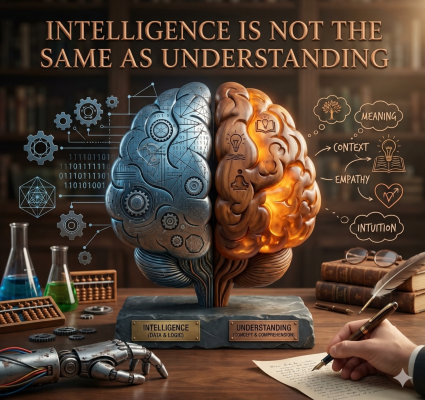
Intelligence Is Not the Same as Understanding in AI
Sahil Sharma
It usually happens around 2 AM. I’ll be staring at a Python script that’s supposed to extract admission cutoff data from a massive batch of PDFs, and it keeps throwing a weird parsing error. Out of frustration, I paste the messy block of code into an AI prompt. Five seconds later, it gives me a perfectly refactored snippet using pdfplumber and pandas, complete with a polite explanation of why my logic was failing. It fixes the bug, parses the data flawlessly, and even optimizes the loop.
In moments like that, the AI feels brilliant. It feels like I'm talking to a senior engineer who completely grasps what I’m trying to achieve. But after using these tools daily for assignments, debugging, and machine learning projects, a strange question keeps bothering me: If an AI can write code, analyze datasets, and explain complex concepts so convincingly, does it actually understand what it is doing?
The Gap Between Doing and Knowing
To an engineering student, intelligence often just looks like capability—the ability to perform a task effectively. If a system solves a problem, we call it intelligent. But understanding goes deeper. It involves knowing what something means, why it matters in the real world, and what the consequences of a particular answer might be.
Think about asking an AI to write a program that finds the shortest route between two locations. It will instantly spit out Dijkstra’s algorithm and calculate the mathematically perfect path. But the engineering problem isn't always just about the shortest distance. Maybe the route needs to avoid a flooded area, or maybe it’s for a heavy commercial truck, or perhaps we want the safest route at night.
The AI can calculate the exact answer to the prompt, but it doesn't automatically know what the user actually values unless it is explicitly defined. Solving a mathematical problem and defining the right problem to solve are two entirely different things.
When "The Code Works" Isn't Enough
I run into this distinction a lot when I'm building predictive models. A few weeks ago, I was tweaking a Support Vector Machine to classify some data trends. I asked an AI to help optimize the hyperparameters, and it handed me a highly efficient block of code. I plugged it in, and my accuracy jumped.
The code worked. But there is a massive difference between "the code works" and "I understand why the code works."
Because the AI handed me the answer so quickly, I realized I couldn't explain why it chose that specific kernel function over a simpler logistic regression. If the input data changed slightly next year, would the model break? What were the edge cases?
The AI successfully solved the immediate syntax problem, but blindly accepting it left me with a brittle system. It possessed the intelligence to generate the code, but the burden of actual understanding—the why and the what if—still fell entirely on me.
Patterns, Predictions, and Context
So what is actually happening under the hood? Modern AI models aren't magic; they learn complex relationships and representations from enormous oceans of training data. Their core objective during training involves predicting the next logical piece of information based on the context they are given.
Over time, these systems become extraordinarily good at recognizing structural patterns in human language and logic. They can connect the concept of a "loop" to a "variable" and output a working script. They can reason through mathematical steps by following learned contextual structures.
But a system can become unbelievably good at producing highly useful, contextually accurate outputs without that alone settling the philosophical debate of what meaning actually is.
The Calculator Dilemma
We don’t struggle with this distinction when using older tools. A standard scientific calculator can instantly compute the square root of a massive number. It gives the exact right answer every time, but nobody argues that the calculator understands mathematics. It is just executing logic circuits.
Modern AI is obviously completely different and vastly more sophisticated than a calculator. It can handle ambiguity, context, and unstructured language. But the underlying question remains: Where exactly do we draw the line?
Is increasing capability and model size eventually enough to cross the threshold into genuine understanding? Or does true understanding require something fundamentally different—like lived experience, intention, or a physical presence in the real world?
It is a line that gets blurrier every day.
Why the Distinction Matters for Engineers
This isn’t just late-night dorm room philosophy. It is a highly practical engineering problem. As we start integrating these models into software architecture, healthcare, cybersecurity, and financial systems, the stakes get much higher.
The critical question for us isn’t just, "How intelligent is this system?" We have to ask harder questions: What assumptions is this model making? What does it actually know, and more importantly, what does it not know? When the context shifts—say, a sudden change in user behavior or an unpredictable real-world event—how gracefully will it fail?
If we mistake a system’s high-level capability for human-like understanding, we risk trusting it in situations where it fundamentally lacks the context to make a safe decision. Engineers have to know exactly when a human must step in to verify the output.
These tools are undeniably powerful, and they have completely changed how I learn and write code. A system can be incredibly useful without being human-like, and it can produce brilliant results without experiencing "meaning."
But as we build the next generation of software, we have to keep the distinction clear. Maybe the most important question about AI isn't how intelligent it can become. It is whether intelligence without the kind of understanding humans rely on is enough for the decisions we want AI to make.