Have We Made Protests Too Casual
When every disagreement becomes a protest, what happens to protest"s power?


Have We Made Protests Too Casual
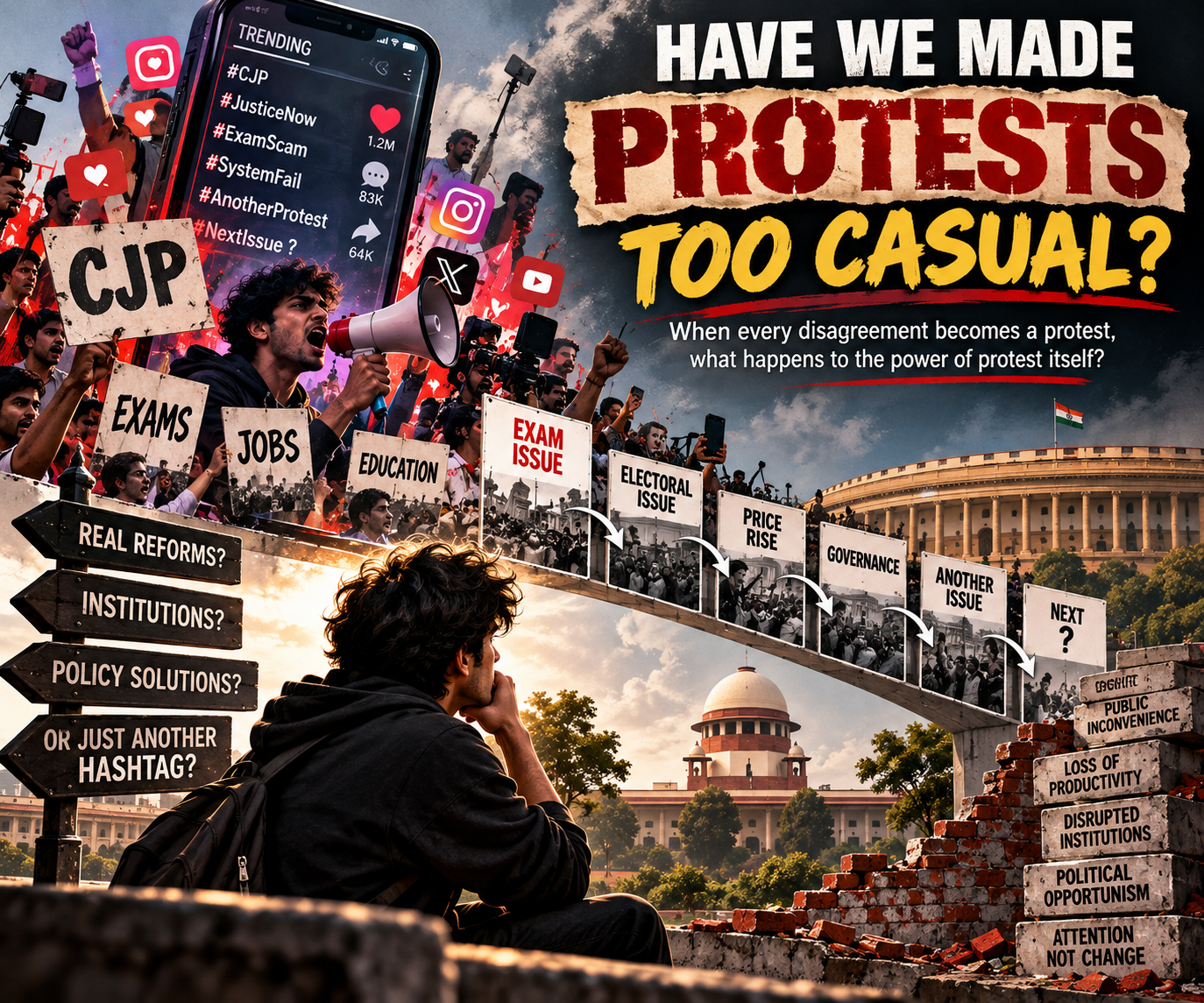
Have we made protesting too casual?
Aaj protest hua. Kal morcha. Parson road blockade. Uske baad hashtag. Two days of social media outrage. And then, a new issue. At some point, the question itself starts changing.
“Why are they protesting?” slowly becomes “Aaj protest kahan hai?” And that is where the real problem begins. Because when protest becomes too common, its ability to shock, attract attention, and create urgency can also begin to decline. Thousands of people taking to the streets for the first time can make the entire country look up. But when every week brings another protest for another issue, protest itself can start becoming background noise. The protest paradox is simple: the more casually we use protest, the less powerful protest itself can become.
This does not mean protests are unnecessary. Far from it. Some protests are essential. Some movements have changed policies, forced institutions to respond, and given ordinary citizens a voice when formal channels failed them. Lekin meaningful protest aur perpetual protest mein ek important difference hai.
One creates pressure with a purpose. The other can slowly become a habit. Look at the new-age protest culture. CJP offers an interesting example of this changing landscape.
In 2026, its mobilisation moved from student and examination-related concerns to electoral issues. Its NEET-related agitation continued for several weeks before being called off following the resignation of Union Education Minister Dharmendra Pradhan. Later, the organisation again mobilised around voter-list revision and demands concerning the Chief Election Commissioner.
Whatever one's political position may be, there is something important to observe here.
protest today can move extremely fast. Instagram post → outrage → gathering → media attention → political pressure. That speed is powerful. But speed and depth are not the same thing. A viral post can bring thousands of people together within hours. But can those same people remain organised around a specific policy demand months later?
Can the movement survive after the cameras disappear? Who negotiates with the government? What exactly is the alternative policy being demanded? What institutional reform is actually being proposed? Aur sabse important—
jab immediate anger khatam ho jaata hai, tab organisation mein kya bachta hai?
That question is not limited to CJP. It is a question for the entire new-age protest culture. Because social media visibility is not the same as public legitimacy. A viral protest can create attention. But attention is only the beginning of politics.
Organisation Still Matters
A movement is not just a crowd.
A movement is organisation + clarity + persistence. Otherwise, protest risks becoming an event. One day, there is a crowd. The next day, there are headlines. Then come the reels. And after four days, there is a completely new issue.
Event khatam. Attention khatam. Aur movement bhi khatam. That is not always the case, of course. Some movements sustain themselves and create real change. But the danger of casual protest culture is precisely this: mobilisation can become easier than organisation. And that distinction matters.
The Cost Is Not Only Traffic
Whenever we talk about the cost of protest, we usually talk about traffic, roadblocks, police deployment, public inconvenience, or lost working hours. But the deeper cost can be much bigger. When every disagreement's first response becomes street mobilisation, trust in institutions can also begin to weaken. Courts exist. Parliament exists. Commissions exist. Regulators exist. Formal grievance mechanisms exist. Protest is not a replacement for these institutions.
It is pressure on these institutions. That distinction is crucial.
Because in a democracy, the street and the institution do not necessarily have to be enemies. Street pressure can sometimes force institutions to respond. Lekin agar har institutional problem ka permanent solution sirf street mobilisation ban jaaye, then we have to ask: when do we actually start building stronger institutions? A protest can demand accountability.
But eventually, someone still has to build the system that prevents the same problem from returning. And Then Comes Political Capital. There is another uncomfortable question we need to ask. Youth anger is real. Issues around exams, employment, education, prices, representation and governance can genuinely frustrate young people. And they have every right to express that frustration. But when genuine public anger repeatedly becomes political mobilisation, we should also ask—
Who benefits from the anger? Because youth anger is democratic energy. But if that energy is continuously converted into hashtags, confrontation and camera moments, its civic potential can become smaller than its political visibility.
Aur yahan ek thin line hai. Mobilising people is not the same as empowering people. A protest should not only ask:
“Are you angry?”
It should also ask: “What are we building after the anger?” What happens after the rally? What happens after the hashtag disappears? What happens after the news cycle moves on? That is where a protest becomes a movement or simply remains a moment. So, What Makes a Protest Meaningful? A protest should have a clear demand. It should have courage. It should have organisation. It should have persistence. Sometimes, yes, it should have disruption. Because a protest that never disturbs anything may never force anyone to pay attention. But disruption without responsibility can also make ordinary citizens pay the price for a conflict they may not even understand. Democracy gives us the right to disturb the normal. But it does not completely remove our responsibility towards the people living inside that normal.
Aur shayad protest ki sabse badi cost road block, traffic ya police deployment nahi hai.
Maybe the real cost is what happens when society gets so used to protests that it stops listening. If every disagreement becomes a protest… If every outrage becomes mobilisation.If every mobilisation becomes a headline. Then eventually, what still feels like a genuine movement? Maybe the question is not “Should we protest?”
The question is “What makes a protest worth listening to?” Because protest should not become casual. It should remain powerful enough to disturb the normal and meaningful enough to change it.